In Kirchner’s Dresden street, the pavement is pink. It spreads beneath the crowd, coming toward us between dark coats and long skirts. Faces appear above the clothes, close enough to inspect, difficult to meet.
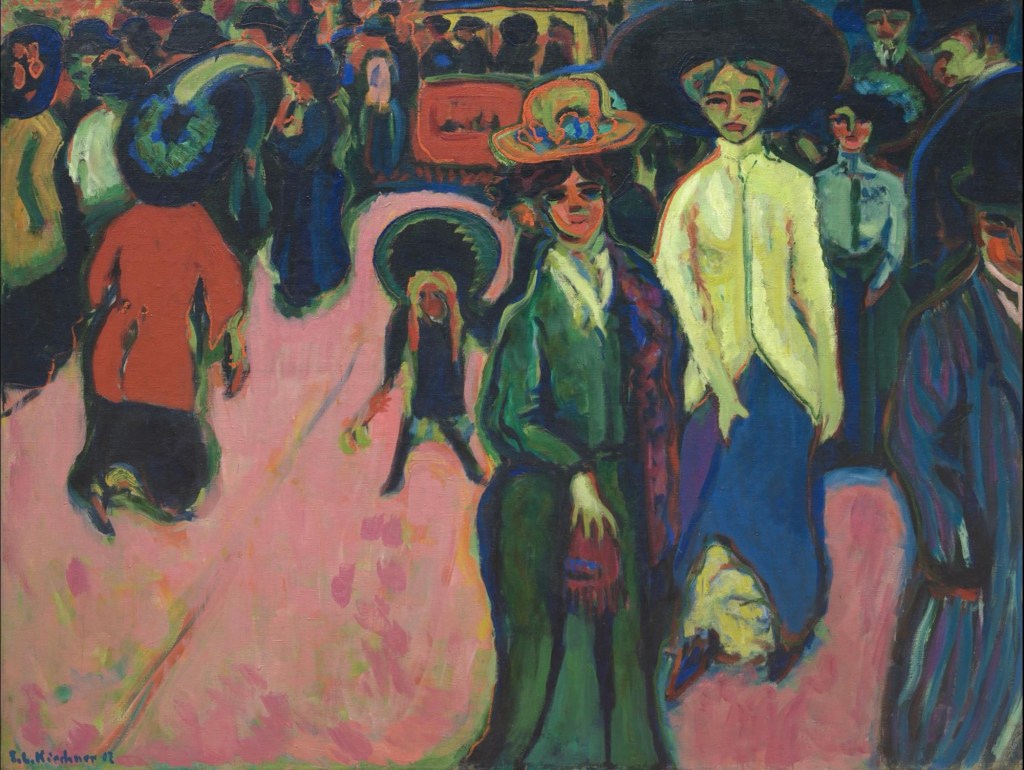
The people share the street without quite sharing a moment. Their bodies overlap, but their eyes lead elsewhere. Even the child near the center seems caught in the movement around her.
This is one place to enter German Expressionism. Across these seven paintings, color and shape give us crowded streets, open landscapes, animals, and a painter in his room. The colors often depart from what we expect. What they make us feel varies from picture to picture.
Kirchner painted the street in 1908 and returned to it in 1919. The version we see has already passed through more than one moment in his life.
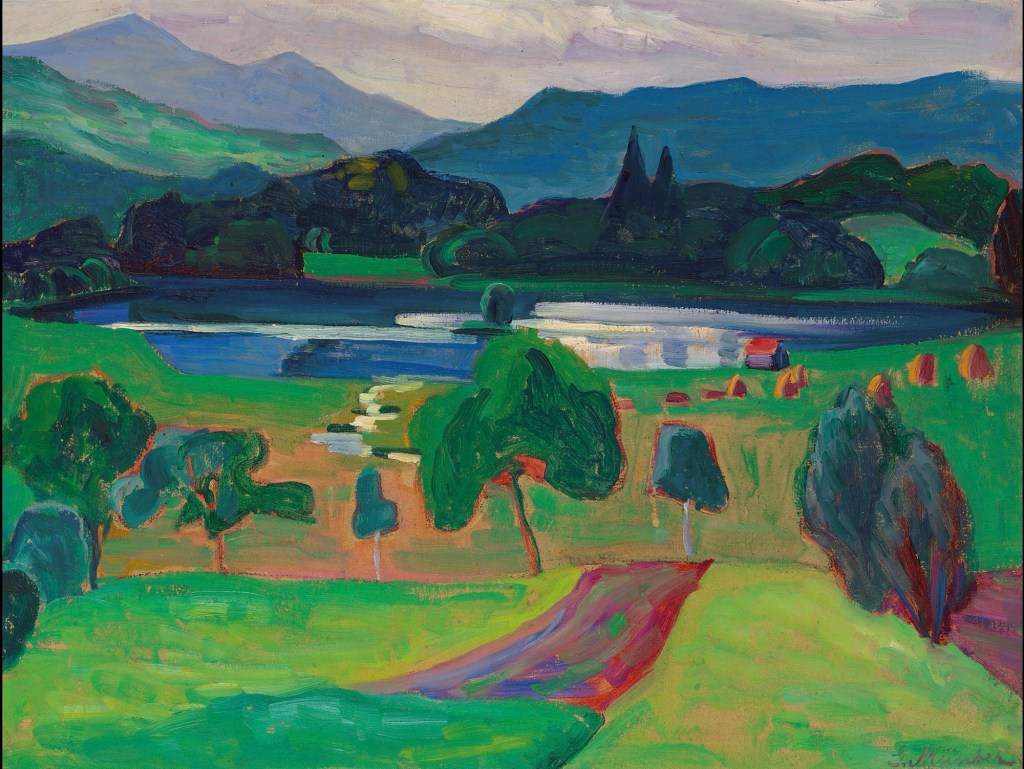
Münter’s landscape gives the eye somewhere else to go. A violet-red path crosses the foreground, and orange ground lies beneath the trees. Farther away, water and hills spread into broad areas of color. There is room between things.
The simplification makes the place easier to take in. A patch can belong to a hillside and still hold our attention as paint. We recognize the landscape through the relationships between its parts, with fewer details asking to be examined.
Put it beside Kirchner’s street. Both painters let color depart from what we might expect to see. One gathers people into a crowded passage. The other opens a landscape.
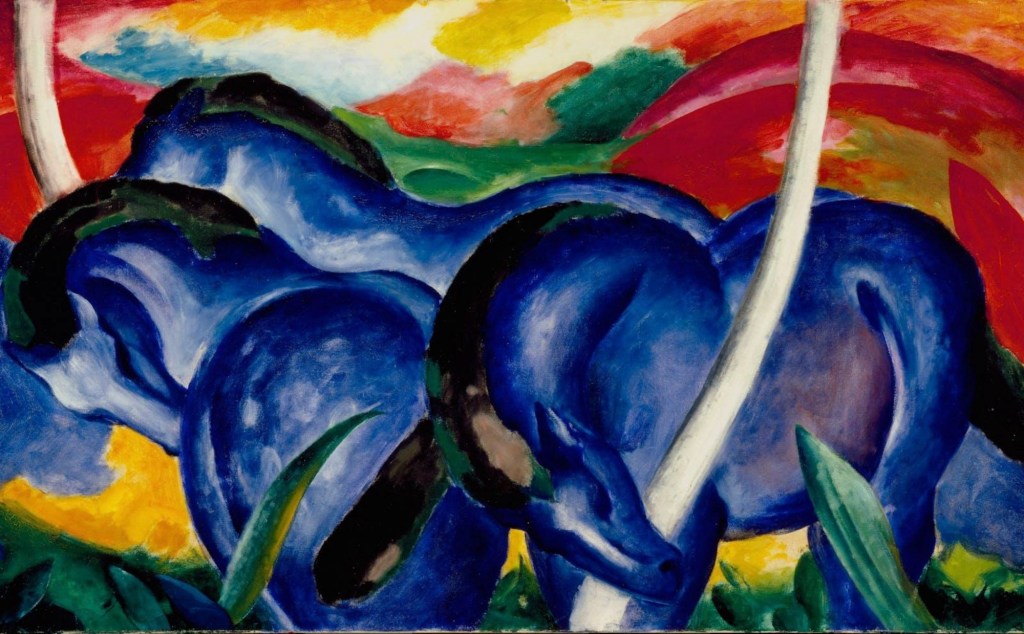
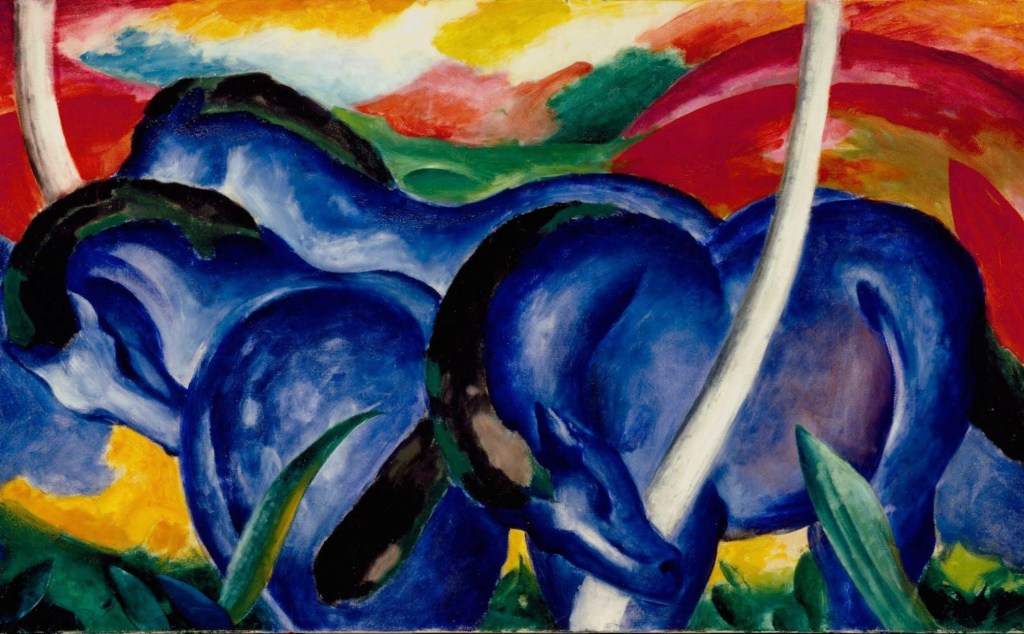
Marc gathers three horses together. Their lowered heads and curving backs form a rhythm that continues into the hills behind them. Blue holds their bodies together against the surrounding reds and greens.
We can count the horses, but it takes a little looking to separate them. Their closeness is part of the picture. Each body contributes to a larger shape.
The hills seem to accommodate those curves. Animals and landscape belong to the same arrangement, as though the ground has taken something from the horses and the horses something from the ground.
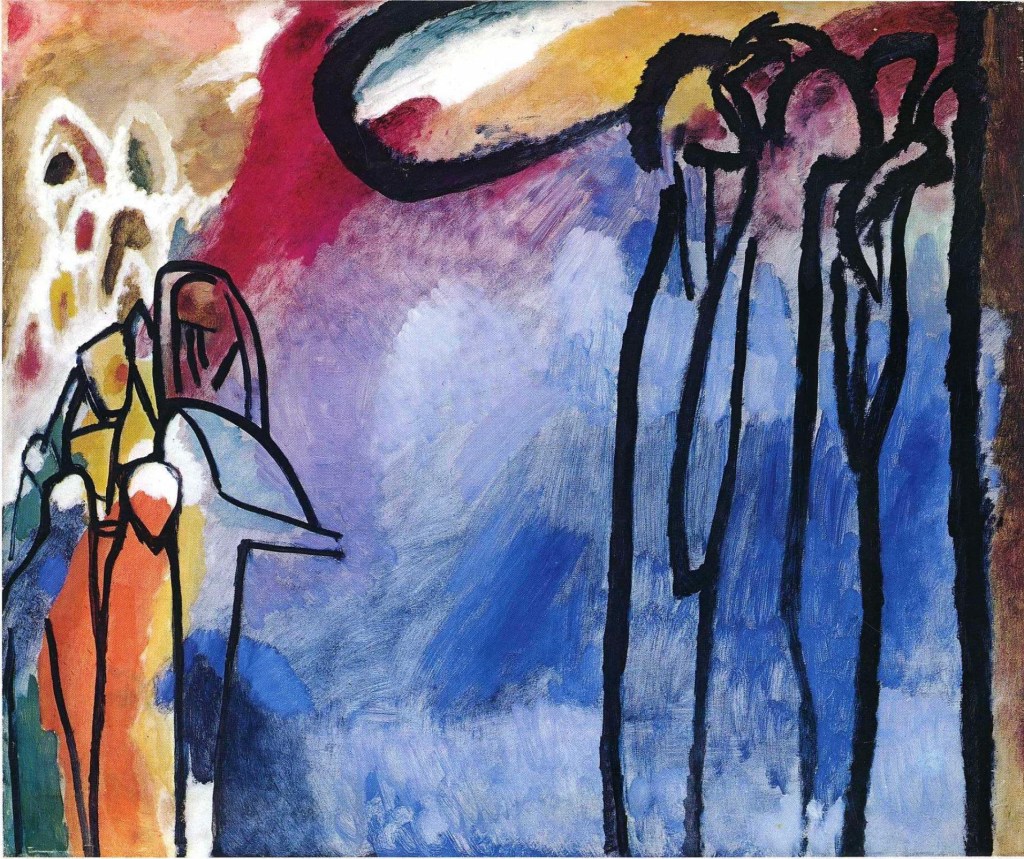
Kandinsky gives us figures we can recognize without making it easy to decide where their colors belong.
On the left, a group gathers in areas of color. On the right, taller figures appear in outline, with blue passing through them. A line suggests the edge of a body, but the color continues beyond it.
The eye keeps trying to assign what it sees. Does that blue belong to the figure, or to the space around it?
In Münter’s landscape, the recognizable place helps us hold the colors together. Here, the figures give us something to find while the colors lead us across their boundaries.
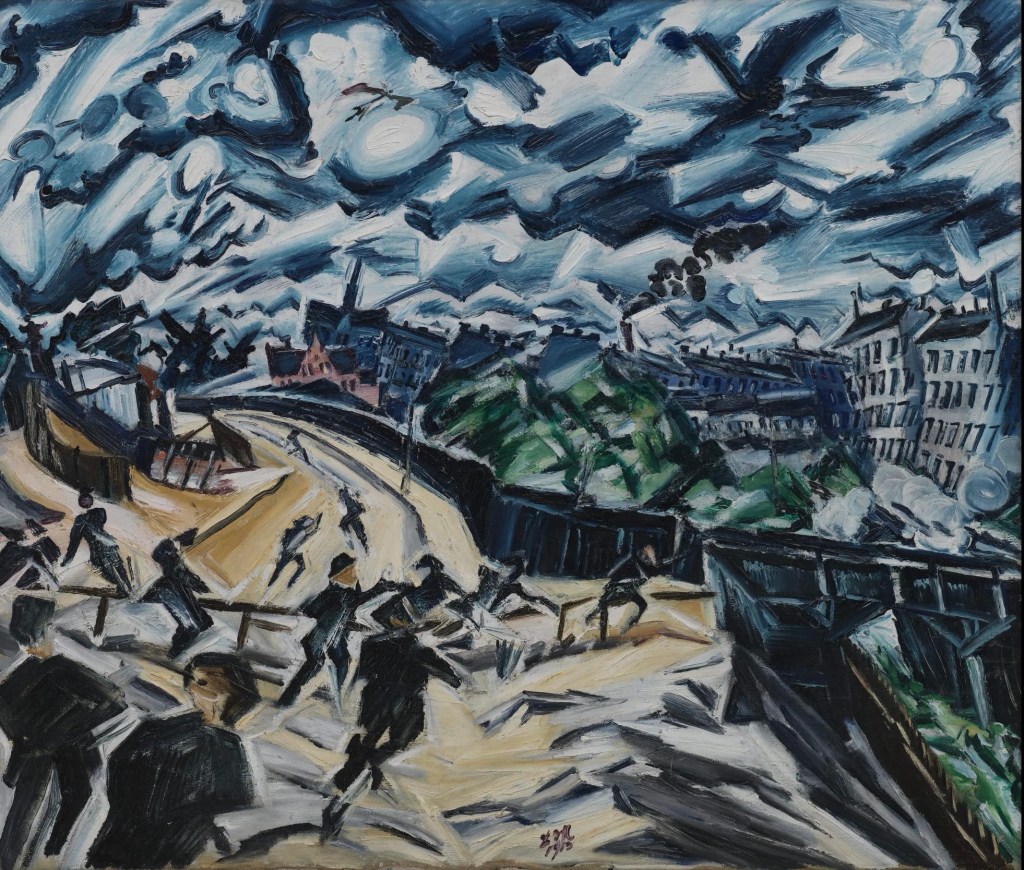
Meidner brings us back to a city. In Dresden, the crowd walks past us. Here, dark figures run along a road beneath buildings that seem about to lose their footing.
White streaks churn through the dark blue sky, taking up the agitation below. There is scarcely a quiet area where the eye can rest.
We know that war will begin the following year. That knowledge makes the painting difficult to approach innocently. But the picture already supplies its own disturbance. The angles, the crowded marks, and the fleeing people make the city feel as though it is coming apart.
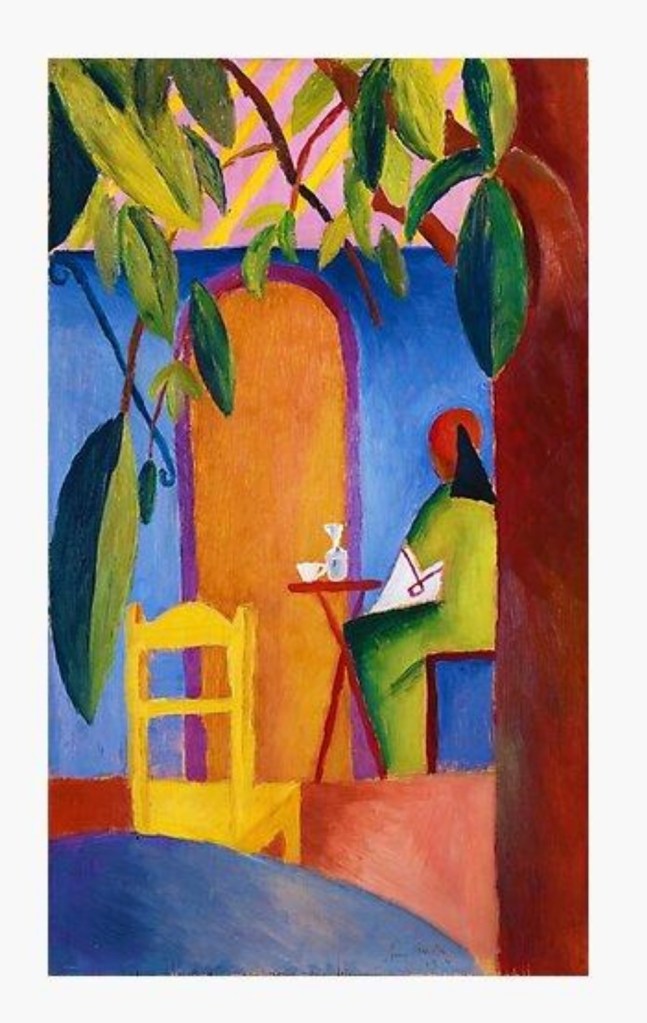
Then Macke gives us a café.
Green leaves hang above an empty yellow chair. Farther in, a seated figure has his back to us. We have no face to meet, and the scene feels restful.
The figure belongs to the café as Marc’s horses belong to their hills. A person, a chair, and the surrounding shapes hold the scene together. The empty chair is nearer to us. There is somewhere we might sit.
These paintings were made close enough in time to sit together in a history of Expressionism. Yet the café makes room for an afternoon, while Meidner’s city makes even standing still seem difficult.
Macke was killed on September 26, 1914. Marc died near Verdun in March 1916.
Knowing that, I linger over the café. The afternoon acquires a limit that the painting itself never announces.
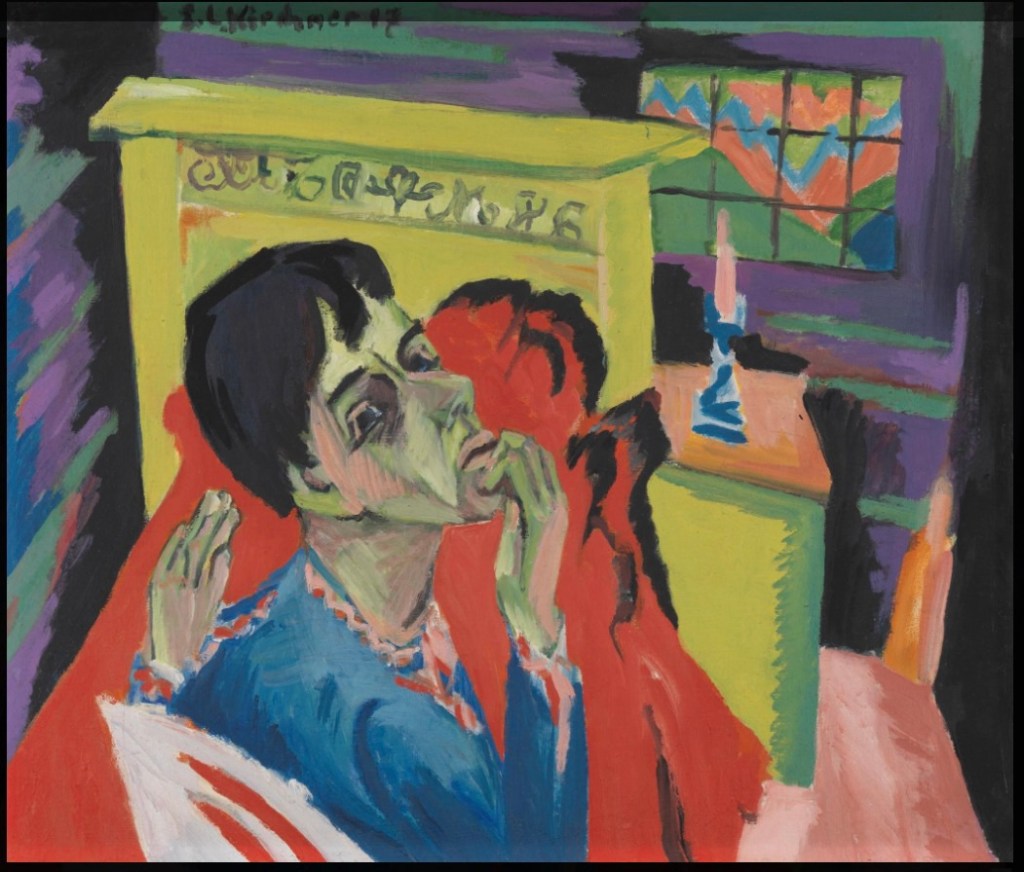
Kirchner brings us indoors. A yellow bed rises behind his head. His blue clothing meets the red bedding. Beyond him, a window holds angular patches of landscape.
One hand reaches toward his mouth. The other is raised beside his shoulder. His eyes look upward, away from us.
There is little empty space around him. Bed, face, hands, furniture, and window press into the same small room. The colors remain strong enough to catch us before we have understood his expression.
He returned to this painting too. Begun in 1918 and subsequently reworked, it records him looking again at an earlier image of himself. At both ends of this walk, Kirchner has revisited a picture.
In the Dresden street, we looked among strangers for a face that might meet us. Here, the painter gives us his own face, close and exposed.
We still have to find our way to him.
WE&P by: EZorrillaMc&Co.
Sources and further reading
- National Gallery of Art, “What Is German Expressionism? 8 Things to Know.” Background on the movement and its two principal groups, Die Brücke and Der Blaue Reiter. Read the article
.
- The Museum of Modern Art, “Expressionism.” An introduction to Expressionist approaches to color, nature, city life, portraiture, and war. Read the overview
.
- Museum August Macke Haus, “Life and Work.” Macke’s artistic development and biography, including his death on September 26, 1914. Read the biography
.
- Verdun Memorial, “Franz Marc.” Marc’s military service and death near Verdun in March 1916. Read the account
.
The individual collection records are linked beneath each painting in the draft.


You must be logged in to post a comment.