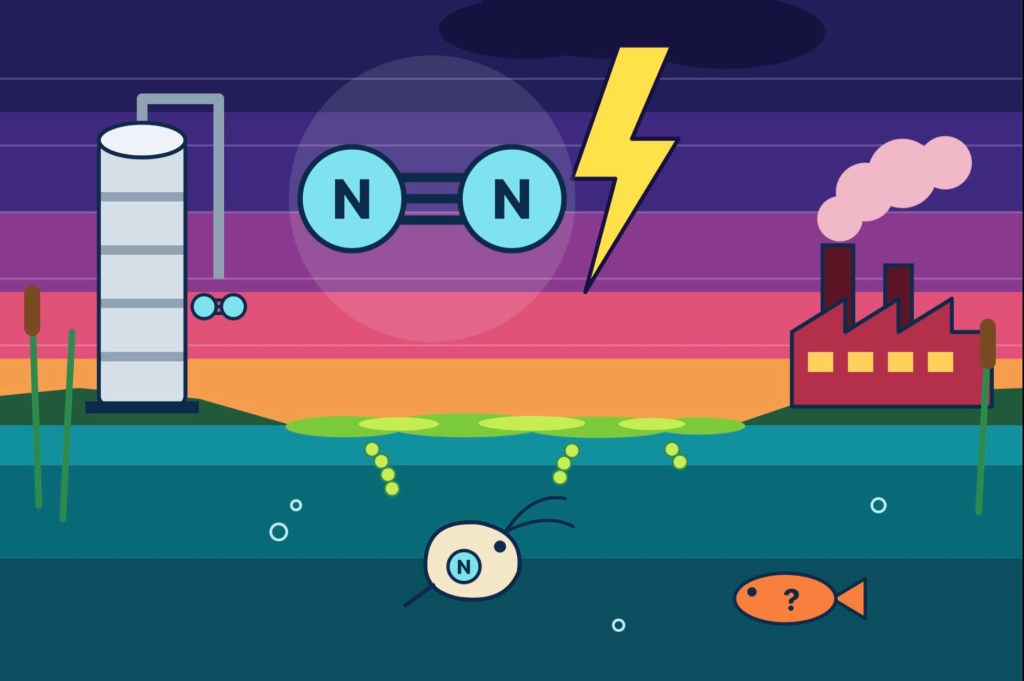
The flea got away. It was too big for the trap. That gave me time to wonder how the nitrogen got into the flea.
It ate something. Fair enough. But keep going back and somewhere there were two nitrogen atoms bound together in the air. They’d been a pair for a long time. A triple bond between them. Now one of them was swimming around in a flea.
Who broke up the pair?
My first guess was distillation. I’d heard that’s how you get nitrogen out of air.
“It is,” you said. “Cool the air until it’s liquid, warm it slowly, and the nitrogen boils off first.”
“So the column splits them.”
“Look at what comes out.”
N₂. Both atoms, still together. The column had them in custody and let them walk out arm in arm.
Wrong machine.
“Lightning?”
“Better. A bolt is hot enough to tear the pair apart. The pieces join up with oxygen and come down in the rain.”
“So lightning did it.”
“Some of it. A small share.”
Right crime. Small-time.
That left the factory. We went in and watched the iron.
It’s hot, and the gas above it is under pressure. Our pair comes down on the metal and sticks. The iron loosens the bond. For a moment they’re side by side on the surface. Then they’re apart.
Hydrogen has been landing there too. Each nitrogen picks one up, then another, then a third. Each leaves as ammonia, with three hydrogens and without the other.
Caught in the act.
“How long has the factory been doing this?”
“A little over a hundred years.”
The flea’s ancestors were eating nitrogen long before that. Guilty, then. New in town.
“Who had the job before?”
“Go back to the pond.”
I went back. You pointed at the green film on the water, which I had taken for scenery.
“What am I looking at?”
“It could be cyanobacteria. Some of them can do the job. Inside one of those, an enzyme holds the pair at a little cluster of metal atoms and takes it apart.”
“At pond temperature?”
“At pond temperature.”
“How far back does that go?”
“We’ve found traces of the work in rocks more than three billion years old.”
I’d come back to the pond looking for something smaller than the flea. I hadn’t expected the job to be that old.
As for this particular pair, any of them could have done it. The bacteria. A bolt of lightning. Even the factory, by way of a field upstream.
And I still don’t know where the other atom went. One is in the flea. Its partner could be anywhere by now. In the reeds. In a fish. In my lunch.
I had one more question for the bacterium.
“Fine. You’ve got the nitrogen. Where did you get the H?”
WE&P by: EZorrillaMc&Co.
Exhibits
The whole lineup. “Animated Nitrogen Fixation,” U.S. Geological Survey. Microbes, lightning and the factory in one animation. https://www.usgs.gov/media/videos/animated-nitrogen-fixation
The factory. “The End of Haber Bosch,” Reactions, American Chemical Society. The hundred-year-old reaction and the search for another way to do it. https://youtu.be/dFcaEUj43OY
The lineup. Image created with Claude.


Leave a Reply