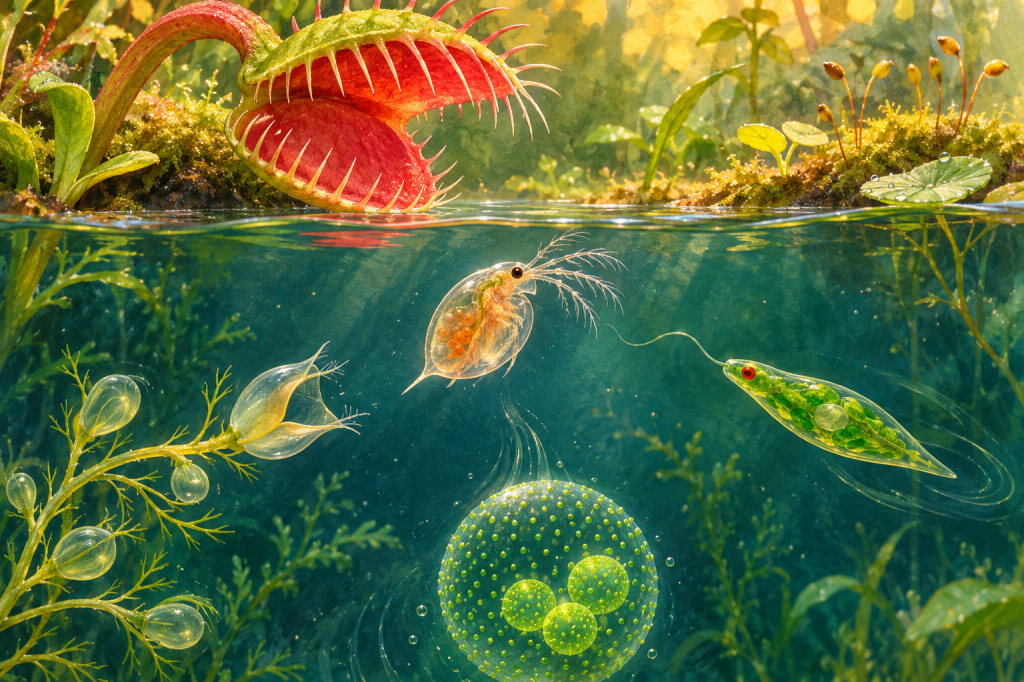
I went looking for a plant that could hunt. I had the Venus flytrap in mind. An ant walks across a leaf, the leaf closes, and the plant has caught its dinner. I wanted to know how much farther a plant could take that arrangement. Could it go after something?
The bladderwort gave me a reason to slow the question down. Picture a water flea swimming past one of its underwater traps. The bladderwort has already pumped water out of a little chamber. The flea brushes a trigger hair. A door opens, water rushes back in, and the flea goes in with it. The capture takes a few milliseconds. What interests me is the part I would have missed watching it happen. The plant did much of the work before the flea arrived.
Then I saw Volvox. Under the microscope there were nine green spheres, each with little dots across its face. Each sphere was a colony. The dots were cells, and the ones along the surface beat tiny flagella that propel the whole sphere through the water. A rolling sphere keeps the same outline. To see the turn, you have to pick a patch of dots and follow it.
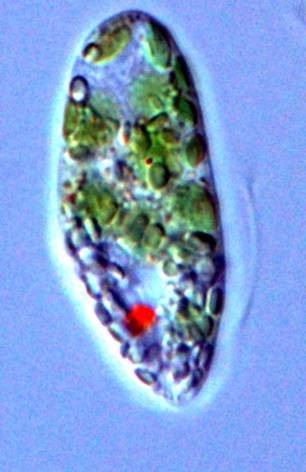
With Euglena, I could pick out one long green cell by the red fleck near its tip. Here one cell does the swimming. The fleck is an eyespot that helps it orient to light, and the green comes from chloroplasts. I had been looking for something that swam toward its dinner. Here was something that could swim toward a place where it could make its dinner.
I started out asking how far a plant would go for a meal. I ended up watching three quite different things happen in pond water. A water flea crosses the last little distance in a current the bladderwort creates. A green sphere rolls because thousands of cells swim together.
And that one cell with the red spot can take its chloroplasts someplace sunnier.
WE&P by: EZorrillaMc&Co.
Sources and credits
Bladderwort. Simon Poppinga and colleagues filmed water fleas being drawn into the trap in “Biomechanical analysis of prey capture in the carnivorous Southern bladderwort.” In the embedded clip, the trap fires, but this particular flea is too large to enter. “Bladderwort catching flea in slow motion,” by IDT_UK.
Volvox. For how the flagella on the surface cells make the sphere swim and turn, see “Stability of dancing Volvox,” Journal of Fluid Mechanics. The nine green spheres appear in “Volvox, an incredible view of a unique algae,” by The Spoken Word. The embedded close-up is “Volvox spinning around,” by Andrew Gatt.
Euglena. For the red eyespot and how a swimming cell orients itself to light, see “The Flux of Euglena gracilis Cells Depends on the Gradient of Light Intensity.”
Photograph. Euglena gracilis. Photograph by Ellis O’Neill, via Wikimedia Commons, CC BY-SA 3.0.
Opening illustration. Everyone Wants the Water Flea, created with ChatGPT.


Leave a Reply