“I can get you the nitrogen, Majestät.”
“And the hydrogen, Bosch?”
“That too.”
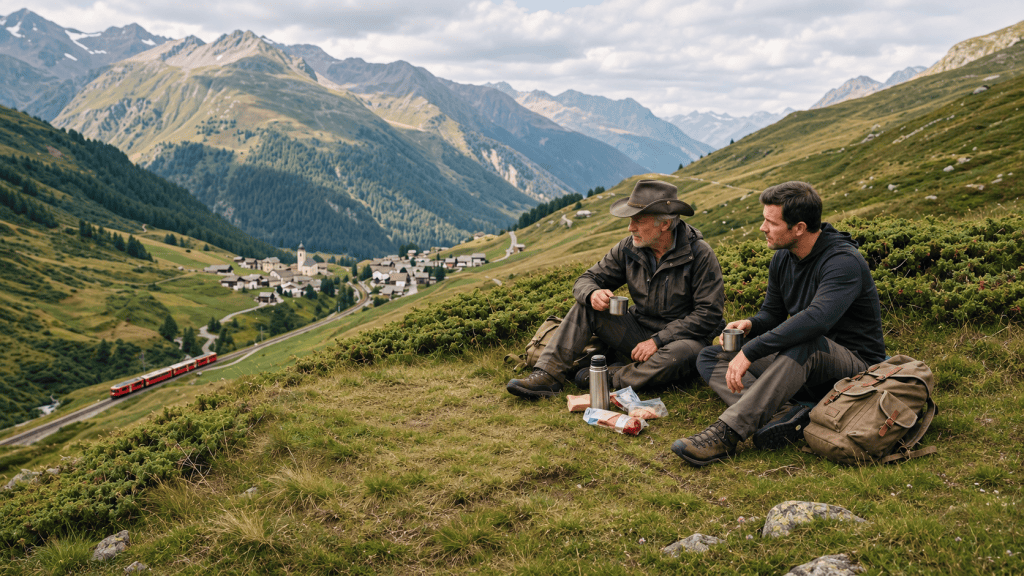
The older hiker waited. The younger one reached for his cup.
“Is that all you’re going to tell me?”
“You only asked if I could get it.”
“Where does it come from?”
“The steam. We pass it over hot coke.”
The older man poured the tea.
“Who told me about the nitrogen in the first place?”
“Emil Fischer. Berlin, 1911. You were there.”
“Was I?”
“They say you nodded.”
They’d walked a long, nearly level stretch along the ridge, the ground falling steeply away on one side. Where the trail widened into a grassy shoulder, they’d put down their packs. Below the village church, a red train was passing.
“Do you think that’s how it happened?” the older man asked. “The first plant came online at Oppau in September 1913. Suppose Bosch comes to see me that week.”
“And tells you something you’ve known for two years? You heard Fischer say it could be done in 1911. Now Bosch has a plant doing it. You’re the Kaiser. What do you want to know?”
The older man held his cup between his hands. “Whether he has what he needs to keep it running.”
The younger man nodded.
“Why do you suppose I’m the one asking? Surely the farmers want to know that too.”
“They do. I think Bosch was one of the people you wanted to see that morning.”
“Who else?”
“Do it again, from the top,” the younger man said.
They looked at each other.
“I can get you the nitrogen, Majestät.”
“And the hydrogen, Bosch?”
“That too.”
“Good. Keep it running.”
The younger man reached for his cup. The older man turned to the empty place beside him, where he’d decided the war minister was sitting.
“Send for Frau Krupp.”
The older man put out his hand. “Wait, did I know yet?”
He looked across the valley. “I know what comes next, though.” He took a drink. “How do we know Wilhelm put those two things together?”
“There’s a clipping from a Berlin paper. October 1912. Haber was getting ready to show the Kaiser how he made ammonia. The paper told its readers who could use it.”
“The farmers.”
“‘Our farmers and explosives manufacturers.’ In the same sentence. And before the plant opened.”
“Nearly a year before. Do we know if he read it?”
“No.”
The older man tipped the last of the tea into his cup. “What section was it in?”
“Art, Science, Literature.”
WE&P by: EZorrillaMc&Co.
Sources and further reading
The hikers imagine the conversation between Carl Bosch and Kaiser Wilhelm II and the request for a meeting with Frau Krupp. The lecture, the plant opening, and the newspaper clipping are historical.
- “They say you nodded.” Emil Fischer delivered his lecture Neuere Erfolge und Probleme der Chemie in Berlin on January 11, 1911. Its published title records the Kaiser’s attendance. The nod comes from a later historical account, traced in Timo Baumann’s Giftgas und Salpeter, p. 114, note 296. Fischer’s lecture record
· Baumann’s study (PDF)
.
- The Berlin newspaper clipping. The morning edition of the Vossische Zeitung for October 17, 1912, previewed Haber’s expected demonstration for the Kaiser. It named unsere Landwirte und Sprengstofffabrikanten (“our farmers and explosives manufacturers”) in the same sentence. Baumann quotes the passage on p. 114. Note 295 identifies the clipping in the BASF archive and gives the section heading, Kunst, Wissenschaft, Literatur (“Art, Science, Literature”). Whether Wilhelm read it remains open. Timo Baumann,
Giftgas und Salpeter
, p. 114, note 295 (PDF)
.
- Bosch, the hydrogen, and the plant. The first industrial ammonia synthesis plant went into operation at Oppau on September 9, 1913. BASF recounts Bosch’s work bringing Haber’s process to industrial scale. For the question about steam and hot coke, see Baumann’s section on the search for an industrial hydrogen supply, beginning on p. 153. BASF’s biography of Carl Bosch
· Baumann, section 1.6.4 (PDF)
.
- Frau Krupp. Bertha Krupp owned the firm. Her husband Gustav chaired its supervisory board, and she retained influence over major decisions. Wilhelm attended the company’s centenary celebration in August 1912. Krupp Historical Exhibition, “The fourth generation”
.
For readers who want to follow the question further, Benjamin Johnson’s Making Ammonia (2022) goes back to Haber’s public lecture in Karlsruhe on March 18, 1910. Haber was already describing his discovery in terms of both agriculture and the explosives industry. Chapter 12 follows what he wanted to disclose and what BASF wanted to keep secret. Read Making Ammonia (open-access PDF).

