When I went back to the photograph, Scruggs’s hand was still open. That was where I’d left him in I’m Looking at His Hand. I knew Jordan got away. I’d spent a surprising amount of time waiting for those fingers to close.
This time I wanted to ask everybody in the picture to do something for me.
Hold there.
In my mind they all fell to the ground.
That was the first impossible. Nobody could stand like that for a picture. Jordan had been there, certainly. I could see the cleat in the grass, the angle of his body above it, the other foot off the ground. What I was asking him to do was stay.
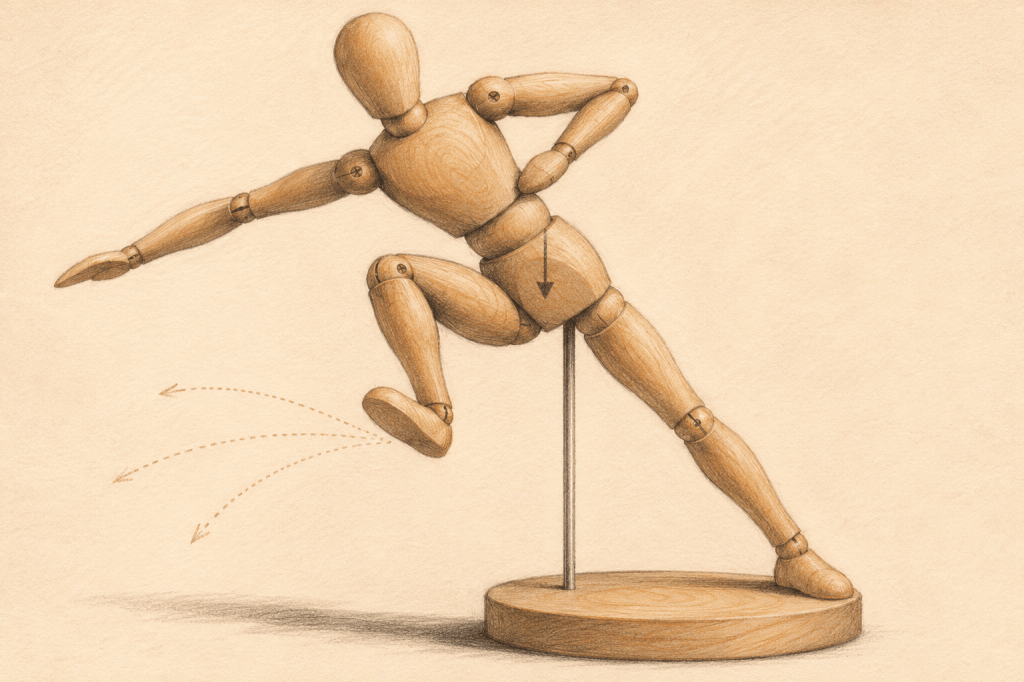
I thought some arrows might help. Take everybody else out for a moment. Leave me Jordan and the ground. He’s pushing against it through that planted foot. Which way does that send him? I wanted one arrow, the result of adding up all those forces. I asked for it. When it came back, I wanted to argue with it. I could feel him going the other way.
I was already swinging his back leg for him.
Bring it straight through under the hip and I could imagine him carrying on forward. Let it swing a little wider and I could feel a turn beginning. Then I remembered the bend in his planted knee. How much push did he still have there? And I’d taken Scruggs out of the picture. I needed his hand back. Could that open hand change Jordan’s next step?
Each time I went back to the photograph to settle one of those questions, I found another move I could make from there. I knew the feeling of pushing off at an angle. For a moment that made me quite sure of the direction. Then I tried the other step and recognized that feeling, too.
We gave the position to a little wooden man. He has the other foot planted. His stand holds his pose. I can finally say hold there and take my time looking. The solid arrow points down with gravity. The dotted lines are three ways I imagined his foot might go.
Maybe that’s where the second impossible is. I wanted to work my way from one cleat in the grass to the other coming down. I could supply several ways to get there. I couldn’t tell which one belonged to him.
The caption had already given me the touchdown. What I wanted by then was one more frame.
See Allen J. Schaben’s photograph in the Los Angeles Times.
WE&P by: EZorrillaMc&Co.

