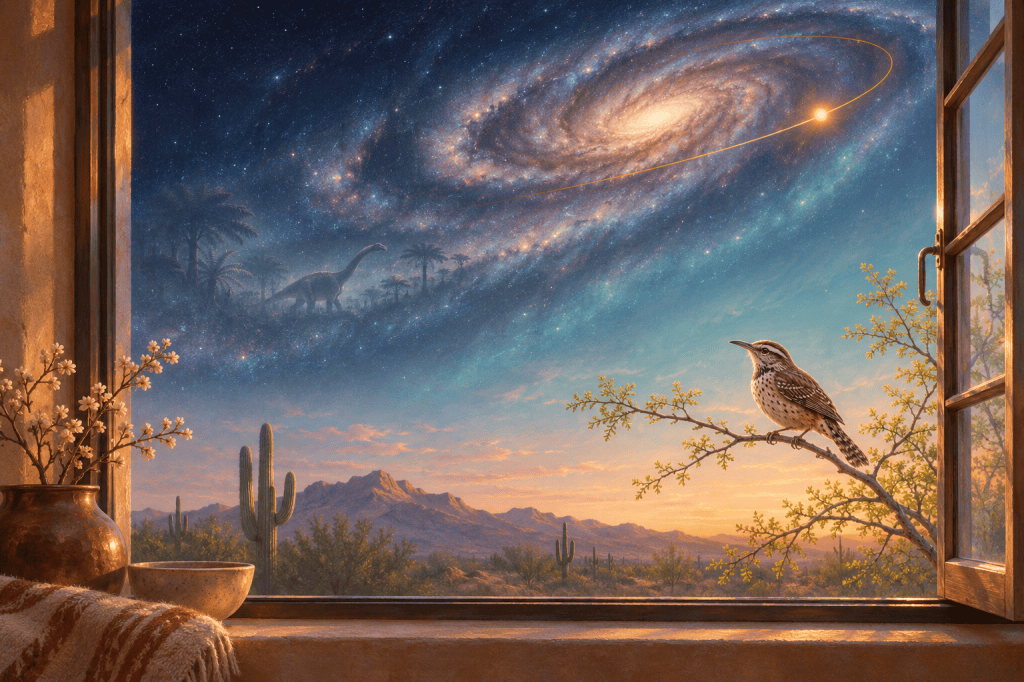
Twenty Times Around
I’m watching a documentary about prehistoric predators when another picture interrupts the itinerary.
The planets are circling the Sun, and the Sun is going somewhere.
Around the Milky Way, apparently. One circuit takes about 230 million years.
I knew we moved. I hadn’t given much thought to counting the trips.
“How many have we done?”
“About twenty.”
Earth formed roughly 4.5 billion years ago. Divide that by a galactic lap and twenty is close enough for the conversation.
Twenty sounds manageable.
I have done twenty minutes on a bicycle. I have lived through twenty summers without needing to put them on a chart.
Then we begin putting things beside the track.
“Dinosaurs?”
“About a lap ago. They appeared in the Late Triassic.”
“And they stayed almost a lap?”
“Nearly three-quarters.”
Roughly 164 million years between their appearance and the extinction 66 million years ago, if we mean the dinosaurs other than birds.
The birds continued.
There is probably one outside while I’m working this out.
“And us?”
“About three hundred thousand years for Homo sapiens.”
“What part of a lap is that?”
“One seven-hundred-and-seventieth.”
“Of the twenty?”
“Of one.”
I have to put twenty down and start again.
If a single lap lasted a calendar year, our species would have been here for about eleven hours.
Twenty years of travelling. We’ve been here eleven hours.
Our ancestors were aboard before there was anything we would call human. The eleven hours belong to the name we give our species.
Still, I had given us more room.
“What about the Carboniferous? Two laps ago?”
“Closer. About a lap and a half ago.”
A little farther back is the Devonian. Two full laps takes us to the Ordovician.
The giant straight-shelled cephalopod we were just watching belongs over there.
The shrimp king is farther back again.
All those animals, all those seas, all those forests fit into a little more than the last two laps.
“What were we doing for the rest?”
“For much of it, life was microscopic.”
I almost say nothing was happening.
Billions of years of organisms living and reproducing, changing the chemistry of the planet, and I am waiting for something with eyes.
The documentary has encouraged this. It has twelve periods to cover and a predator to introduce in each. A creature enters the water. Something else should be worried.
Microbes require a different production.
Meanwhile, the track itself is getting troublesome.
The Sun travels around the galaxy, but the other stars travel too. They have their own paths and speeds. The neighbourhood changes.
About seventy thousand years ago, Scholz’s star and its companion passed through the distant outskirts of our solar system.
Humans were here.
That doesn’t mean someone looked up and said, “There goes Scholz.”
We worked out the encounter much later, from where the stars are now and how they are moving.
There are planetary systems billions of years older than ours. Kepler-444 and its small planets were already ancient when Earth formed.
We have done twenty laps.
Other worlds started earlier.
I’m still trying to picture the first two laps when a bird lands outside.
It folds its wings.
I look up in time to see it.
WE&P by: EZorrillaMc&Co.
Sources and further reading
- NASA: Solar System Facts
— our roughly 230-million-year galactic orbit.
- International Commission on Stratigraphy
— the geological periods.
- NASA: Our Sun’s Near Miss
— Scholz’s star.
- NASA/JPL: An Ancient System with Five Small Planets
— Kepler-444.
“Laps” are approximate conversions using today’s estimated orbital period, rather than a reconstruction of the Sun’s entire journey.

