Put Them There
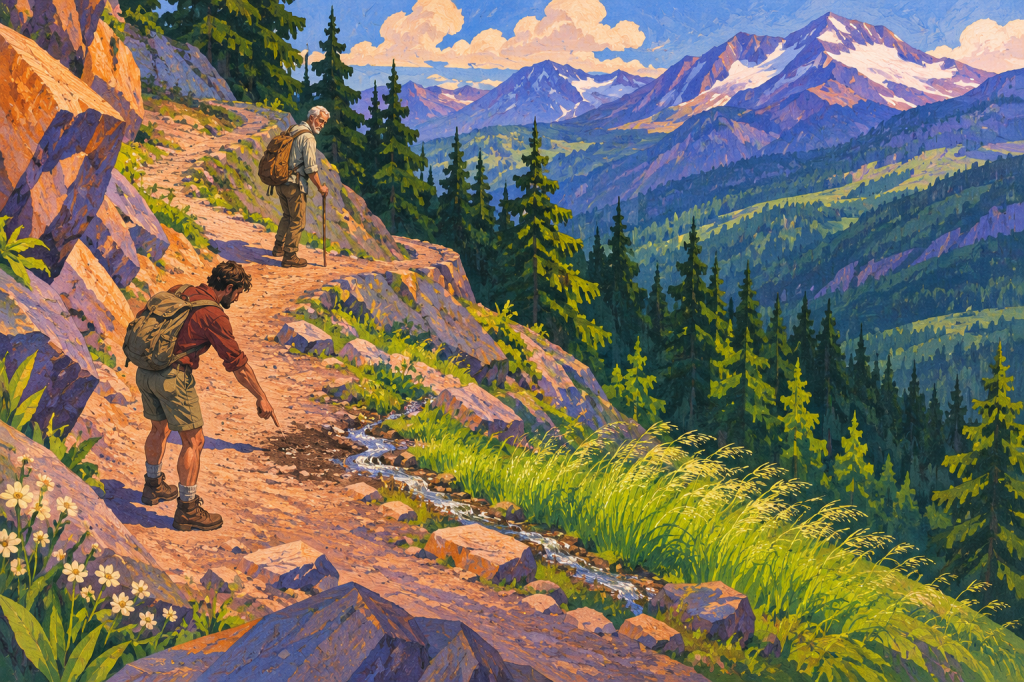
The younger man stopped where the trail came out of the trees. Something small was moving through a patch of grass, bending the stalks one at a time.
“Bird,” he said.
“The crow?” the older man asked, still watching his footing.
“No.”
The older man drew level with him. A little brown bird had pulled a seed head down with its weight. It picked at the seeds until the stalk slipped free and sprang up again.
“When were we smart enough to farm?” the younger man asked.
The older man turned to look at him.
“I’ve been reading,” the younger man said.
“I thought you might have been.”
“Max Bennett. Five things brains learned to do. Steer, learn from what pays off, imagine what might happen, understand what somebody else has in mind, speak. He has better names for them.”
“Which one gets you a farm?”
“That’s what I’m asking.”
The bird lifted off and crossed the trail. Both men were still looking at the grass.
“Suppose we found a sickle,” the older man said.
“Then somebody cut it. That’s the take. I’m asking about the put.”
They walked on. The trail doubled back above the patch. From there they could see how the grass followed a shallow run of water through the rocks. Farther along, a marmot sat holding a stem between its forefeet. The younger man pointed. This time the older man had seen it first.
“People were making flatbread about fourteen thousand years ago,” the older man said. “We have pieces from a hearth in what’s now Jordan. They could gather wild grain and make bread from it.”
“That matters,” the younger man said. “I think we put too much into what the first person had to imagine. Whoever held that grain already knew what bread tasted like.”
“All right.”
“Suppose they sat down to eat somewhere they liked. Some grain fell. Maybe the baby dropped it.”
“Does it have to be a baby?”
“No. But if the baby did it, we can give up trying to find out what he had in mind.”
The older man laughed. The marmot dropped to all fours and went between two rocks.
“The following year,” the older man began.
“Why the following year?”
“I thought they were coming back for the grain.”
“They haven’t planted any yet. They come back because it’s on their way. They might make the circle three or four times. One time there’s something green where they sat. Another time it’s up to here.”
He put his hand beside his knee.
“Eventually somebody picks up grain in the very place where they remember eating it.”
“Eventually,” the older man said.
The younger man smiled. “You can have that one.”
They found a rock broad enough for the stove. While the water heated, the older man took two biscuits from the side pocket of his pack. One had broken. He fitted the pieces together on the lid and offered the younger man his choice.
“So the next time they stop there,” he said, “somebody says, ‘Leave a little.’”
The younger man had taken the broken biscuit. He put the larger piece down.
“Almost. Put them there. We’ll be back.”
The older man looked where his companion was pointing. A little below the trail, water had gathered in a dark patch of earth.
“You picked a spot.”
“Yes. They were coming back anyway. Now they’ve done something about what they might find.”
The older man poured the tea.
“And then?” he asked.
“For a while, nothing they can eat. That’s the part I like. They come around again and both patches are green. The grain that was there already and the grain they carried. Imagine seeing them side by side.”
The older man glanced down at the dark patch. “I think I’d remember where you pointed.”
Below them the brown bird was back, or another like it. From this height they could see the stalk bend before they could make out the bird.
“We could do it farther along,” the older man said.
The younger man turned to him. “Yes. There’s another place where we stop.”
“Or we stay here?”
“Maybe. Once we’ve gathered enough to eat later and kept enough to plant again. I’d give us a while before I built the village.”
The older man drank his tea.
“How early do you think people could have done it?”
“That’s what’s bothering me about could. A patch somebody planted with a finger might look exactly like the patch the baby left. Suppose you found one. Could you tell which it was?”
The older man looked down the slope again. “I’d have to have seen you point.”
For a while they ate. The younger man gathered the crumbs from the lid with a damp fingertip.
“It’s like a play nobody’s written down yet,” he said.
The older man waited.
“Suppose I want to tell the story of this morning. I can do you and I can do me. I could tell it tonight.”
“Go on, then. Do me.”
The younger man set his cup down with care.
“Does it have to be a baby?”
The older man laughed hard enough to spill tea on his trousers. He brushed the drops away.
“I did ask that.”
“The second time I tell it, I could pause there. Someone who’s heard it could do your part. By the time anybody writes it down, we might have been doing you for years.”
“I see the disadvantage of staying in one place.”
They packed the stove. The older man took the cups down to rinse them while the younger man held both packs clear of the damp ground. Then they continued up the mountain.
At the next turn, a trickle crossed the trail. On the uphill side, the earth was bare. The older man had gone several yards past it before he heard his companion call.
“Here, too.”
He turned. The younger man was pointing at the ground.
This time the older man knew what he meant.
WE&P by: EZorrillaMc&Co.
Sources and further reading.
- The five capacities. Max Bennett, A Brief History of Intelligence: Evolution, AI, and the Five Breakthroughs That Made Our Brains (2023). The younger hiker paraphrases Bennett’s five terms steering, reinforcing, simulating, mentalizing, and speaking. Author’s book page
- The bread. Amaia Arranz-Otaegui and colleagues, “Archaeobotanical evidence reveals the origins of bread 14,400 years ago in northeastern Jordan,” Proceedings of the National Academy of Sciences (2018). Charred fragments from a hearth at Shubayqa 1 show that hunter-gatherers could make flatbread-like food from wild plants. This is the find behind the line about already knowing what bread tasted like. Read the study
- The take. Iris Groman-Yaroslavski and colleagues, “Composite Sickles and Cereal Harvesting Methods at 23,000-Years-Old Ohalo II, Israel,” PLOS ONE (2016). Wear on five flint blades reveals how people cut cereal stalks. A blade can preserve evidence of the harvest while leaving open who put the grain there. Read the study
- The put. George Willcox, Sandra Fornite, and Linda Herveux, “Early Holocene cultivation before domestication in northern Syria,” Vegetation History and Archaeobotany (2008). The researchers drew on several clues, including weeds associated with cultivation and changes in the plants people gathered, to infer that people tended cereals while the plants still had wild characteristics. The hikers’ patch and the baby’s spilled grain are imagined. This paper gives the archaeological reasoning behind their question. Read the study

