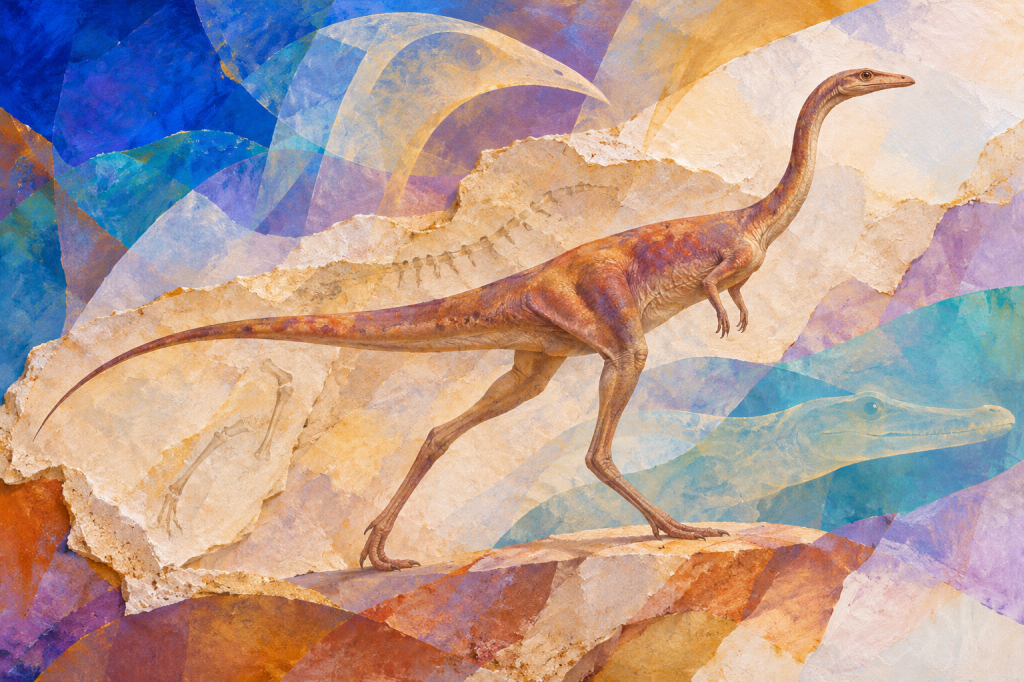
“What is that?”
“Effigia.”
“A dinosaur?”
“No.”
It had the long tail, the little arms, the substantial back legs. I had begun putting it somewhere before learning its name.
“The head reminds me of a parrot.”
“It had a toothless beak.”
“Then where does it belong?”
“On the crocodile side of the archosaur family.”
I looked at it again. The answer hadn’t changed the picture.
“That walked on two legs?”
“Yes.”
“Like a dinosaur.”
“Like some dinosaurs.”
The fossil had been collected at Ghost Ranch in New Mexico in 1947. The quarry contained so many skeletons of the dinosaur Coelophysis that another lightly built, long-tailed animal could arrive in New York with its identity apparently settled.
Another Coelophysis.
Preparators began removing the surrounding rock. Once they had decided what it was, they stopped. The partly exposed skeleton went into storage.
“How long was it there?”
“Until 2004, when Sterling Nesbitt resumed preparation and recognized something different.”
“Nearly sixty years.”
“Yes.”
“So it had been found.”
“The fossil had.”
That was a peculiar kind of waiting. The animal had already crossed the distance from a Triassic landscape to a museum in New York. Someone had excavated it, protected it, transported it. Someone had even begun uncovering it.
It still needed to be discovered.
“What did he see?”
“The beak caught his attention. Then the proportions—the tiny arms, the way the body was put together. The ankle had features that placed it on the crocodile branch.”
“Effigia?”
“The name came afterward. It means ‘ghost,’ for Ghost Ranch. The full name, Effigia okeeffeae, also honors Georgia O’Keeffe.”
“But the rest of it looks so much like a dinosaur.”
“Some members of both branches evolved similar bodies.”
“Independently?”
“Yes. Long hind legs, smaller forelimbs, a body balanced above two feet. Much later, some dinosaurs would also have toothless beaks and a remarkably similar appearance.”
“So the beak doesn’t make it a bird.”
“No.”
“And the two legs don’t make it a dinosaur.”
“No.”
I was running out of things I could recognize with confidence.
“Show me the hip.”
There were two arrangements to compare. In one, the head of the thighbone turned inward to meet the socket on the side of the pelvis. In the other, the socket faced more downward, receiving the leg beneath it.
Both animals could carry their bodies above their legs. The bones met differently.
“I have a hip socket.”
“You do.”
“And a jaw.”
“Yes.”
We had already talked about the mammalian jaw: one bone on each side, meeting the skull. In our distant ancestors, bones from the older jaw hinge had gradually taken on a role in hearing.
I put a finger beside my ear and opened my mouth.
There was something reassuring about finding a piece of the discussion moving beneath my skin.
“So you can’t identify the family just by what the animal is doing.”
“You need to examine how its body is put together. And compare more than one feature.”
I returned to Effigia.
Its beak still reminded me of a parrot. Its body still looked like a dinosaur’s. Knowing where it belonged hadn’t removed either resemblance.
“What did the crocodiles look like then?”
“There were many kinds of animals on that branch. Large land predators. Armored plant-eaters. Some that ran on two legs. The crocodilians alive today preserve only a small part of that variety.”
I had taken the crocodile I knew and stretched it backward through time. There it was, beside the river, waiting for the dinosaurs to pass.
Meanwhile, this relative had been walking across the land on its hind legs.
“And Coelophysis?”
“That one really was a dinosaur.”
I put the two pictures beside each other.
For nearly sixty years, Effigia had waited in the museum, still partly enclosed in the rock, presumed to be another Coelophysis.
Now I had the right names.
I still needed to look.
WE&P by: EZorrillaMc&Co.
Sources and further reading
- Steve Brusatte, The Rise and Fall of the Dinosaurs (2018).
The starting point for this piece, particularly his account of Effigia’s collection, partial preparation, and eventual recognition at the American Museum of Natural History. - Sterling J. Nesbitt and Mark A. Norell, “Extreme convergence in the body plans of an early suchian (Archosauria) and ornithomimid dinosaurs (Theropoda)”, Proceedings of the Royal Society B (2006).
The original scientific description explaining Effigia’s crocodile-line identity and its striking resemblance to later dinosaurs. - American Museum of Natural History, “Sterling Nesbitt.”
An accessible account of the discovery and the meaning of Effigia’s name. Its description of the specimen as unopened differs from Brusatte’s account of earlier partial preparation; this piece follows Brusatte on that detail. - Karl T. Bates and Emma R. Schachner, “Disparity and convergence in bipedal archosaur locomotion”, Journal of the Royal Society Interface (2012).
For the comparison of upright locomotion and hip anatomy on the dinosaur and crocodile branches. Figure 1 illustrates the two hip arrangements. - “Evolution of the mammalian middle ear and jaw: adaptations and novel structures”.
Further reading on the evolutionary connection between the ancestral jaw joint and the mammalian hearing bones.

