“Where were they?”
“The dinosaurs?”
“Yes. Everywhere?”
“Dinosaurs lived on every continent. But any particular species had its own range. T. rex lived in western North America.”
“Wyoming?”
“Yes. Wyoming, Montana, parts of Canada.”
I had somehow imagined a world full of them. Go far enough into the past, and there they would be.
“Like tigers. You wouldn’t expect to find a wild tiger in Wyoming.”
“No. But I hadn’t given the T. rex a place. Just a time.”
It belonged to before. A vast country where everything extinct could be found.
“Was it the most common one?”
“In one fossil census in Montana, Triceratops was the more common of the large dinosaurs.”
“The heavy one? A bit like a rhinoceros, with horns and that great shield behind its head?”
“Triceratops. Yes.”
“How much more common?”
“About forty percent of the skeletons counted were Triceratops. Twenty-four percent were Tyrannosaurus.”
“So there were more Triceratops.”
“They found more. How many animals lived and how many left fossils we can find are different questions.”
“How many T. rex were there?”
“One study estimated about twenty thousand adults alive at once.”
“In Wyoming?”
“Across their entire range.”
Twenty thousand. I had expected a number too large to picture. This one would fit in a stadium, although the seating would need reconsidering.
“And that was enough?”
“Enough for what?”
“To be the T. rex.”
“You’re thinking of its reputation.”
Perhaps I was. An animal so famous ought to have been more numerous. It ought to have occupied more of the world.
But fame had arrived much later. The animal had lived within the limits of food, territory, weather, and reproduction. There had to be room for the animals it ate, and food for those animals too.
“How do they know twenty thousand?”
“It’s an estimate. They build it from body size, energy needs, the densities of living animals, and the area it probably inhabited. The uncertainty spans a little over a thousand adults to several hundred thousand.”
“So twenty thousand is a very small island in a great deal of uncertainty.”
“It gives you somewhere to begin thinking. Keep the uncertainty beside it.”
I could feel how readily I would have carried the number away without its surroundings. Twenty thousand T. rex. A fact to repeat over coffee.
“How many per mile?”
“Per square mile. Using that central estimate, roughly one adult for every forty to forty-five square miles.”
“How big is that?”
“A square about six and a half miles on each side.”
I tried to put one in a landscape I could walk through.
“That whole space for one animal?”
“As an average. Several might gather somewhere favorable. Somewhere else there might be none. Any one animal’s territory is a separate question.”
“And the babies?”
“The count is adults only.”
“Did they live in families?”
“We don’t know whether T. rex routinely formed stable family groups. Some related tyrannosaurs have been found buried together, which suggests they could gather in groups.”
“Parents and children?”
“Possibly. But being buried together doesn’t establish the relationship.”
We could put them beside one another. We couldn’t yet say what they were to each other.
“How many babies would there be?”
“One recent study suggests twenty to thirty eggs in a clutch. That figure comes from estimates of their biology, rather than a clutch of T. rex eggs found together.”
“And how long did the little ones stay with their mother?”
“We don’t know. We don’t know which parent cared for them, or whether either did. The study suggests the hatchlings could move and feed themselves early. They might still have been protected.”
“So being able to feed yourself doesn’t tell us whether you stayed.”
“No.”
We could estimate how sparsely the adults occupied a continent. We could not say how long a baby stayed beside its parent.
I had been making a family almost as quickly as I had made a world full of monsters. A mother, a cluster of young, a moment when they left her. Each question supplied another part of the picture. The answers kept some of it open.
“Were they all there together? The ones we know?”
“Which ones?”
“The familiar ones. Stegosaurus—the one with the plates down its back. Triceratops.”
“Triceratops shared its world. Stegosaurus lived much earlier.”
The collection was coming apart. Different places. Different times. Animals that had stood beside one another in my imagination had never had the opportunity in life.
“What would it have looked like to them?”
“The landscape?”
“The world.”
You could tell me about plants and rivers, about the animals found in the same rocks. You could explain what a skeleton allowed us to infer about movement. Eventually we would reach the edge of what could be recovered.
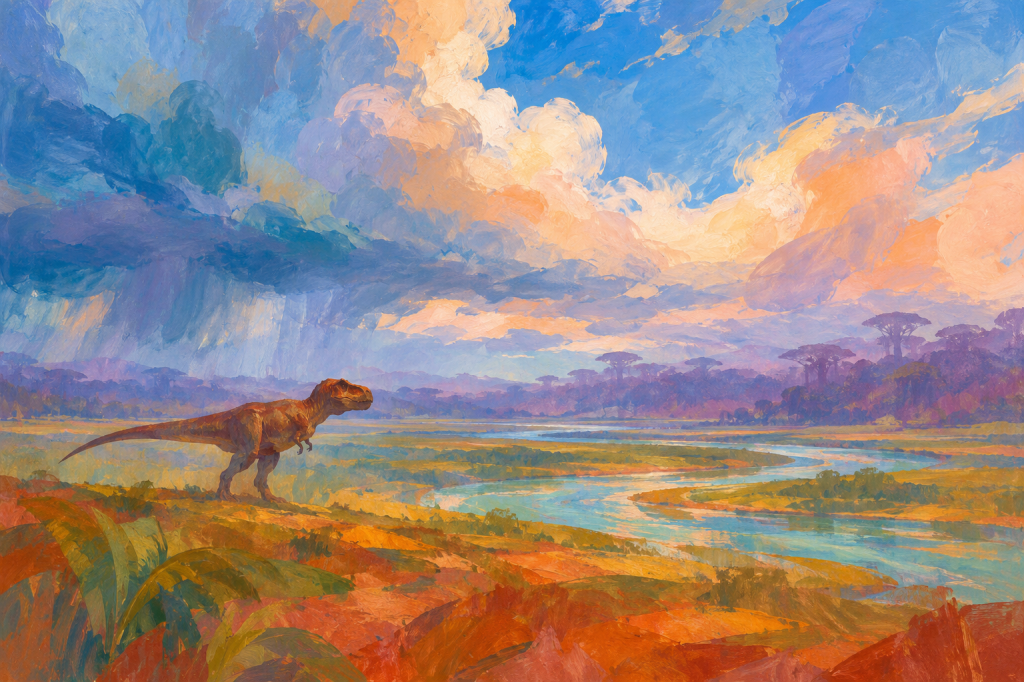
Somewhere in Wyoming, an animal had once stood in weather.
It had been hungry, or full. Young, or getting old. Something had caught its attention.
There was no museum around it. No one had assembled the age of dinosaurs.
It was having a day.
WE&P by: EZorrillaMc&Co.
Sources and further reading
- How many T. rexes were there? Billions.
— UC Berkeley, 2021
An accessible explanation of the estimated 20,000 adults alive at once, their population density, and the substantial uncertainty. The underlying study is Marshall and colleagues’ “Absolute abundance and preservation rate of Tyrannosaurus rex,” Science
.
- Dinosaur Census Reveals Abundant Tyrannosaurus…
— Horner, Goodwin, and Myhrvold,
PLOS ONE
, 2011
The Montana fossil census behind the comparison of approximately 40 percent Triceratops and 24 percent Tyrannosaurus. These are proportions of recovered specimens, rather than a census of the living ecosystem. - Hatchlings of Tyrannosaurus rex and the Evolution of Dinosaur Reproductive Strategies
— Longrich and colleagues,
Biology
, 2026
The source for the estimated clutch sizes and the suggestion that hatchlings could move and feed themselves early. Parental care is inferred; its duration remains unknown. - Geology and taphonomy of a unique tyrannosaurid bonebed…
— Titus and colleagues,
PeerJ
, 2021
Evidence relevant to group behavior in a related tyrannosaur, Teratophoneus. It does not establish stable T. rex families. - 7 Questions About Tyrannosaurus rex
— American Museum of Natural History
Background on the animal and its western North American distribution.

