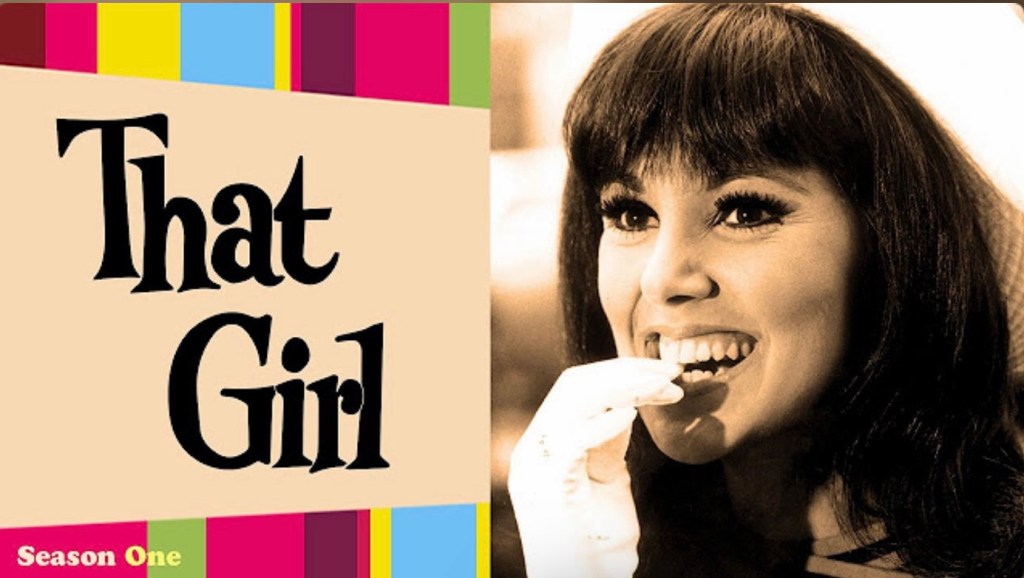
Look closely at the television landscape of 1966, and you will see why That Girl was not merely a sitcom—it was a quiet revolution disguised in vibrant mod fashion and infectious optimism.
Before Ann Marie stepped onto the streets of New York, women on television were almost exclusively defined by their domestic utility: they were the wife of the boss, the zany neighbor, the dutiful secretary, or the teenage daughter waiting for a husband. Marlo Thomas walked into ABC executives’ offices and asked a radical question: “Have you ever thought about doing a show where the girl is the somebody?” By centering a young woman who left her small-town safety net to chase an acting career in Manhattan—living entirely on her own, paying her own rent, and navigating her own ambition—Thomas created the blueprint for the modern single-woman comedy. Without Ann Marie flying her kite in Central Park, there is no Mary Richards tossing her tam in Minneapolis. That Girl proved that a woman’s life did not require a marriage license to have stakes, comedy, and narrative gravity.
Examine the mechanics behind the camera and the evolution of the characters, and you will uncover three fascinating truths about how this series was built:
1. The Radical Refusal of a Series-Finale Wedding
Pay attention to how the series ended in 1971. By the fifth and final season, ABC executives and the show’s major sponsor, Clairol, desperately wanted Ann Marie and her longtime boyfriend, Donald Hollinger (Ted Bessell), to finally tie the knot—knowing full well that television weddings guaranteed massive ratings. Marlo Thomas, who also served as an uncredited executive producer on the series, flatly refused. Although she allowed the characters to get engaged at the start of Season 5, she insisted the series conclude without a wedding. Thomas recognized that marrying Ann off in the final episode would betray the entire thesis of the show, sending a retrograde message to young women that independence is merely a temporary waiting room before marriage makes a life complete.
2. The Unaired Pilot’s Completely Different World
Do not assume the That Girl that aired in September 1966 was the exact vision filmed a year earlier. In the original 1965 unaired pilot, the architecture of Ann Marie’s life looked vastly different. Her parents, Lew and Helen Marie, were originally played by Harold Gould and Penny Santon (before being recast with Lew Parker and Rosemary DeCamp for the series run). Even more notably, Ted Bessell’s character was not a Newsview magazine writer named Donald Hollinger—he was Ann’s talent agent, a part-Cherokee man named Don Blue Sky. The creative team quickly realized that making her love interest her professional agent muddied the waters of her independence, prompting the pivot to a journalist who functioned as her equal rather than her manager.
3. When Fiction Bled Into Reality on Set
Observe the dynamic between Ann and her overprotective father, Lew Marie, played by Lew Parker. Off-camera, Parker had been married twice and had no children of his own, and he quickly developed a deep, paternal bond with Thomas. During the filming of a poignant episode where Lew recounts the day Ann was born—delivering a line about praying for a child and realizing she was everything he had ever wanted—Parker could not make it through the take without breaking down in tears. The emotion wasn’t acting; the script had accidentally tapped directly into the real-life void of a man who had never been a father, turning a standard sitcom beat into a moment of raw, unscripted truth.
Consider how those deliberate creative choices—refusing a neat romantic resolution and protecting a protagonist’s autonomy—echo in the stories we tell today.
WE&P by: EZorrillaMc&Co.

