THE LOBBY
INT. HOTEL RIO — LOBBY — AFTERNOON
The revolving door moves once.
CELIA VALE enters carrying no luggage.
Jonas leaned over his shoulder.
“No luggage?”
“She owns the hotel.”
“She doesn’t know whether she’s staying.”
“She has always owned it.”
“She may have always owned a toothbrush.”
“Let her enter empty-handed,” Leda said.
Maron continued.
The desk clerk looks up.
“What does he say?” Jonas asked.
“Welcome to the Rio.”
“No.”
“May I help you?”
“No.”
“Miss Vale.”
Leda looked at him.
“He knows her?”
“Everyone knows Celia Vale.”
“That makes it less interesting.”
“What if he doesn’t recognize her?”
“Then we spend half a reel waiting for him to catch up.”
Maron rested his hands on the typewriter.
“What does the room expect him to say?”
Jonas looked toward the empty chair at the far end of the table. The chair had a brass plate on the back:
CELIA VALE
She rarely attended story meetings. The chair remained there anyway.
“Welcome back,” Jonas said.
Maron and Leda both looked at him.
“She’s never been there,” Maron said.
“I know.”
Leda smiled.
Maron typed:
CLERK
Welcome back.
Then:
CELIA
I’ve never been here.
They waited.
The room had changed slightly. Not enough to name. Enough to continue.
“What does he say?” Maron asked.
Jonas began to answer, but Leda raised one finger.
She was looking at the next item on the list.
She read it aloud.
“Sometimes a room remembers the person who was expected.”
Nobody laughed.
Maron placed his fingers on the keys.
Leda shook her head.
“Don’t type it.”
“Why?”
“The clerk wouldn’t say that.”
“Who would?”
She looked at the photograph on the cork wall, the board, the empty chair, and the two lines already on the page.
“No one yet.”
Jonas took the statement from her and pinned it beside the photograph.
The blue envelope lay open on the table. Four pages remained.
Maron turned the roller back half a line.
From the hallway came the sound of a woman laughing.
Not Celia Vale.
All three waited anyway.
When the laughter passed, Jonas said:
“Your room is ready.”
Maron typed it.
Leda did not object.
They read the exchange:
CLERK
Welcome back.
CELIA
I’ve never been here.
CLERK
Your room is ready.
Jonas sat down.
“Is it a ghost story?”
“No,” Leda said.
“Romance?”
“No.”
“Thriller?”
“Not yet.”
“What is it?”
Maron removed the page from the typewriter.
“A vehicle,” he said.
“For Celia?”
Leda picked up the morning list.
“We’ll know when she gets in.”
THE MORNING LIST
The blue envelope arrived three minutes late.
No one mentioned it.
Jonas did.
“The system is failing.”
“The system overslept,” Maron said.
Leda was pinning yesterday’s pages onto the cork wall. Celia’s entrance now occupied three typed sheets, each carrying penciled corrections in different hands.
On the board:
A VEHICLE FOR CELIA VALE
SHE RETURNS TO A HOTEL SHE HAS NEVER VISITED.
Below it:
FIND THE PICTURE.
Someone—probably Maron—had added underneath:
DON’T PROTECT THE LINE. PROTECT THE PICTURE.
Leda left it there.
Jonas opened the envelope.
“The first statement.”
He cleared his throat dramatically.
“Nothing is original except the mistake.”
Maron smiled.
“I like whoever writes these.”
“You always do.”
“No.”
“Yesterday?”
“I liked the piano.”
“The hotel?”
“The piano.”
Jonas continued.
“Every masterpiece begins as theft.”
Leda held out her hand.
He gave her the page.
She read it twice.
“No.”
“You don’t like it?”
“I don’t believe it.”
Maron shrugged.
“I believe half of it.”
“Which half?”
“The masterpiece.”
Jonas laughed.
“You don’t believe theft?”
“I think that’s too romantic.”
Leda laid the page flat on the table.
“What are we actually talking about?”
“The line.”
“No.”
“The author.”
“No.”
“The picture.”
She nodded once.
“Better.”
Jonas reached into the envelope again.
“There’s a note.”
“A note?”
“They’ve never sent notes.”
He unfolded it.
Research cannot verify the attribution of Statement Seven.
Maron looked up.
“What attribution?”
Jonas found Statement Seven.
He read it aloud.
“A room remembers the person who was expected.”
Silence.
“Who said it?” Maron asked.
“I thought Woolf,” Leda said.
“I thought Wilder,” Maron replied.
“I thought nobody,” Jonas said.
He looked back at the note.
“It says the quotation has circulated for years.”
“So?”
“So no one knows who first wrote it.”
Yesterday’s page was still pinned beside the Hotel Rio photograph.
Sometimes a room remembers the person who was expected.
Maron leaned back.
“Then whose is it?”
Nobody answered.
Two pairs of earrings lay in the center of the table.
Wardrobe had sent them over with a note.
One pair is the original. One pair is the duplicate. Insurance requires separation. We no longer know which is which.
Jonas picked one up.
“They’re identical.”
“To us,” Leda said.
“They’re worth different amounts.”
“Only if someone knows.”
She shook her head.
“No.”
“Then where’s the difference?”
“One was made to look like the other.”
“Which one?”
Leda looked at the earrings.
“I don’t know.”
At ten-thirty the door opened.
Celia entered carrying yesterday’s pages.
No greeting.
She placed the script on the table.
“I have a problem.”
Jonas immediately reached for a pencil.
“What page?”
“Not the page.”
“The entrance?”
“No.”
“The flowers?”
“No.”
“The line.”
On the page, Celia placed one white flower among the red ones. The clerk had been told what to say.
“Your room is ready.”
She pointed.
“Then show me what it remembers.”
Leda looked surprised.
“You don’t like it?”
“I like it.”
“So what’s the problem?”
“I can’t play remembering.”
Maron stopped writing.
Celia continued.
“I can remember.”
She touched the page.
“But I can’t play this.”
The room became quiet.
Finally Jonas asked,
“What are you trying to do?”
She looked at him.
“I don’t know.”
“Good.”
Leda smiled.
“Now we’re working.”
“What do you want from the clerk?”
Celia thought.
“To stop hiding.”
Jonas wrote on the board:
MAKE HIM STOP HIDING.
Leda shook her head.
“Too direct.”
“What then?”
Celia looked at the Hotel Rio photograph.
“I want him to forget the script.”
“The clerk?”
“Everyone.”
Jonas slowly nodded.
“So you aren’t asking the room to remember.”
“No.”
“I’m asking it…”
She stopped.
Maron waited.
“…to stop pretending.”
Nobody wrote.
Then Leda quietly said,
“Read the scene.”
Celia stood.
She became still.
Not actress still.
Waiting still.
She looked toward an imaginary lobby.
An imaginary clerk.
An imaginary arrangement of flowers.
She spoke.
“Welcome back.”
“No,” Jonas said.
“That’s the clerk.”
“I know.”
She smiled.
“I wanted to hear it.”
Again.
She waited.
Then quietly:
“I’ve never been here.”
The room changed.
Maron drew a line through the stage direction.
He wrote:
She makes him abandon the prepared welcome.
Leda nodded.
“Now she has something to do.”
Jonas picked up the anonymous quotation again.
“A room remembers the person who was expected.”
He looked at the attribution.
Without speaking, he crossed it out.
Only the sentence remained.
Maron watched him.
“So we keep it?”
Jonas shrugged.
“The picture wants it.”
“But who wrote it?”
Celia looked at the Hotel Rio photograph.
Then at the earrings.
Then at the script.
Finally she said,
“I don’t think that’s today’s question.”
Outside the story department someone laughed.
A typewriter began somewhere down the hall.
Another room had found its picture first.
Jonas folded the morning list in half.
“Tomorrow?”
Leda smiled.
“Tomorrow someone will claim they wrote it.”
“And if they did?”
She pinned the anonymous sentence beside the Hotel Rio photograph.
“We’ll see whether it still works.”
ONE
The young woman had two earrings on when she came through the door.
Celia watched from the sofa.
“Again.”
The young woman went back.
Nobody had told her what was wrong, so she changed the entrance.
She came in more slowly.
“Again.”
She went back.
The third time she waited outside long enough for the assistant director to look at Celia.
Celia shook her head.
The door opened.
The young woman entered.
She was twenty-four, perhaps twenty-five, and had been hired because the part required everyone in the room to notice her before she spoke.
They did.
That wasn’t the problem.
“Cut.”
The young woman stopped.
Celia remained on the sofa for a moment.
Then she stood.
The director looked at her.
“What?”
Celia crossed the set.
The young woman watched her coming.
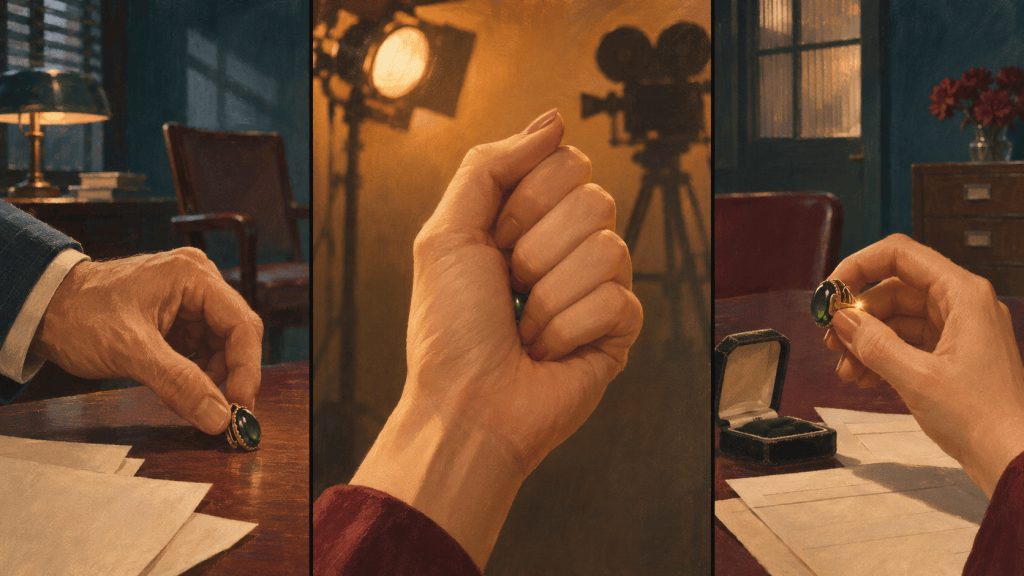
Up close the earrings were larger than they had looked from the sofa. Two drops of dark green stone, almost black where the light did not catch them.
Celia looked at one.
Then the other.
“One.”
The young woman did not understand.
Celia lifted her hand.
“May I?”
The young woman nodded.
Celia reached behind her ear and found the clasp.
It resisted.
“Sorry,” the young woman said.
“For what?”
“I don’t know.”
Celia smiled.
The young woman smiled back.
The clasp gave.
Celia stepped away with the earring in her hand.
She looked once.
“Yes.”
The costume woman came forward.
“Do you want me to—”
“No.”
Celia turned and went back to the sofa.
The young woman touched the bare ear.
“Leave it,” Celia said without turning.
She left it.
Wardrobe smoothed Celia’s sleeve.
Makeup came in and touched the corner of her mouth.
The assistant director called for quiet.
Celia settled into the sofa.
Her character had owned the hotel for eleven years and had never been inside it.
That had taken them most of yesterday to understand.
The lobby knew her.
The clerk knew her.
The flowers knew her.
Someone had put her initials on the stationery upstairs.
None of it meant she had been there.
Today was later in the picture.
By now the hotel had begun to fit.
That was the problem.
The young woman was supposed to walk through the door and disturb the fit.
Celia looked down.
The green earring was still in her hand.
Nobody had asked for it.
She closed her fingers around it.
“Picture.”
The room settled.
“Roll.”
The slate came in.
Celia looked toward the flowers.
“Action.”
The door opened.
The young woman entered.
She did exactly what she had done the first time.
Same speed.
Same turn after the door.
Same small uncertainty before she saw the people waiting for her.
But one side of her face ended differently from the other.
Celia looked up.
The young woman saw her.
For an instant the smile from beside the door was still available between them.
Then it wasn’t.
Celia’s face changed.
Not much.
The young woman crossed the lobby.
A man beside the desk stopped speaking.
The clerk looked up from the register.
The young woman noticed neither of them.
She was looking at Celia.
“Mrs. Vale?”
Celia let the name reach her.
“Yes.”
“I was told to give you this.”
The young woman held out an envelope.
Celia did not take it.
“You were told?”
“Yes.”
“By whom?”
The young woman hesitated.
That was in the script.
The hesitation after it was not.
Celia waited.
The girl’s hand remained extended between them.
One green stone moved slightly beside her cheek.
Celia could feel the other one against her palm.
“By Mr. Arlen.”
“Of course.”
She took it.
The young woman started to turn away.
“Miss—”
She stopped.
Celia had the next line.
Everyone knew it.
The young woman waited.
Celia looked at the bare side of her face.
Then the other.
She said the line.
The young woman answered.
Nobody stopped them.
The scene went another page.
Then two.
At the desk, the clerk missed a piece of business and recovered it without looking down.
The man beside him forgot to lift his glass.
Celia remained on the sofa.
The young woman reached the door.
She turned.
Celia looked at her.
The scene ended there.
Nobody moved.
“Cut.”
The room released.
The clerk reached for his glass.
The young woman exhaled and looked toward Celia.
Celia opened her hand.
The second earring was still there.
THE ORIGINAL
The man from insurance had been talking for six minutes.
Celia had said nothing.
There were two black cases on the table between them.
He had opened both when he came in.
Four green stones lay against black velvet.
“The problem isn’t value,” he said. “The scheduled value is already established.”
Celia looked at the earrings.
“The problem is identification.”
He had brought three forms. One was beneath his hand. The second was beside his briefcase. The third had a yellow sheet clipped to it.
“The first pair was made for the picture and scheduled separately. The second was made to match it. Same stones, same metal, same specifications.”
He turned the first form toward her.
“The tags were separated from the cases.”
Celia looked at him.
“We know they were separated before the picture wrapped. We don’t know when.”
He moved one case slightly to the left.
“Ordinary examination doesn’t help us. The duplicate was commissioned to match the first pair exactly.”
He pointed to a paragraph.
“We can authorize material testing.”
“It would require sampling. Possibly opening the settings. Depending on what they find, they may need material from the solder.”
He pushed the form toward her.
“Once they establish which pair was assembled first, we can restore the schedule.”
“And the earrings?”
“They’d be restored.”
“By whom?”
He gave her the name of a jeweler.
Celia looked at the earrings again.
“The same jeweler?”
“No.”
He continued.
“The work would be documented. Any restoration would be added to the file, and the appraisal would be amended to reflect the condition after examination.”
Celia looked back at him.
“So you’d have another appraisal.”
“Yes.”
“Another description.”
“Yes.”
“The invoice?”
“It remains part of the provenance.”
“But it wouldn’t describe what came back.”
“Not completely.”
He waited.
“That’s why there would be an amended appraisal.”
Celia said nothing.
He pushed the form another inch.
“We have to distinguish them somehow.”
She looked at the two open cases.
The man continued.
“If the first pair we test turns out to be the duplicate, there’s very little difficulty. We document the examination, identify the untouched pair as the original, and amend the schedule.”
“And if it isn’t?”
“Then we’ve identified the original.”
“After taking it apart.”
“To the extent required.”
“And then you repair it.”
“Restore it.”
“With somebody else’s work in it.”
“Yes.”
He put one finger on the authorization.
“But we would know.”
Celia looked at the earrings.
The man was still speaking.
“The insurer isn’t asking you to certify which pair is which. Only to authorize examination. Once we have a laboratory finding, the rest is administrative.”
She reached toward the nearer case.
He moved the authorization closer.
“If you sign there, I can have them collected this afternoon.”
Celia lifted one earring from the velvet.
The green stone turned once beneath her fingers.
“We’d photograph both pairs before anything was removed. The laboratory report would become part of the permanent file.”
Her thumb found the clasp.
It opened.
She closed it.
“The repaired item would be reinspected before return to the studio. Nothing would be done without a complete record.”
Celia put the earring back.
She reached into the other case.
“The only thing we cannot leave indefinitely is the present designation. We have two scheduled items with different histories and no defensible way to say which history belongs to which.”
Celia lifted the second earring.
“We need a distinction that survives a claim.”
Her thumb found the clasp.
It caught.
The man kept talking.
“If both remain listed without identification and one is lost, there is no way to establish which scheduled value applies. That is the exposure we’re trying to remove.”
Celia pressed the clasp again.
It resisted in exactly the same place.
Her hand stopped.
The man had reached the signature line.
“So, unfortunately, it becomes your problem because the production was the last documented point at which—”
Celia looked up.
“These are the originals.”
He stopped.
The camera pushed in.
Celia held his eyes.
Cut.
Earlier versions of these scenes appeared separately on Travel in Life. I wrote them in the spirit of and then this happened too. When I read them together later, I kept noticing what the hands were doing. That’s what made me want to put the scenes beside one another.
WE&P by: EZorrillaMc&Co.

