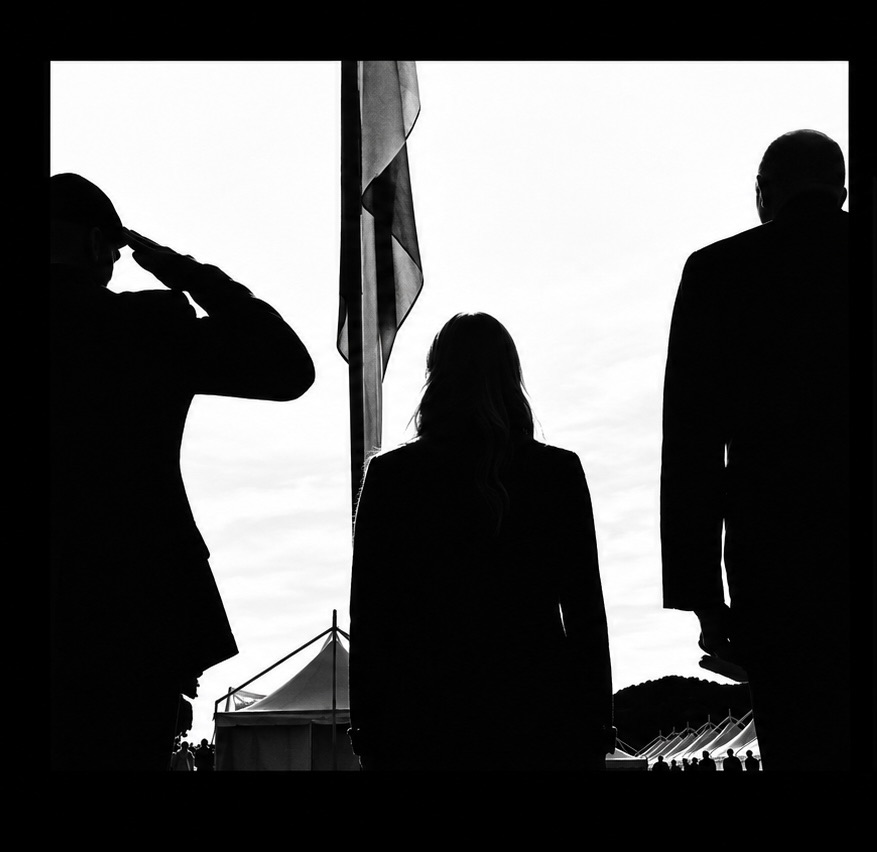
A dark figure stands at the center of the image.
Two darker figures close the sides. Beyond them is pale November light. A vertical standard rises beside the central figure. The face is invisible.
At first, I do not know who I am looking at.
What I know is the mood.
The figure on the left is saluting. The vertical standard is a flag. The central figure is still. The two bodies at the edges close the scene around that stillness.
The photograph never shows me grief on a face.
It makes grief legible without one.
The salute makes the scene ceremonial. The flag makes it national. The central figure supplies no gesture of its own. Its back is to me. Its face is unavailable. The figures at the edges become almost architectural, dark forms framing the brightness beyond her.
I am looking at someone standing in the presence of something solemn before I know what the solemnity is.
What my eye supplies is mourning.
Then gender arrives. The long hair, the cut of the jacket, the shape of the silhouette: a woman.
And then the old image arrives with her.
Mater Dolorosa.
I know the image before I know what I am looking at.
Then I look again.
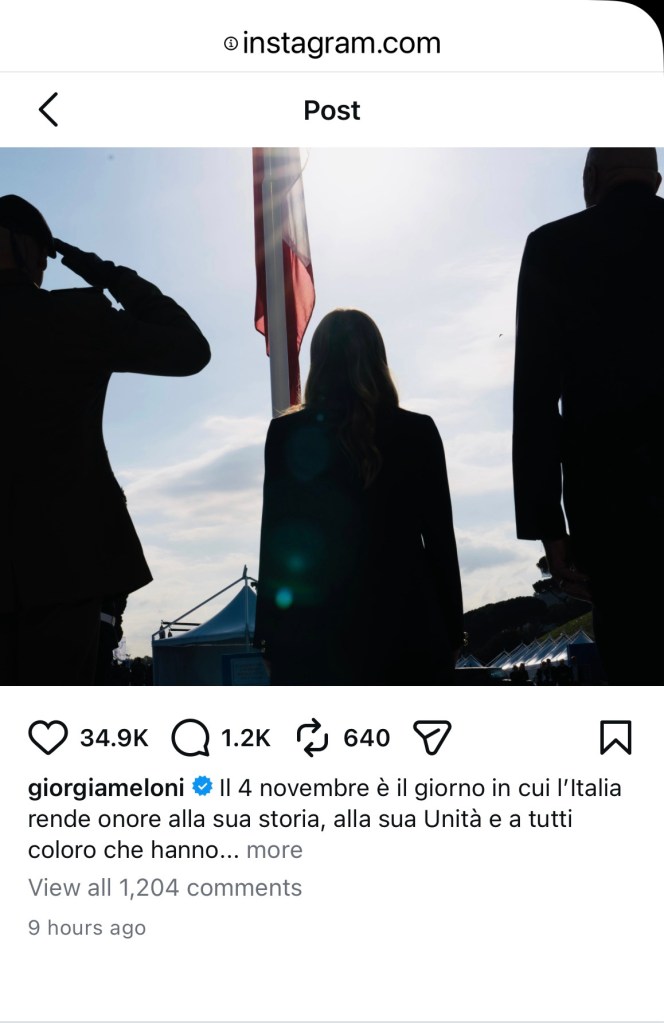
The standard was an Italian flagpole. The figure on the left was a soldier, saluting. The dark figure on the right was a man in a suit.
And the woman was Giorgia Meloni.
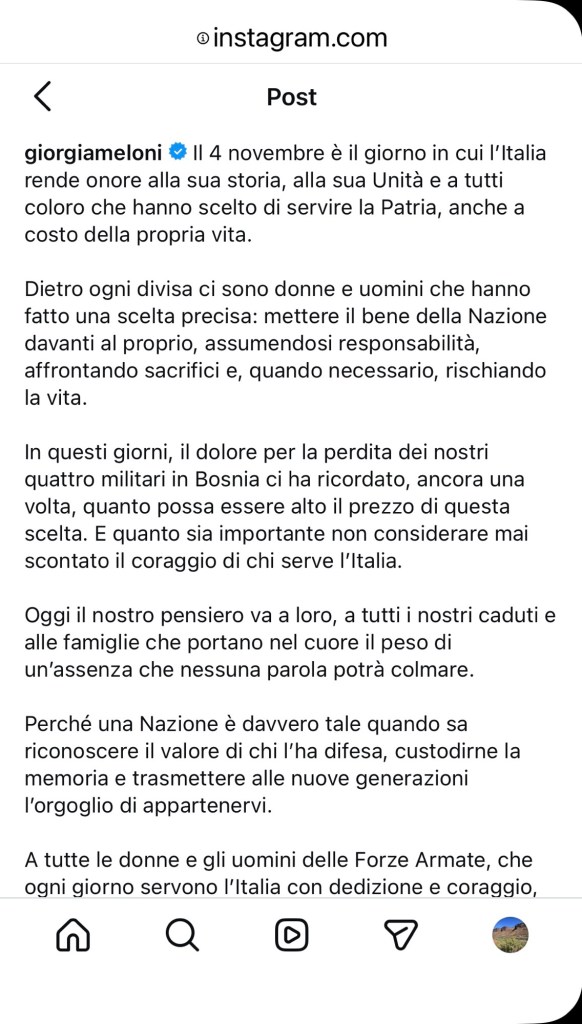
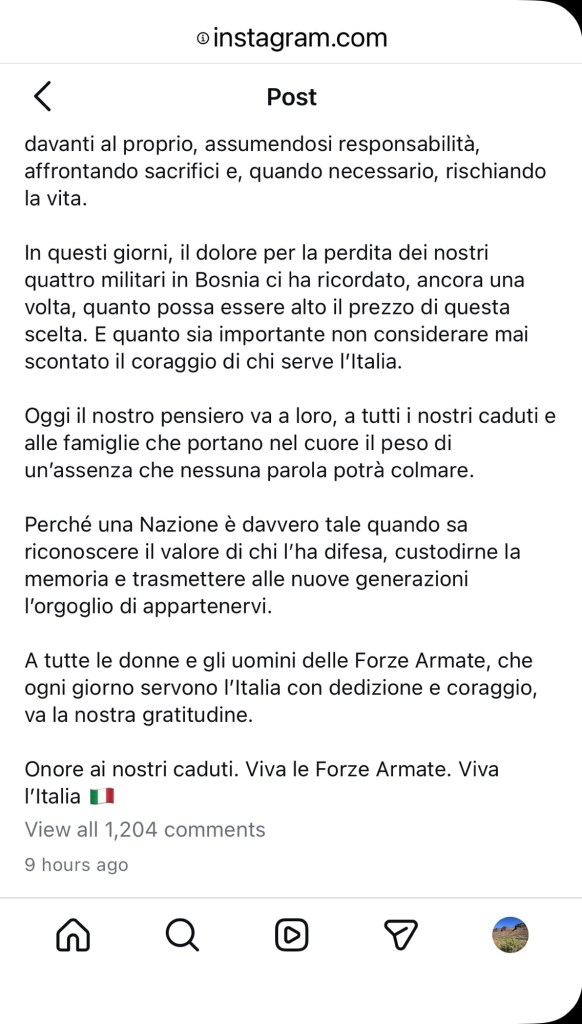
I had been scrolling through my feed and stopped before I understood the photograph as political photography at all. Only afterward did I register that it came from Italy’s November 4 commemoration, the Day of National Unity and the Armed Forces, and that the prime minister had posted it with a message about sacrifice, service, the dead and the obligations of national memory.
That order matters.
I did not begin with Giorgia Meloni and discover a resemblance to an old religious image. The form came first. Meloni arrived a beat later.
The photograph feels less like documentation than a film still.
Political photography usually wants a face. The politician looks solemn, resolute, compassionate or triumphant. Recognition is part of the transaction.
Here, recognition is delayed.
The emotional information has migrated out of the face and into the arrangement.
A salute. A flag. A still figure. Darkness at the edges. Light beyond. The dead somewhere outside the frame.
None of those things, by itself, means grief.
Together they make grief available.
Aby Warburg had a word for this, Pathosformel, the forms of feeling that outlive the settings that made them.
That seems close to what happened to me.
The image does not need to depict a crying face or a collapsing body. The emotion is carried by the relation among things: posture, stillness, surrounding bodies, flag, light, absence.
This is Pathosformel at low volume.
The traditional formulas of grief can be dramatic—raised arms, twisted bodies, flowing cloth, faces opened by anguish. Here the opposite happens. The body barely moves.
The sorrow is held rather than performed.
And still the old form arrives.
The Mater Dolorosa is present because a grieving woman who stands, restrained, in the presence of death belongs to a very old visual grammar.
The photograph gives just enough for that grammar to complete itself in the eye.
That is what happened to me.
And then came the second surprise.
The person occupying this inherited form turned out to be Giorgia Meloni, whose public imagery I had already noticed for its cinematographic quality.
Her photographs often do more than record that the prime minister attended an event. They create scenes. Bodies, distance, foreground and background carry part of the meaning. The image seems to belong to a sequence larger than the single frame.
At Amatrice, on the tenth anniversary of the earthquake, the camera did almost the opposite of what it does here.
It moved close.
Meloni entered the crowd. She touched people and allowed herself to be touched. In one sequence, an elderly man came close enough to touch her face. The emotional force came through proximity. The camera seemed almost inside the encounter.
This photograph works through distance.
The camera remains behind her, and we remain behind her with it.
Yet the result is just as cinematic.
Cinema can give meaning to a figure by withholding the face. Seen from behind, a person becomes less an expression to inspect and more a position within a scene. We look where they look. We are placed in relation to whatever stands before them.
The dark figures at the edges intensify that effect. They create a frame within the frame. The center opens into light, almost like a proscenium, with Meloni standing inside it.
A conventional political photograph says: Giorgia Meloni was here.
This one first says: someone stands here.
Only afterward does the name arrive.
And once it does, the fit becomes difficult to ignore.
Meloni’s accompanying words are about service, sacrifice, death, bereaved families and the transmission of memory. She writes that a nation becomes truly a nation when it recognizes those who defended it, preserves their memory and passes to the next generation the pride of belonging to it.
The nation in that sentence is constituted partly through remembrance.
The photograph performs the same idea without explaining it.
A living figure stands before a national symbol in the presence of absent dead.
The soldier on the left carries the active gesture. He salutes. The flag occupies the brighter vertical space. The figures at the edges provide the architecture.
Meloni is smaller, almost absorbed into the scene.
For a politician, that is unusual.
Political imagery generally enlarges the person. Here, diminishing the politician gives her another kind of authority. She is subject to the ceremony rather than its source.
The flag is above her.
The dead precede her.
The ceremony is larger than she is.
She is the one who remains.
The custodian of the warrior’s death.
That role complements something in Meloni’s public imagery that her more combative photographs cannot supply. Her political language often emphasizes nation, inheritance, sacrifice and belonging. In this frame, those ideas acquire another body.
Force gets a mourner.
Nationalism gets a memory keeper.
The politician who so often faces the camera disappears into silhouette.
I do not need to know whether anyone making the photograph thought of the Mater Dolorosa. The interesting event happened on my side of the image.
A silhouette became a scene.
The scene became grief.
The grief found an old form.
Then I discovered Giorgia Meloni standing inside it.
I stopped scrolling before I knew why.
The recognition came before the explanation.
WE&P by: EZorrillaMc&Co.


You must be logged in to post a comment.