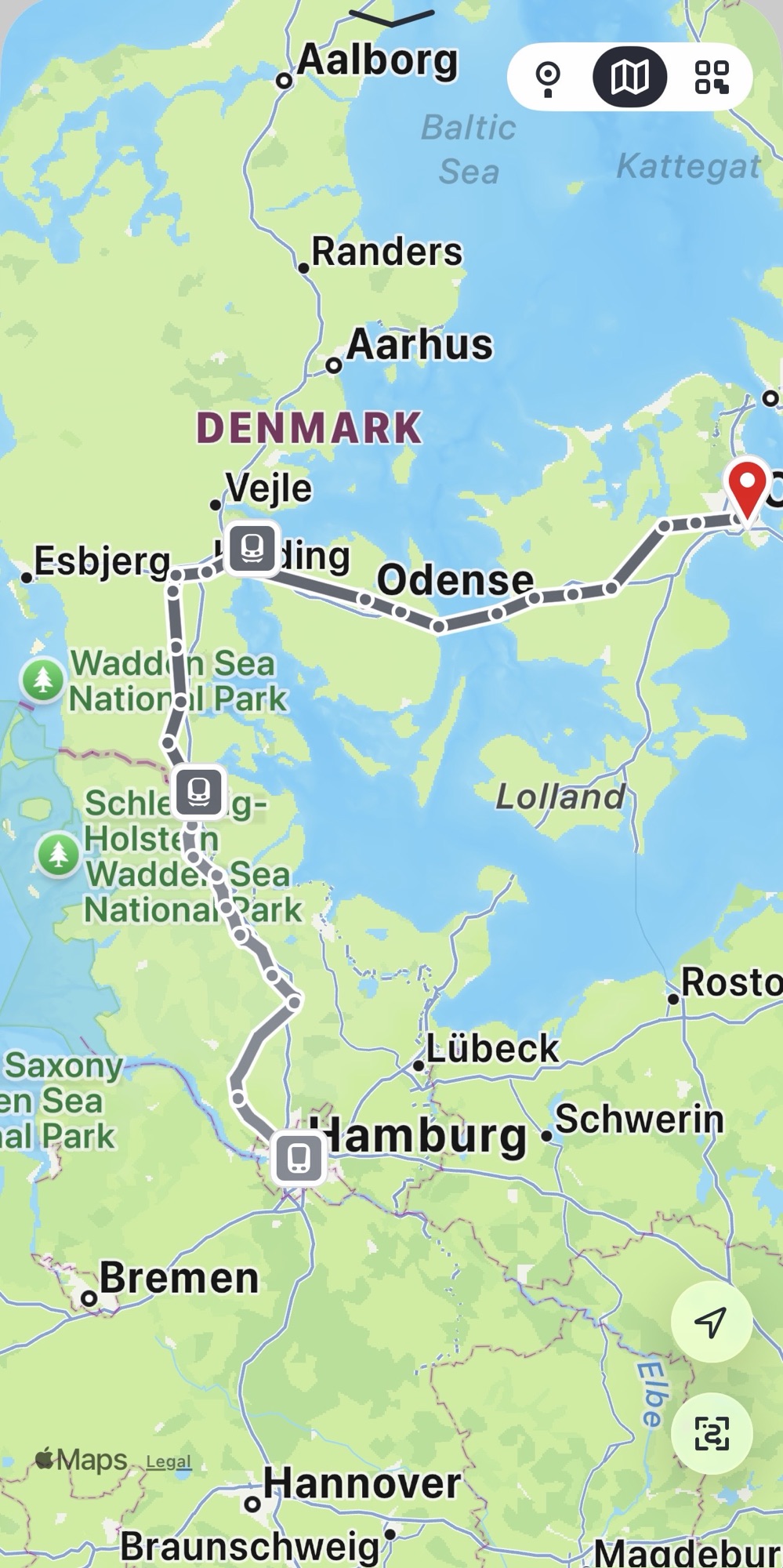
On the German side of the route depicted in the map, the railway crosses the Kiel Canal via the Rendsburg High Bridge. This specific segment features a highly unique historical and engineering marvel known as the Rendsburg Loop.
- The Problem: When the Kiel Canal was widened in the early 20th century, the original swing bridges caused significant delays for both naval and merchant shipping, requiring a new high-level bridge with a 42-meter clearance. However, the existing Rendsburg railway station was located less than a kilometer from the canal, making a direct descent impossible.
- The 360-Degree Solution: To overcome the 30-meter elevation drop on flat terrain, engineers constructed an elevated 4.5-kilometer elliptical spiral. Trains traveling this route must complete a full 360-degree loop over the district below to gradually gain or lose enough altitude to connect the high bridge with the station.
- Historical Engineering: Completed between 1911 and 1913, this massive steel cantilever viaduct was designed by engineer Friedrich Voss. It held the record as the longest railway bridge in Germany for 99 years.
- Suspended Ferry: The structure also functions as a transporter bridge. It features a gondola suspended by cables directly underneath the railway tracks, ferrying cars and passengers across the channel.
WE&P by: EZorrillaMc&Co.
Sources.
- Source 1: Rendsburg High Bridge – Wikipedia (English)
- URL: https://en.wikipedia.org/wiki/Rendsburg_High_Bridge
- Verified Data: Verifies the 1911-1913 construction timeline. Verifies the designer as Friedrich Voss. Verifies the 42-meter height clearance requirement over the Kiel Canal. Verifies the integration of the suspended ferry (Schwebefähre).
- Source 2: Rendsburger Hochbrücke – Wikipedia (German)
- URL: https://de.wikipedia.org/wiki/Rendsburger_Hochbr%C3%BCcke
- Verified Data: Verifies the elliptical spiral loop construction, known as the Rendsburger Schleife. Verifies the structure held the record as Germany’s longest railway bridge for 99 years.
- Source 3: Rendsburg High Bridge – myCityHunt
- URL: https://www.mycityhunt.com/cities/rendsburg-de-6210/poi/rendsburg-high-bridge-24386
- Verified Data: Verifies the Rendsburg Loop is an elliptical ramp built on flat terrain to allow trains to gain the necessary altitude.


You must be logged in to post a comment.