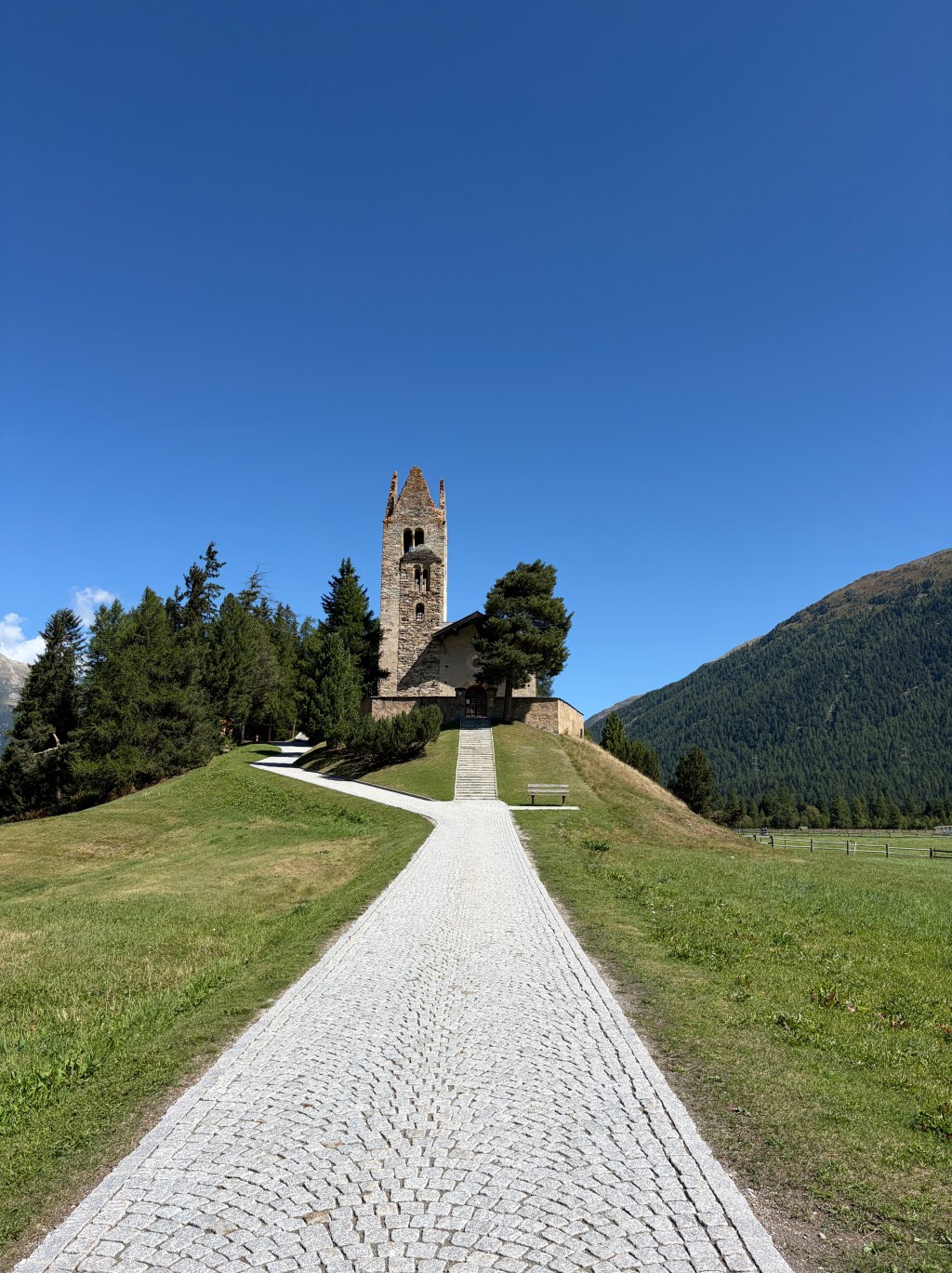
The church is almost too easy to photograph. The path does the arranging before I touch the camera: pale stone running through the grass, climbing toward the hill, the tower waiting at the end of it, and an unreasonable amount of blue sky above everything.
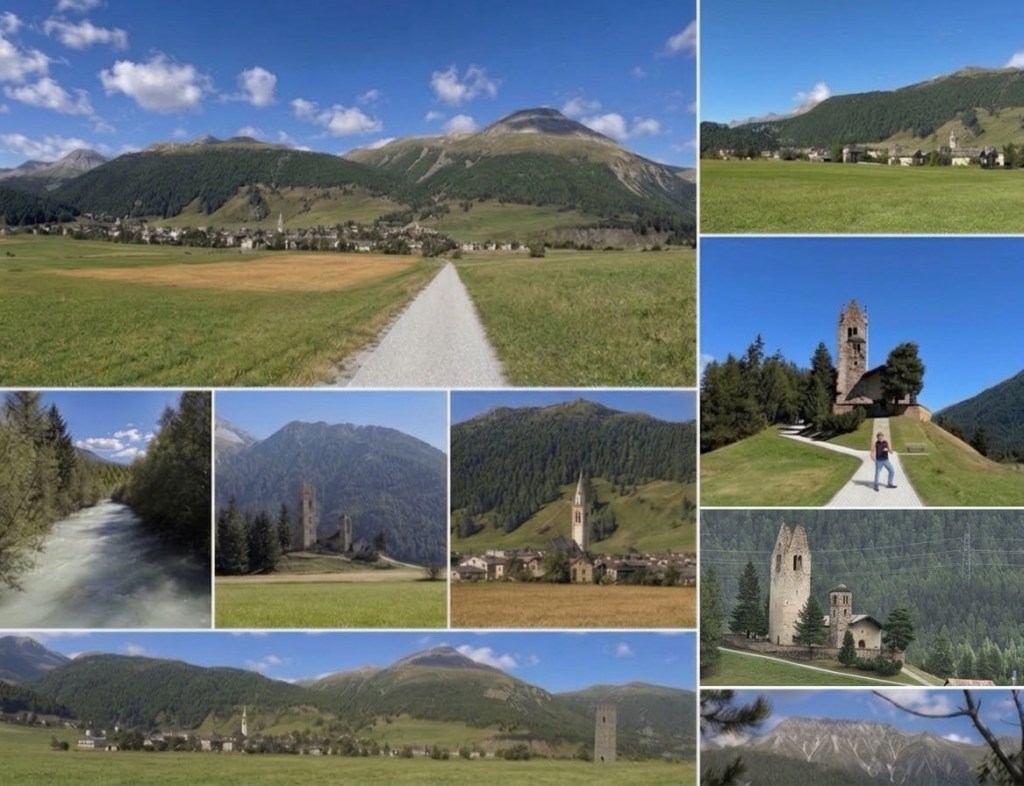
This is San Gian, the landmark of Celerina. The church dates from the 15th century and stands on a small rise in the plain between Celerina, Samedan and Punt Muragl. Inside are frescoes and a hand-painted wooden ceiling. Photography inside is restricted to help protect them.
What struck me first from outside was simpler. The building has been given room. Nothing crowds it. You approach across the valley and watch it become larger.
Then the church gives the landscape back.
Celerina sits low against the mountains, a compact village surrounded by fields, forest, water and rail lines. Its older center carries the Engadin vocabulary of heavy walls, decorated façades, wood and stone, but a few minutes on foot takes you back into open ground.
The railway arrived here in 1903, when the Albula line initially ended at Celerina. St. Moritz was connected a year later. More than a century later, the train still feels like part of the landscape rather than something imposed upon it.
And the valley is the larger room.
Roads, walking paths and rail lines cross it. The river keeps moving through it. Villages sit beneath mountains large enough to make everything human look temporary.
I can walk toward the church, turn toward the river, continue toward another town, or simply stop at the fork.
That may be what I like most about being here.
The valley keeps offering a direction without needing the distance.
WE&P by: EZorrillaMc&Co.
Sources
Engadin Tourism — Visit the Church of San Gian. The official description identifies San Gian as Celerina’s landmark, dates it to the 15th century, and notes its frescoes, hand-painted wooden ceiling and location between Celerina, Samedan and Punt Muragl.
Visit the Church of San Gian — Engadin Tourism
Engadin Tourism — The History of Celerina. Includes the history of the Albula railway, which reached Celerina in 1903 and St. Moritz in 1904, along with background on the village and its architecture.
The History of Celerina — Engadin Tourism


You must be logged in to post a comment.