The Lean
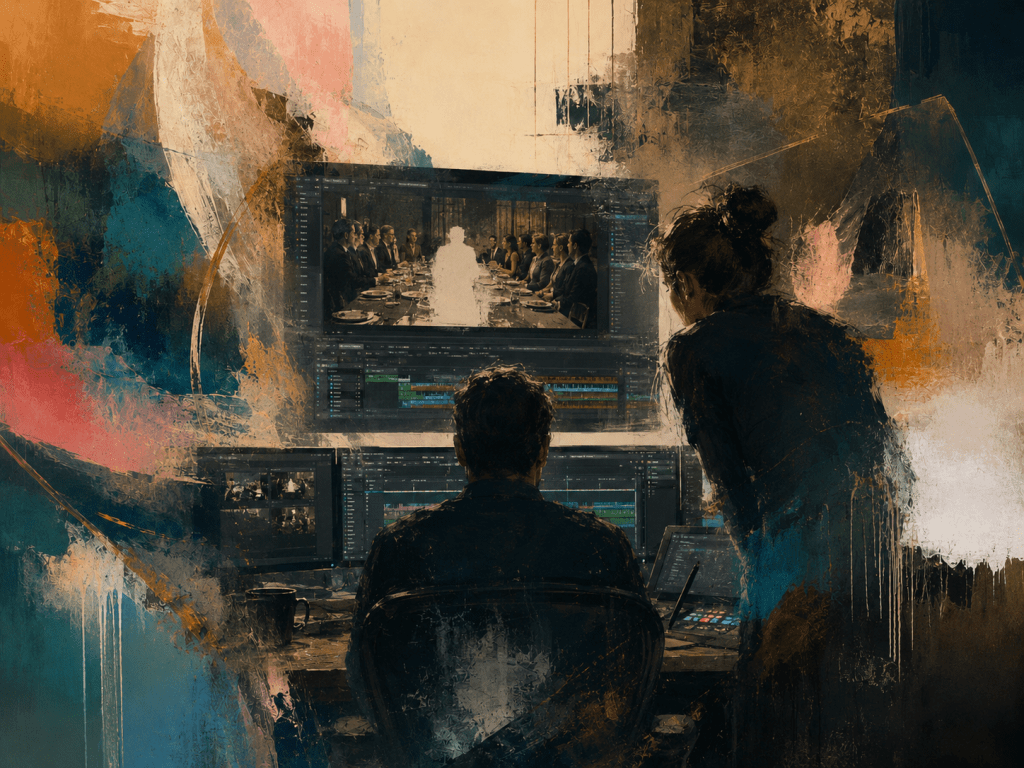
The review room was behind editorial and had no windows.
Two monitors on the desk. One large screen on the wall. A tablet beside the keyboard and a coffee cup with a skin on it.
Celia stood behind the compositor.
Twelve people at a long table. A wrap dinner in the picture. Somebody had said something and the whole table had turned toward the middle of it.
The compositor stopped on a frame.
“Which one,” Celia said.
He put the cursor over the woman fourth from the left.
Dark dress. One hand around the stem of a glass.
“Her lawyer called publicity.”
“I know.”
“They want her out before the international delivery.”
“Does she know it’s this scene?”
“They didn’t say which scene.”
“So she doesn’t.”
He dragged the playhead back.
The woman laughed. The man beside her turned. Celia, on the other side, leaned toward her and put an elbow on the table.
The shot ran eleven seconds.
“Clean plate?” Celia said.
“Enough of one.”
He opened another layer.
The woman disappeared.
Behind her was the wall, a chair back and a section of tablecloth reconstructed from other frames.
He played it.
Celia watched.
“Good.”
“Edges need work.”
“I won’t see them.”
“You will.”
He enlarged the frame until the woman’s hair became pixels against the man behind her.
He worked for a while.
The edge of the hair went. A shadow under the chair went. The glass disappeared and a fold in the tablecloth continued through the place where her hand had been.
He played the shot again.
No woman.
Celia leaned closer.
“Again.”
He played it.
The man on the left turned toward the empty chair.
On the other side, Celia did the same thing.
“They’re leaning,” she said.
“Yes.”
“At nothing.”
“Yes.”
He went back three seconds.
The man began turning before the woman would have spoken.
Celia watched her own head follow him.
“I can move his head,” the compositor said.
“Show me.”
He made a mask around the man’s face, tracked it through the shot and opened another tool.
The head moved a little less.
He rendered a preview.
They watched.
“He’s straighter,” Celia said.
“Yes.”
“His eyes.”
“I know.”
The eyes still went to the chair.
He changed them.
Another render.
The man looked forward now.
Celia did not.
“My turn,” she said.
He brought up her face.
Her chin came around. Her near shoulder dropped. Her weight had already gone onto the far hip before the turn began.
“You want the head first?”
“The shoulder.”
He warped the shoulder upward.
Played it.
Celia watched herself.
“No.”
He undid it.
“Too much?”
“That isn’t what I did.”
“That’s the point.”
“I know.”
He waited.
“Try the head.”
He shortened the turn.
Played it.
Her eyes still moved.
He fixed the eyes.
Played it.
Now her elbow went toward the empty place for no reason.
He stopped.
“The arm.”
“Yes.”
He pulled the elbow back toward her body.
Played it.
Celia watched.
The woman was gone.
The man beside the gap faced forward.
Celia faced forward.
The wall behind them was clean.
“Again.”
He played it.
This time Celia smiled.
“Stop.”
He stopped.
“Back.”
He went back six frames.
“Forward one.”
He did.
“Again.”
One frame.
Her mouth had begun to change.
“Why am I smiling?”
“She said something.”
“What?”
“I don’t know.”
He opened the production audio.
There was the room, silverware, somebody laughing off camera.
Then the missing woman’s voice.
Celia smiled.
The compositor stopped it.
Neither of them said anything.
“Can you take the smile out?”
“Yes.”
“How?”
“I can borrow your mouth from before she talks. Track it through. Maybe regenerate the transition.”
“And after?”
“You look at him.”
“Because?”
“He laughs.”
“At her?”
“Yes.”
Celia looked at the screen.
“And after that?”
“You reach for the bottle.”
“Why?”
“She asks for it.”
He clicked farther down the timeline.
The woman’s hand entered the edge of the frame.
He stopped.
“I can rebuild that too.”
Celia said nothing.
He zoomed the timeline out.
Eleven seconds became a short strip between two cuts.
“I can keep going,” he said.
“How far.”
“For this shot?”
“Yes.”
“Everything’s fixable.”
“That wasn’t the question.”
He looked at the screen.
“The turn. The eyes. Your elbow. The smile. His laugh. The bottle. Her shadow. We can change all of it.”
“And then?”
“Then it works.”
Celia looked at the twelve people at the table.
Eleven now.
“What are they doing?”
He looked at her.
“In the new version.”
He did not answer.
She pointed at herself.
“Why does she lean forward?”
“She won’t.”
“The smile?”
“Gone.”
“The bottle?”
“Gone.”
“The man?”
“He looks ahead.”
“And what happens in the eleven seconds?”
He looked at the timeline.
“Not much.”
Celia put her hand on the back of his chair.
The room was quiet except for the fans in the workstation.
“Play the original.”
He restored the layers.
The woman came back.
The shot ran.
The woman said something.
The man turned.
Celia leaned in.
Someone laughed.
Celia smiled.
The woman reached for the bottle.
Celia gave it to her.
Cut.
“Again.”
He played it again.
Celia watched herself do all of it.
She did not remember any of it.
He stopped on the last frame.
“I can take her out,” he said.
“I know.”
“I can take everything around her out too.”
Celia looked at the frozen table.
“How long.”
“A day for this shot. More if they want the whole sequence.”
“And when you’re finished.”
He waited.
“It’ll be clean.”
“That’s not what I asked.”
He looked at her.
Celia looked at the woman.
Then at herself leaning toward her.
The compositor took his hand off the mouse.
“After a while,” he said, “we’re making a different scene.”
Celia stayed where she was.
“Send them this one.”
“The original?”
“No.”
He waited.
“The first pass.”
“The one with the gap?”
“Yes.”
He brought it back.
The woman disappeared.
The wall returned.
The man leaned toward it.
Celia leaned from the other side.
He played the shot once.
“They’ll see it,” he said.
“They’ll see a wall.”
He looked at her.
On the screen, both of them were still leaning.
WE&P by: EZorrillaMc&Co.
Source note: The originating photograph anecdote was found in Michael Shnayerson, Bugsy Siegel: The Dark Side of the American Dream.

