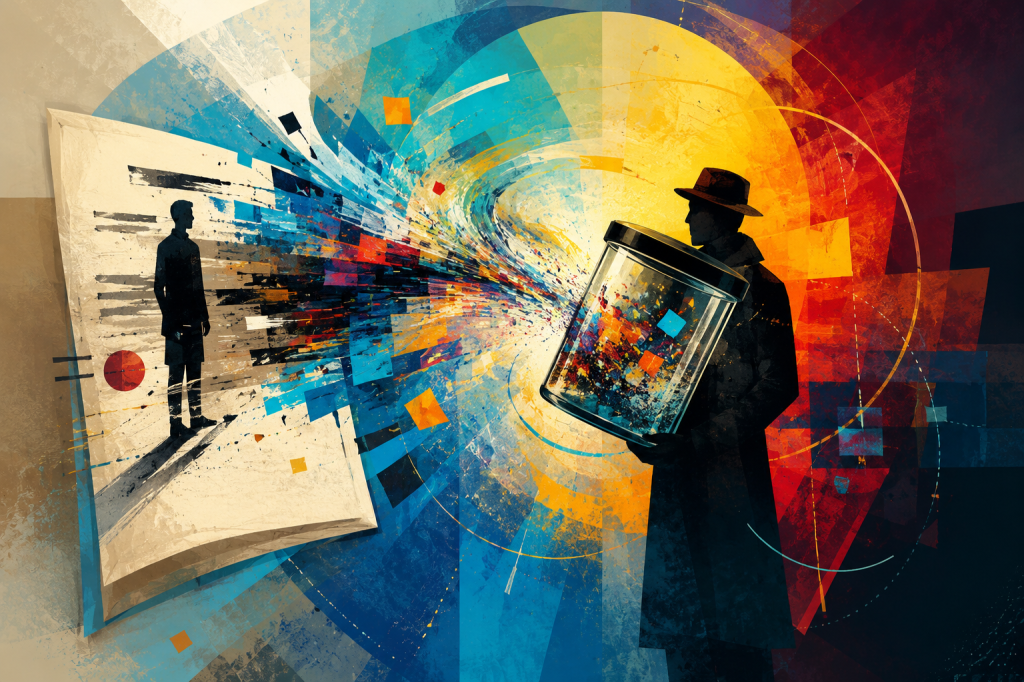
The copier inherits provenance risk without inheriting provenance knowledge.
That sentence took a long conversation to arrive at, and it describes something small and specific: what happens when a piece of writing that openly declares its production method gets taken by someone who conceals theirs.
Start with the page as it sits. An essay appears on a blog. Beside it, a line states that the work was composed with AI assistance. The disclosure is addressed to the reader. It gives the reader more information, not less agency. Some readers will discount the work for it, which means the candor can cost something, and candor that can cost something carries weight. The label tells the reader how the work was made, and the reader is free to weigh that however they like. The transaction is complete and everyone in it is better informed than they were.
Now a second figure arrives. This one likes a passage enough to carry it off. In an earlier era the calculation was simple. Text was text. A lifted paragraph carried its words and its words only, and the taker could dress them in a new byline with nothing inside them to object.
The labeled page changes the contents of the theft. The passage is now a mixture. Some of its sentences began with a person and some began with a machine, and the boundary between them is recorded nowhere on the page. The writer knows where the seams run. The writer watched each sentence arrive and decided which ones stayed. That knowledge stays home when the passage leaves.
So the taker walks off with a sealed container. Inside it is a production history they were told exists and cannot inspect.
The container matters because of where it travels. Screenplay competitions ask entrants to certify their pages. Publishers and fellowships write AI clauses into their contracts and submission forms. The taker must now sign something. Certifying the work as wholly their own means gambling that the mixture stays quiet. Some systems now embed statistical marks in generated text that can survive ordinary copying and pasting, though heavy rewriting can weaken or erase them. Declaring the assistance instead means explaining how a production method they never used got into work they claim to have written. Every truthful door out of the room leads back toward the source.
The escape route runs through revision. Rewrite the passage deeply enough and the mark may dissolve, while the distinctive language dissolves with it. What made the passage worth taking was its particular arrangement of words. Destroying the evidence means destroying the goods. The taker can have the passage or the safety, and the two subtract from each other all the way down.
Meanwhile the original page keeps its own records. The work appeared there first, on a date, under a name, with its method stated. Publication history says the language existed here before it existed anywhere else. Where machine provenance is detectable, it may also be consistent with the method the page disclosed. The chronology carries the weight and the mark corroborates it. Together they leave the taker explaining a textual match and a chronology while a disregarded label sits in the record, and the explanations must all succeed at once.
The counterintuitive part is where the protection comes from. Nothing was added to the work to defend it. The disclosure was made for the reader, as a matter of candor about method. The deterrent is a byproduct. Honesty toward the audience turns out to function as a burden on the thief, because the thief must carry the honesty forward or be caught suppressing it. A conventional page invites the comfortable fiction that a borrowed passage was merely an influence. The labeled page removes the fiction in advance. Whoever takes from it takes knowingly, and the knowing is documented before the hand moves.
Banks learned a version of this. A dye pack sits inert in the drawer for years. It rides along only when the money leaves the wrong way, and then the bills announce themselves in every transaction that follows. The label on the page works the same way. For the reader it is a statement of method. In the taker’s bag, it stains.
WE&P by: EZorrillaMc&Co.
EU Artificial Intelligence Act — Recital 133
Explains the provenance rationale behind machine-readable marking and identifies watermarks, metadata, cryptographic provenance, logging, and fingerprints as possible techniques. The recital specifically frames these mechanisms as ways of tracing the origin of information.
Anthropic — Claude text-watermarking documentation, August 2026.
Documents Anthropic’s statistical text-marking system for newer Claude models: the mark is carried through patterns in generated language rather than hidden characters or ordinary file metadata, can survive ordinary copying, and can be weakened by substantial rewriting.

