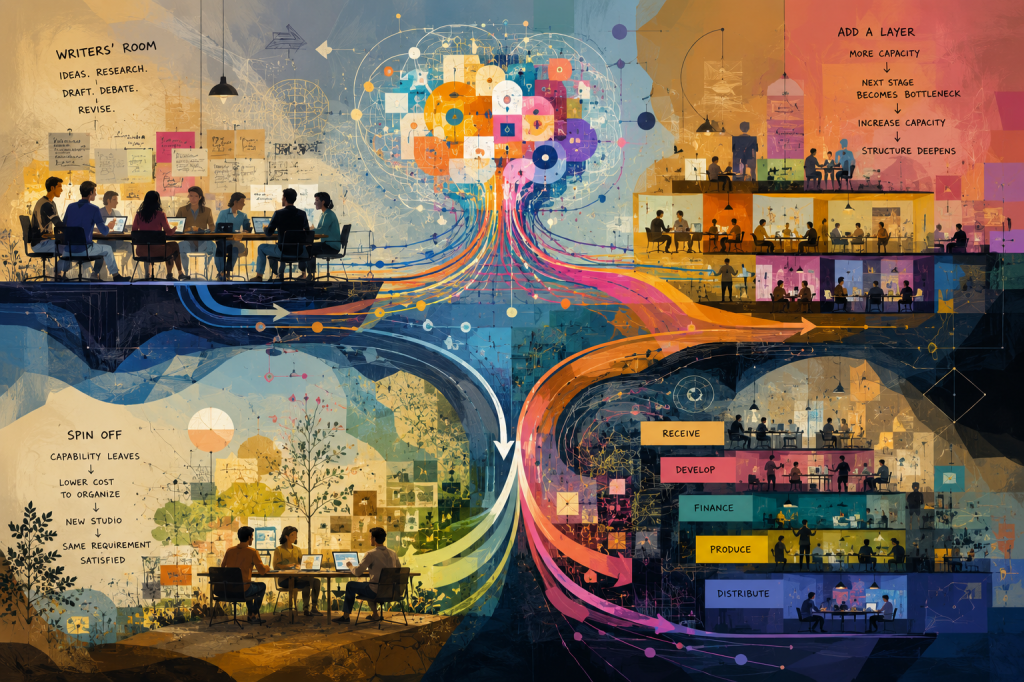
Take a writers’ studio.
Five writers work together. They pitch, research, draft, argue, reject and revise. A head writer receives their work, keeps the larger project coherent and sends work back into the room.
Now give the five writers AI as a shared intellectual hub.
The AI can receive input from all five, retain the history of the project, retrieve earlier material, connect one writer’s observation with another writer’s research, generate alternatives and return different material to each writer for review.
The writers can produce more.
They can also test more, discard more and develop more.
Eventually they may become capable of producing more good work than the person receiving it can absorb.
There are at least two ways the organization can respond.
Add a Layer
The studio can grow.
Instead of reducing the writers because yesterday’s quantity of work can now be produced with fewer people, it can use the increased capacity to develop more work.
The writers’ room produces more developed material.
The next stage in the production stream becomes the bottleneck.
So increase its capacity too.
The person who once received one stream of developed work can now receive several. Another person may be needed to coordinate what that person produces. More projects may require more people to develop, finance, produce, edit, market or distribute them.
The increased capacity of one layer creates a requirement in the next.
The structure deepens.
AI has not created the new job by performing it badly or by leaving something undone.
It has created enough additional productive capacity below it to make another human layer useful above it.
Spin Off
The studio can also choose subtraction.
Five writers become two writers and AI.
Three writers leave.
The original studio remains.
But the writers who leave take something with them: their craft, experience, judgment, relationships and knowledge of how the business works.
And the technology that disrupted the old arrangement goes with them.
They no longer need all of the institutional infrastructure that once made a studio expensive to create. They may not need an office. Their meeting room can be virtual. Research, archives, continuity and much of the organizational work can be supported by the same kind of AI intellectual hub they used inside the larger studio.
One writer may be able to form a small studio.
Several may build one together.
The old studio still has advantages they do not: capital, customers, distribution, reputation and access to buyers. AI does not make those disappear.
It lowers the cost of becoming an organized producer.
And the new studio may now satisfy the requirement created by the increased flow of developed work: another place capable of receiving it, developing it and moving it forward.
The writer does not necessarily have to find another chair.
The writer can build another table.
WE&P by: EZorrillaMc&Co.

