The numbers come first.
USDA’s July forecast puts the 2026/27 U.S. rice crop at 153.3 million hundredweight.
A month earlier, the estimate was 175.2 million.
In 2025, the United States produced 206.7 million.
That puts the coming crop about 26 percent below last year’s.
The acreage underneath that number has fallen just as sharply. American farmers planted 2.017 million acres of rice, 28 percent less than the previous season and the lowest acreage since the 1970s.
In Arkansas, the largest rice-producing state, farmers planted about 851,000 acres, the lowest total in 50 years. Long-grain acreage fell 38 percent, to its lowest level since 1977. Mississippi planted its smallest long-grain acreage since 1961. Texas planted the least rice since records there began in 1929.
There isn’t one explanation.
Drought affected parts of Arkansas, Mississippi and Missouri. Input costs remain high, particularly fertilizer. Long-grain prices have remained low, and the demand outlook has been weak. Farmers responded in the ordinary way farmers respond when a crop stops making enough sense.
They planted something else.
Then the July forecast moved the consequences through the rest of the balance sheet.
USDA cut projected ending stocks by 28 percent in a single month, to 30.9 million hundredweight.
It simultaneously increased projected imports by 4 million hundredweight, to 49.8 million.
All of that increase is long-grain rice.
Imports can replace rice in the national balance sheet. They cannot necessarily replace it in every factory. Much of the rice the United States imports is aromatic long-grain rice—jasmine and basmati from Thailand and India—varieties not currently grown domestically. A processor making a particular American rice product may need something more specific than simply “rice.”
And now something else is happening.
There is less rice moving through parts of the machinery built to handle it.
At the end of June, Riceland Foods, the large farmer-owned cooperative based in Stuttgart, Arkansas, announced that it would temporarily close nine of its 23 rice drying facilities. It cited historically low acreage and prices. Producers Rice Mill was considering idling two more.
That brings the numbers closer to something I can see.
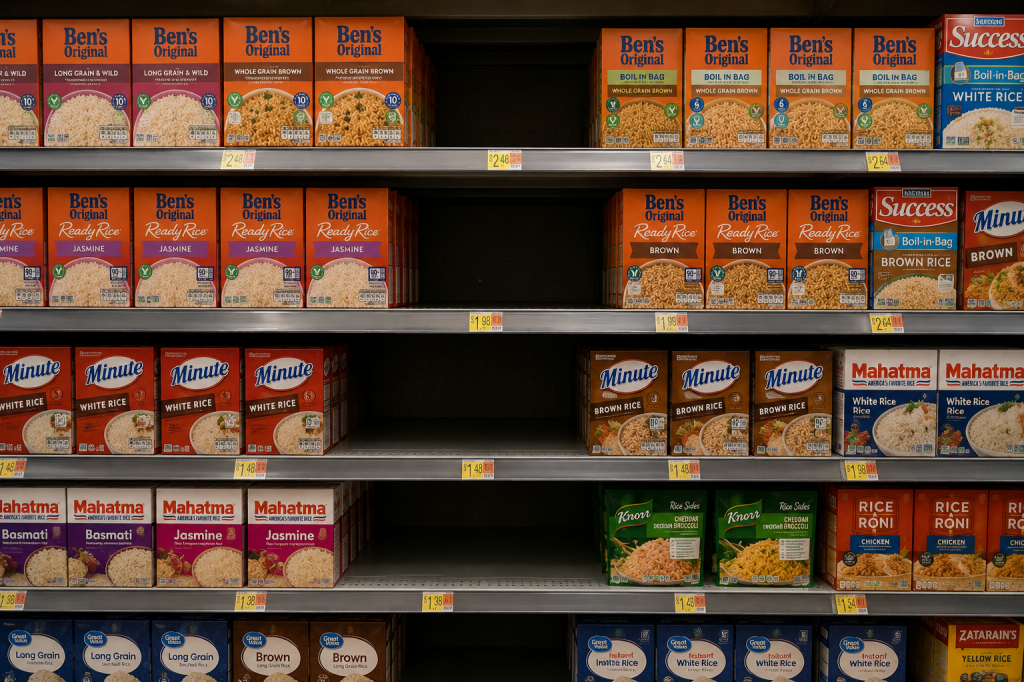
For at least two weeks, there have been holes on the shelves of my grocery store.
I first noticed the rice crackers.
Quaker.
The space where they normally sit wasn’t empty once. It stayed empty.
Then I noticed the microwave rice.
Ben’s Original.
More holes.
There is plenty of food in the store. There is rice in the rice aisle. This does not look like the photographs we associate with shortages: long empty shelves, customers searching from store to store, signs limiting purchases.
It is much less dramatic than that.
A few things aren’t there.
Then they aren’t there again.
That interested me because the agricultural numbers describe something similarly undramatic.
The United States isn’t running out of rice.
It is producing considerably less of it.
A grocery store does not receive the number 153.3 million hundredweight. It receives a particular box or pouch after rice has been grown, harvested, dried, milled, processed, packaged, shipped to a warehouse, allocated to a store and placed on a shelf.
Every stage has some ability to absorb variation.
Until it has less.
A missed truck can produce an empty space for a day. A warehouse can run short of one item. A manufacturer can have trouble with a packaging line. A store can simply order badly.
I don’t know why those particular Quaker and Ben’s Original products are missing. The holes themselves don’t establish a cause.
But the background has changed.
Rice acreage fell 28 percent.
Production is forecast roughly 26 percent below last year.
Projected ending stocks fell to 30.9 million hundredweight.
Imports are being increased.
Some drying facilities are being temporarily closed because there isn’t enough rice coming through them.
There is less slack in the system.
And perhaps this is what less slack looks like from the consumer end.
Not a shortage.
Not yet, anyway.
Just a space where something normally sits.
Then another.
And two weeks later, the holes are still there.
WE&P by: EZorrillaMc&Co.

