Wherever It Lies
Yesterday Giorgia Meloni gave herself a standard.
“Accertare eventuali responsabilità, ovunque esse siano.”
Establish any responsibility, wherever it lies.
The sentence came in response to Giuseppe Conte, who had spent about five hours before Italy’s parliamentary COVID commission. Conte called the commission a plotone d’esecuzione—a firing squad—and afterward called Meloni its director.
Meloni answered by widening the frame. The commission, she said, was not a trial of one person. She had no interest in throwing mud. Italians had a right to know what happened during the pandemic, and responsibility should be established wherever it might be found.
That last word is useful.
Ovunque.
Wherever.
Because Conte brought something with him.
At the beginning of his testimony, he deposited a ten-page record dated April 14, 2022. He said it had arrived anonymously, with names redacted, and that he had already delivered it to prosecutors in Rome. It concerns pandemic-era mask supplies associated with JC Electronics Italia.
The document is contested. That needs to remain attached to it.
JC Electronics says the material was already introduced in litigation by the state, along with material from the emergency commissioner’s office, and survived judicial examination. The company says conformity was attested by INAIL and the customs agency. It has challenged Conte to repeat his allegations outside the protection afforded by his political role.
So we do not yet have a revelation.
We have another card on the table.
And this one is awkwardly placed.
The litigation surrounding JC Electronics did not end with Conte’s government. On October 31, 2025, under Meloni, the state signed a settlement agreement with the company for €100,221,429.85.
There was substantial legal exposure behind that decision. A Rome tribunal had already ordered Palazzo Chigi and the Health Ministry to pay more than €203 million, plus interest and costs. The judgment was immediately enforceable. The state appealed.
Health Minister Orazio Schillaci told the Senate on July 2 that the settlement agreement had been drafted by the Avvocatura dello Stato and carried its favorable opinion. Waiting for the appeal, he said, carried the risk that the counterparty could collect the entire amount awarded by the lower court.
Fratelli d’Italia has supplied a broader political account. Party figures have pointed to developments in the parallel criminal proceeding and portrayed the settlement as the Meloni government negotiating its way out of a much larger liability inherited from the emergency procurement system.
Those accounts can coexist. A government can inherit a bad contract and later make a reasonable decision about litigation arising from it.
That is precisely why this is interesting.
The commission began with a strong direction of travel.
Backward.
Toward Conte.
Toward the emergency government.
Toward Domenico Arcuri and the extraordinary procurement machinery constructed during the first frightening months of COVID.
Now one strand of the record has crossed the change of government.
It reaches October 2025.
That does not implicate Meloni in whatever may or may not have happened when the masks were purchased. It asks a different question: what did her government know when it decided to settle, what evidence was available, what alternatives remained, and why did the state’s lawyers recommend the course they did?
Those are exactly the kinds of questions the commission has been asking about the people who governed before her.
And suddenly Meloni’s photograph looks a little different.
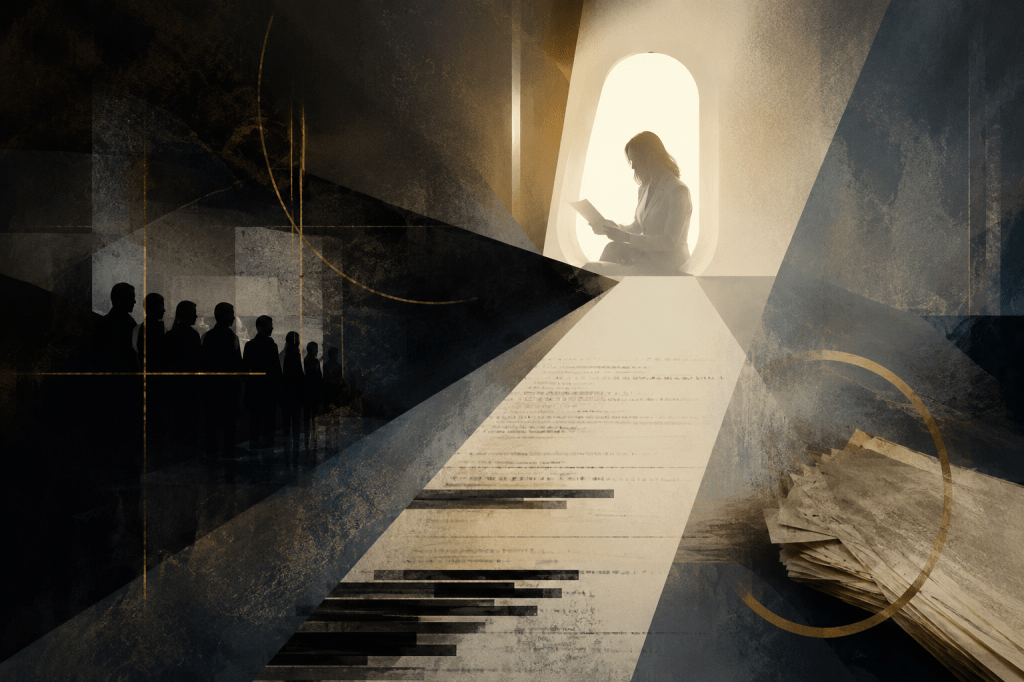
She is sitting on an airplane, dressed in white, looking down at papers.
The papers suggested evidence.
Her lowered eyes suggested reading rather than confrontation.
The airplane put her above the political fight below.
Conte supplied the opposite image: a firing squad.
Meloni rejected it.
She offered the reader instead.
Now the record has handed the reader a page she did not write.
That is the test.
Not whether Conte is vindicated.
Not whether JC Electronics is guilty of anything.
Not whether the Meloni government was wrong to settle a case in which the Italian state had already suffered a very large enforceable judgment.
Those questions require evidence that has not finished arriving.
The smaller question can already be asked.
What happens when an investigation encounters evidence that points somewhere it wasn’t originally looking?
An inquiry can absorb that without difficulty. In fact, that is what inquiry is for.
A prosecution has a harder time.
Its direction has already been chosen.
Conte returns to the commission on September 14.
By then there may be more documents, more testimony, perhaps clarification about the settlement and whether the agreed payment has actually been disbursed.
We can wait.
Meloni has already supplied the standard by which the next part can be read.
Ovunque esse siano.
Wherever they lie.
The interesting thing about saying wherever is that you don’t get to choose where the record goes.
WE&P by: EZorrillaMc&Co.
 Travel in Life