The Gesture That Outlived Its Occasion
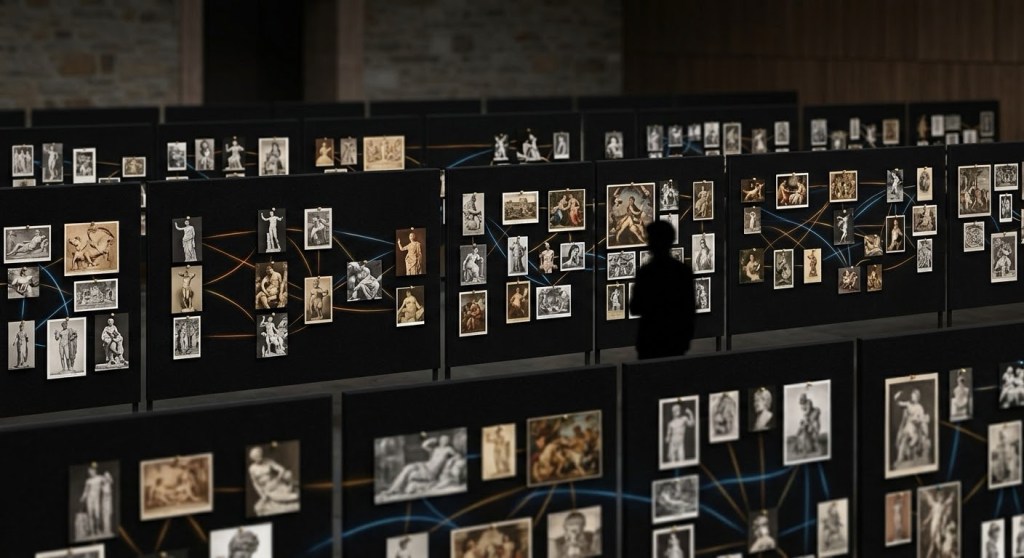
Aby Warburg spent the last years of his life laying photographs on black cloth.
Not writing. Arranging. Wooden panels covered in black fabric, and pinned to them: a Greek vase beside a Renaissance fresco beside a newspaper clipping beside an advertisement for golf clubs. He called it the Mnemosyne Atlas, after the mother of the Muses, and he never finished it. He died in 1929 with sixty-three panels done and no text explaining them. A German art historian, working in Hamburg, with a library he had built himself and would soon have to smuggle out of the country.
What he was tracking was a single thing, and he had a name for it.
Pathosformel. The pathos formula.
Here is what he noticed. A maenad on a Greek vase throws her head back, arms flung wide, hair streaming behind her — a body at the limit of what a body can express. Fifteen hundred years pass. Christianity replaces the mystery cults, Rome falls, the vase is buried. And then a Florentine painter, who has almost certainly never seen that vase, paints Mary Magdalene at the foot of the cross with her head thrown back, arms flung wide, hair streaming behind her.
Same gesture. Different god. Different century. Different grief.
Warburg’s claim was not that the painter copied the vase. It was that the gesture itself had survived — as a formula, a piece of visual grammar for extreme emotion, available to be picked up by anyone who needed to show a body overwhelmed. It travelled. It got attached to new occasions and new meanings, and each time it arrived it did the same work: it carried the charge.
He was very specific about the second half of that. The formula is not neutral. It is not a shape. It is a shape with voltage still in it — what he called the engram, the memory trace, a groove worn into collective memory by an original moment of overwhelming intensity, deep enough that later ages can fall into it without knowing it is there.
Which produces the strange part, and the part Warburg cared about most.
The charge is stable. The polarity is not.
The maenad’s ecstasy becomes the Magdalene’s despair. The same flung-back head serves Dionysian frenzy and Christian mourning without modification. Warburg thought a formula could invert entirely — that the gesture of the vanquished could reappear centuries later on the body of the victor, unchanged, meaning its opposite. The container persists. What gets poured into it is up to the era.
He also thought this was dangerous, and he thought so in the 1920s in Germany, which turned out to be a well-timed anxiety. Warburg’s word for what art does with these formulas was Denkraum — thinking-space, the interval a culture puts between itself and its images so it can look at them rather than be moved by them. His fear was that the interval could collapse. That a society could stop contemplating its inherited gestures and simply be operated by them. He had watched a war run on iconography. He was not speaking theoretically.
So the Mnemosyne Atlas is not an argument, exactly. It is an instrument. Sixty-three black panels, images pinned in constellations, no captions, designed so that a viewer standing in front of them would see the same body appear across three thousand years and feel the recognition happen before the explanation arrived. He was trying to make the survival visible.
The nymph with the wind in her drapery, moving through Ghirlandaio and out the other side. The dying Laocoön, whose agony keeps finding new bodies. The head thrown back, still, in photographs he cut from the papers.
What Warburg gave us, in the end, is a way of noticing that the past does not always come to us as information. Sometimes it comes as a gesture we already know how to make.
WE&P by: EZorrillaMc&Co.
 Travel in Life