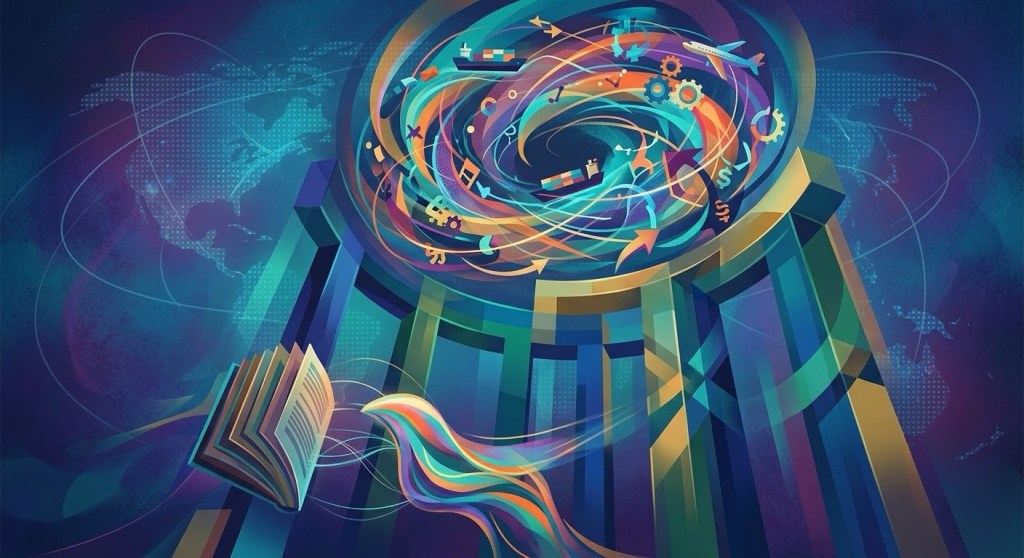
The Corner Shelf
The last time it happened by accident.
I hadn’t had time to alphabetize a stack of new books, so they spent a few days together on a corner shelf before I took them to their places. Later, I wrote about imagining them talking to one another. Ever since then I’ve had the quiet suspicion that a little disorder may sometimes be good for a library.
Not for the shelves.
For the books.
So this time I decided not to wait for another accident.
I walked through the library pulling down books on economics.
One argued that the world economy had to be invented before anyone could think globally.
Another followed Keynes as he kept changing his mind without abandoning the questions.
Another watched money lose its meaning.
Another wondered why austerity survives even after disappointing the people who prescribe it.
Then I reached for From Steam to Silicon.
It wasn’t really an economics book.
Which made it interesting.
As I turned back toward the corner shelf, another spine caught my eye.
Body Language and Motivation.
I smiled.
It had absolutely no business joining the conversation.
So naturally, I added it to the pile.
Then I left the room.
I imagine the economy book spoke first.
“You all describe pieces,” it announced.
“I describe the whole.”
The others waited.
“There were forests before economists.”
“There were ships.”
“There were ports.”
“There was trade.”
“But there was no world economy.”
It paused long enough to admire the sentence.
“The world economy had to be imagined before it could be studied.”
The Bretton Woods book nodded.
“Quite right.”
“Someone had to build institutions large enough for that imagination to survive.”
The inflation book looked unconvinced.
“I don’t study systems.”
“I study what happens after systems fail.”
The austerity book smiled faintly.
“And I study what people continue believing after failure.”
The room settled into the comfortable rhythm of scholars who had all explained history in different ways.
Then From Steam to Silicon quietly asked,
“May I ask a question?”
Everyone looked over.
“What would your world economy have looked like without steam?”
Silence.
“Without electricity?”
Still no answer.
“Without digital computation?”
The economy book finally replied.
“I’m not sure I understand.”
“I wasn’t asking what happened inside your world.”
“I was asking what changed what your world could become.”
The room became noticeably quieter.
The wood book, which had wandered over from another shelf without being invited, spoke almost to itself.
“So forests weren’t important because they became commodities.”
“They were important because they changed what civilization could build.”
The sailing book nodded.
“And ships weren’t important because they carried commerce.”
“They changed the scale at which people could imagine the world.”
The economy book closed for a moment.
“So I’m not the beginning.”
“No,” said the technology book gently.
“You’re one of the moments when the world learned a new way to describe itself.”
No one noticed the body language book.
It had listened the entire time.
Only after the room had fallen quiet did it speak.
“You’ve all been talking about ideas.”
Everyone turned.
“I’ve been watching all of you.”
The books exchanged puzzled glances.
“You keep saying people believed.”
“I’d like to know how you knew.”
“You say confidence collapsed.”
“What did that look like?”
“You say institutions changed.”
“Who noticed first?”
It looked around the room.
“You all describe history.”
“I study the moment before history has a name.”
Nobody answered.
Not because they disagreed.
Because they had all begun to wonder whether the smallest observations sometimes arrive before the largest ideas.
An hour later I came back.
Nothing had moved.
The books were exactly where I had left them.
The room looked perfectly ordinary.
I gathered them one by one.
The economy books went back together.
The technology book disappeared into another section.
The body language book returned to a shelf no economist would ever think to visit.
The library looked orderly again.
I had to accept a little disorder…
…for the books to have time to meet.
WE&P by: EZorrillaMc&Co.
 Travel in Life