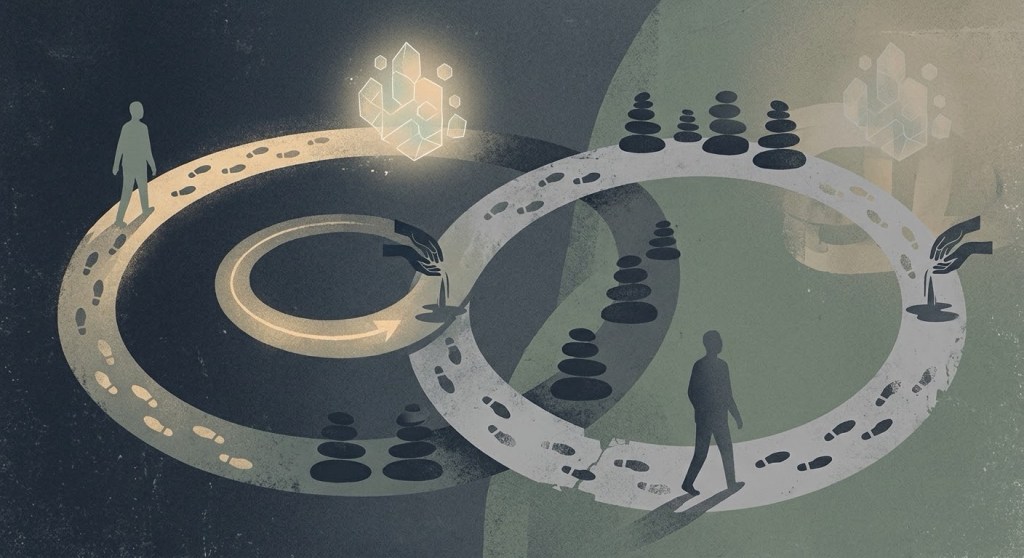
Waiting and Waiting
There are two kinds of waiting.
One is imposed.
The other is chosen.
The first is learned in childhood. A child waits because there is no alternative. Waiting is not a virtue. It is simply reality. The body learns stillness because movement changes nothing. It also learns vigilance. Every approaching car might be the one.
Children become good at what they must survive.
Years later, many discover another kind of waiting.
It happens almost unnoticed—in campgrounds, grocery stores, parks, marinas, gyms, trails, libraries, anywhere people gather because they have something to do.
At first it seems like routine.
Then it becomes clear that routine is not the point.
Returning to the same place does not reproduce yesterday. Walking the same trail does not guarantee the same feelings. Ritual is not magic.
Reality supplies the day.
The body asks for surprisingly little.
A drink.
The routine prepares the ground.
A stretch.
A meal.
A shower.
A familiar place.
To be in a group.
To notice something interesting.
Then it is finished.
The body asks for verbs.
The mind often answers with nouns.
The body asks for movement.
The mind buys a membership.
The body asks for company.
The mind designs an entire future.
The body asks for relief.
The mind invents permanence.
Gradually another possibility appears.
If mind, body, and the body that remembers remain present together, the day rarely becomes empty. Life keeps making small requests.
Walk.
Eat.
Listen.
Notice.
Join the rhythm of a place.
Continue.
The remarkable discovery is that boredom does not disappear because life becomes exciting. It disappears because participation replaces anticipation.
Purpose fills much of what once felt like empty time.
A campground is not interesting because something extraordinary happens there. It is interesting because everyone is living. A grocery store is not exciting because strangers become friends. It is interesting because everyone has a purpose. Shared purpose quietly overrides ordinary social hierarchy. People become fellow participants before they become identities.
This changes waiting.
Waiting is no longer the absence of life.
It becomes one of the ways life unfolds.
Adler wrote that childhood provides material, not destiny.
The child who learned to wait becomes an adult who can wait.
That is no longer a sentence.
It is a capacity.
The first waiting belonged to necessity.
The second belongs to participation.
The first asked, “When will someone come?”
The second asks nothing at all.
It simply remains present, trusting that if one participates in the rhythm of ordinary life, there is remarkably little downtime.
WE&P by: EZorrillaMc&Co.

