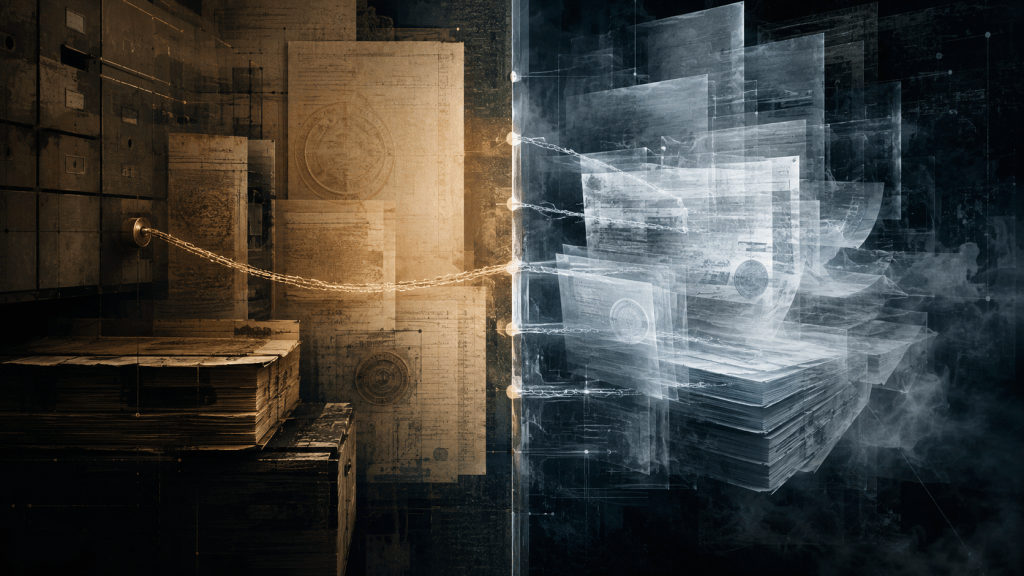
Had They Had a Selectric?
It is an obscene little question, because it reduces a constitutional crisis to office equipment. But sometimes truth hides there: not in the grandeur of motive, but in the machinery available to make a lie look like a record.
I do not mean the question literally. The machine may be wrong. The brand may be wrong. The point is not IBM. The point is the threshold between invention and archive.
A spoken lie is one thing. A typed lie is another. A lie with the right paper, the right spacing, the right institutional smell, the right memo format, the right bureaucratic dullness, begins to ask for a different kind of belief. It no longer says only, “Trust me.” It says, “I was already here.”
That is the ambition of a forged document. It does not merely want to persuade. It wants to have already existed.
One of the grotesque lessons of the Nixon era is that men in power did not only want the record interpreted in their favor. They sometimes wanted the record improved. In the E. Howard Hunt / Charles Colson episode, Hunt testified that he reviewed State Department cables concerning the Kennedy administration and South Vietnam, and that Colson found the actual material insufficient. Hunt then used a Xerox machine, razor blade, and typewriter to fabricate something more conclusive, though he knew the typeface would not survive careful scrutiny.
That last detail matters.
The fabrication failed not only because it was false, but because it could not pass as having come from the world it claimed to belong to. The document did not only need content. It needed provenance. It needed a body. It needed to look as if it had moved through the channels of history before anyone thought to weaponize it.
A forgery is not complete when the sentence is written.
It is complete only when the sentence appears attributable.
That is why “Had they had a Selectric?” is more than a joke. It asks whether the lie had access to the machines of legitimacy. Could it borrow the texture of office work? Could it disappear into the file? Could it appear not as an accusation but as a recovered object?
This is where the modern problem becomes sharper. We now live in a political environment full of document-shaped things: PDFs, screenshots, memos, affidavits, excerpts, unnamed reports, files passed from hand to hand, claims that arrive already formatted. They look like evidence before they have submitted to the duties of evidence.
A document is not evidence because it has margins.
It is not evidence because it is long.
It is not evidence because someone reads from it at a podium.
It becomes evidence only when it can be placed: who wrote it, when, under what authority, from what sources, through what chain of custody, and with what accountability.
Attribution is not clerical. Attribution is part of truth.
That is why the Mueller Report is such a useful comparison case. Not because everyone agrees with it. They do not. Some reject its conclusions, some dispute its framing, some argue about how it was summarized, some believe it was too cautious, and some believe it was illegitimate from the start.
But the report exists as an attributable object. It has an office, a legal mandate, a named Special Counsel, a date, an institutional archive, and a release history. The Department of Justice archive identifies Robert S. Mueller III as Special Counsel and houses the report as the product of that office.
That does not make every interpretation of the report correct.
It makes the report contestable.
That is the difference.
Attribution does not create agreement. It creates the conditions under which disagreement can be honest.
One person may say, “Mueller proved this.” Another may say, “Mueller failed to prove that.” Another may say, “Mueller was constrained.” Another may say, “Mueller was biased.” But all of them are arguing over an object with a return address.
A mystery document does not offer that floor. It asks to be treated as evidence while withholding the structure that would allow evidence to be tested. It enters the room dressed as a record, but no one can say who sent it.
That is not a small defect.
It is the defect.
Because without attribution, the argument cannot properly begin. We are not yet asking whether the document is true. We are asking whether it is a document in the public sense at all, or merely a document-shaped instrument.
This is the old forgery problem turned sideways. A forged document borrows authority by pretending to come from someone. An unattributed document borrows authority by refusing to say where it came from. Both make authorship disappear at the moment authorship matters most.
And once authorship disappears, responsibility disappears with it.
The speaker can wave the document. The audience can feel the charge. The claim can enter circulation. The accusation can harden into atmosphere. But if challenged, the document can retreat into fog: sources say, people are asking, there are reports, there are documents, questions remain.
That is not proof.
It is staged uncertainty.
The lie no longer needs to win the case. It only needs to create the feeling that a case exists somewhere.
This is why provenance matters. Some objects carry authority because they participated in history. A signed treaty, a commander’s log, a court filing, a report produced by an office with jurisdiction — these things do not become true merely by existing, but they have standing because they belong to a chain.
They can be inspected.
They can be disputed.
They can be embarrassed.
They can be forced to answer where they came from.
A document without provenance wants the authority of participation without the exposure of origin.
Had they had a Selectric?
That question returns because every age has its own Selectric: the machine that lets assertion put on the costume of record. In one era it is typeface and paper. In another it is a scanned memo. In another it is an online archive, a cropped image, a congressional packet, a cable-looking object, a report-shaped file, a phrase repeated until it seems sourced.
The machine changes.
The hunger does not.
Power wants the record to say what power needs said. When the record will not say it, power looks for ways to improve the record. Sometimes it forges. Sometimes it leaks. Sometimes it anonymizes. Sometimes it quotes something no one can locate. Sometimes it attaches the new claim to an old collective memory, hoping the audience will confuse familiarity with provenance.
That is where we have to slow down.
Before asking what the document proves, ask what the document is.
Who wrote it?
Who received it?
Who preserved it?
Who verified it?
Who is accountable for it?
What institution, if any, stands behind it?
What chain carries it into the present?
Those are not bureaucratic distractions. They are the threshold questions.
A lie spoken aloud is propaganda. A lie with the right typography asks to become history. And a political culture that cannot tell the difference between an attributable document and a document-shaped object has already weakened one of its own defenses.
The defense is not cynicism. Cynicism says nothing can be trusted.
The defense is provenance.
Cynicism dissolves all documents equally. Provenance discriminates. It asks each document to stand where it claims to stand. It does not require belief. It requires a return address.
That is the discipline.
Do not be impressed first.
Do not be outraged first.
Do not be reassured first.
Ask where the thing came from.
Because the first question is not whether the document confirms what we fear.
The first question is whether the document can survive being found.
Had they had a Selectric?
Maybe the forgery would have looked better.
Maybe it would have lasted longer.
Maybe it would have entered the archive cleanly enough that later people would have had to spend years removing it.
That is the horror inside the joke. Not that lies exist. We know lies exist. The horror is that lies are always trying to acquire paperwork.
And when they do, attribution is not clerical.
It is part of truth.
WE&P by: EZorrillaMc&Co.
 Travel in Life