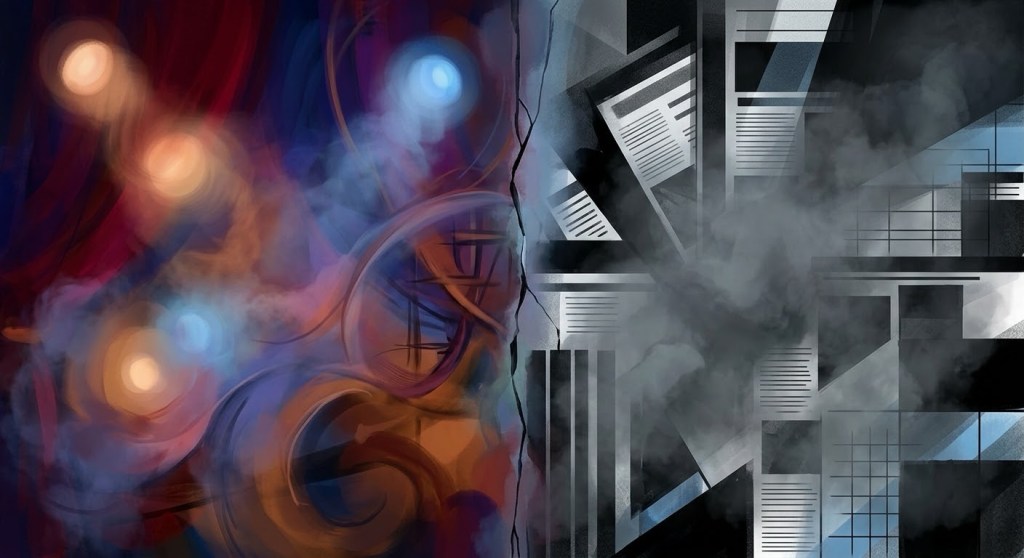
The correspondent glanced down at her notes, then back at the officer.
“Commander… I’d like to go back to something you said.”
He waited.
“You said, ‘Less theatrical fog.’”
A faint smile crossed his face.
“I did.”
“Can you explain what you meant?”
He leaned back for a moment before answering.
“Have you ever walked through stage fog?”
She nodded.
“Of course.”
“What happens?”
She shrugged.
“The lights become dramatic.”
“And the actors?”
She thought for a moment.
“You lose depth.”
He nodded once.
“Exactly.”
Silence settled between them.
“Fog isn’t there to help the audience see,” he continued. “It’s there to help them feel. It makes the lights bloom. It exaggerates movement. It hides the machinery. That’s what it’s designed to do.”
He folded his hands on the table.
“That’s perfectly appropriate in theatre.”
He looked at her.
“It’s dangerous in journalism.”
She glanced at her tablet.
“So you’re saying emotion doesn’t belong.”
He shook his head.
“No.”
She waited.
“Emotion belongs wherever human beings belong.”
Another pause.
“The fog becomes a problem when it replaces the thing we’re trying to understand.”
She raised an eyebrow.
“I’m not following.”
“If the headline tells me who to hate before it tells me what happened…”
He let the sentence hang.
“…that’s fog.”
“If the interview tells me what conclusion to reach before I’ve seen the evidence…”
“…that’s fog.”
“If outrage arrives before sequence…”
“…that’s fog.”
She looked at him carefully.
“So you’re asking journalists to be less emotional.”
Again he shook his head.
“No.”
“What then?”
“I’m asking journalists to trust their craft.”
She remained silent.
“The public doesn’t need us to manufacture importance.”
He gestured toward the dark display on the wall.
“The events are already important.”
“What the public needs is someone willing to make careful distinctions.”
He spoke almost as though he were reading a technical report.
“Scale.”
“Sequence.”
“Causality.”
“Context.”
“Those aren’t decorations.”
“They’re the work.”
The correspondent smiled faintly.
“You make it sound as though journalists don’t trust themselves.”
“Sometimes they don’t.”
“What makes you think that?”
He looked at her directly.
“When a profession stops believing its own craft is enough, it starts borrowing attention from somewhere else.”
She tilted her head.
“Borrowing?”
He nodded.
“Drama.”
“Conflict.”
“Outrage.”
“Certainty.”
“The obvious question.”
“The obvious answer.”
“Theatrics.”
He looked toward the viewport, where the station lights floated silently against the curve of the planet.
“If your reporting cannot hold my attention without smoke…”
“…don’t add smoke.”
“Improve the reporting.”
She laughed quietly.
“That sounds harsher than you probably intended.”
“No.”
“It sounds more respectful than most people realize.”
She looked at him with genuine curiosity now.
“Respectful?”
“I believe journalism matters.”
“So do I.”
“I know.”
“Then why keep pressing on our language?”
He answered without hesitation.
“Because I think the public deserves your best work.”
Silence returned.
Finally she closed the tablet.
“I’ve always assumed criticism meant someone wanted us weaker.”
He smiled, almost imperceptibly.
“That’s because you’ve spent too much time around people who mistake contempt for intelligence.”
“And you?”
“I’m asking for something much more difficult.”
“What?”
He met her eyes.
“I want the ideas to be interesting enough that you no longer need the fog.”
She held his gaze for several seconds.
Then she nodded.
“I think I finally understand what you meant.”
“I was hoping you would.”
WE&P by: EZorrillaMc&Co.

