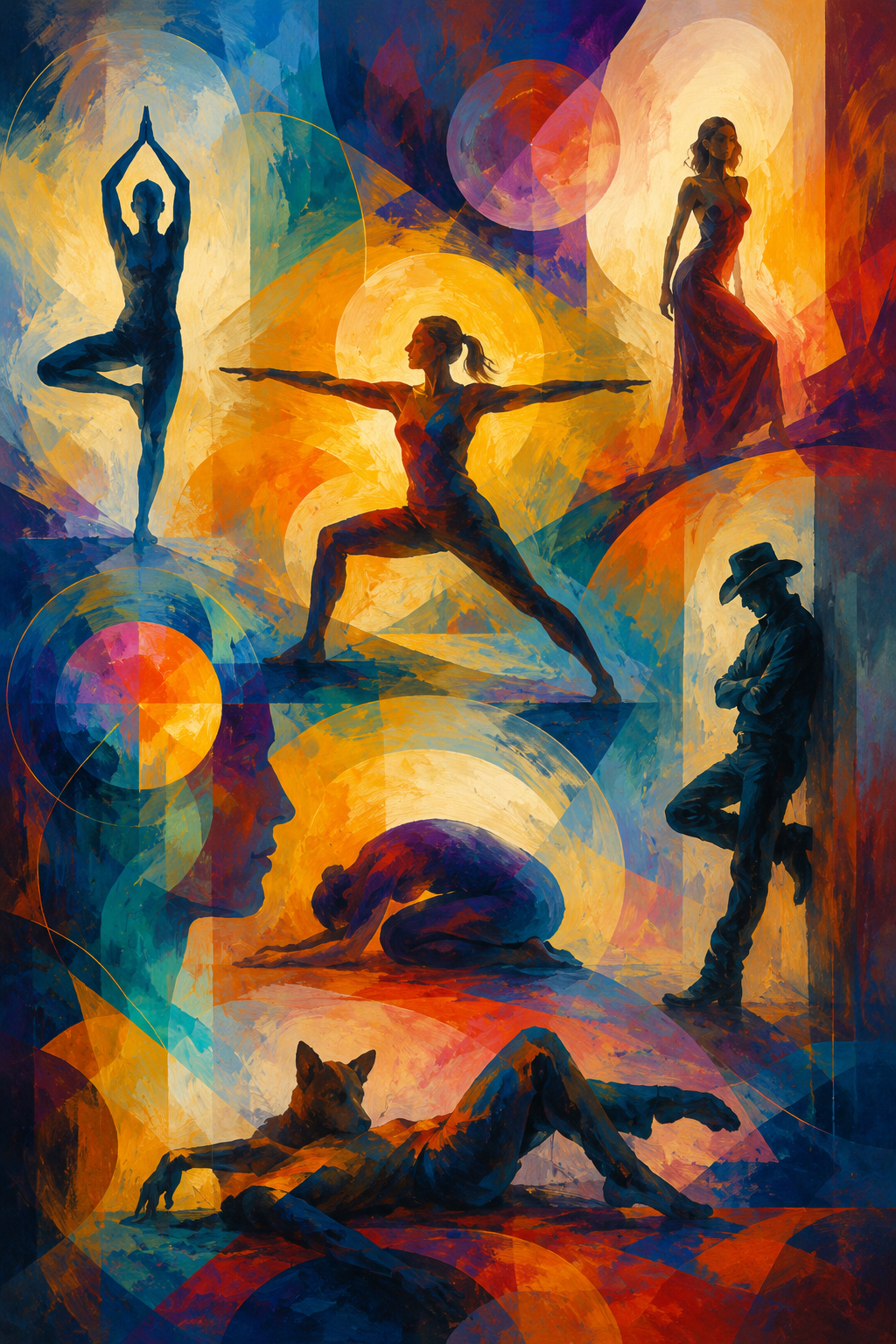
The Pose and the Concept Are the Same Event
For years I thought yoga was about flexibility.
Then I realized I had never gone to yoga for flexibility.
I went because I wanted to become something.
If I wanted to be brave, I stood in Warrior.
If I wanted steadiness, I stood in Mountain.
If I wanted surrender, I folded into Child’s Pose.
I wasn’t interested in stretching muscles as much as metabolizing ideas.
The pose and the concept were the same event.
Not symbolically.
Physically.
I wasn’t pretending to be a warrior.
I was asking my body what courage felt like before my mind had the language for it.
That realization has stayed with me because it explains something much larger than yoga.
We often imagine that ideas change bodies. But bodies also change ideas.
Stand like a mountain long enough and the body begins to organize itself differently. Weight settles through the feet. The spine lengthens. Breathing changes. The room is no longer encountered from the same place.
The geometry quietly produces an atmosphere.
Only afterward does the mind say,
“This feels steady.”
The concept arrives after the body has already begun living it.
That is why yoga names matter.
Mountain.
Warrior.
Tree.
Child.
Corpse.
The names do not merely identify positions. They tell the body what world it is entering.
The pose becomes a doorway.
The concept is metabolized from the inside.
Once I began seeing this, I noticed that yoga does not own the mechanism.
We use unnamed poses every day.
A woman shifts her weight onto one leg. The opposite hip rises. Artists call it contrapposto, but most people feel the atmosphere before they know the word. The body appears poised, elegant, relaxed. The geometry produces an experience that language later names.
A cowboy leans against a wall with one boot behind him, his hat hiding his eyes. The same asymmetry now creates another atmosphere. Not elegance this time, but patience, self-containment, perhaps invitation without pursuit.
Outside a grocery store I noticed an employee smoking. Black clothes. Baseball cap pulled low. Head down. One foot against the wall behind him. His body folded into a series of angles.
The body looked kinked.
The atmosphere felt kinky.
That observation surprised me because I immediately stopped myself from saying something different.
Not:
“He is kinky.”
Only:
“The atmosphere is kinky.”
The pose summoned the concept.
The concept reorganized what I was seeing.
The man himself remained unknown.
That distinction matters.
The atmosphere belongs to the encounter.
The person belongs to himself.
The two are not the same.
The same thing happens in politics.
An event occurs.
Then someone gives it a name.
A protest becomes an uprising.
An election becomes a theft.
An arrival becomes the Fulfillment.
The event has not changed.
The category has.
The category reorganizes perception.
Bodies do something similar.
They recruit atmospheres before they recruit explanations.
I have begun noticing this in myself as well.
Commander pants.
Not simply clothing.
A way of inhabiting command.
The mammal’s den.
Not simply bedtime.
A way of inhabiting safety.
Walking through the grocery store on the way to the vineyards.
Not an interruption.
A way of inhabiting continuity.
Even scent has become part of this discovery.
I once thought fragrance was something added to the body.
Now I understand it differently.
The body already has an atmosphere.
The composition simply helps it become legible.
Nothing is being hidden.
Something is being organized.
Perhaps that is what I have been trying to learn all along.
Not how to imitate a concept.
How to metabolize it.
The pose comes first.
The atmosphere follows.
The concept arrives last.
By then, the body already knows.
Perhaps this is why certain environments stay with us.
Europe was not simply beautiful.
Its streets taught walking.
Its trains taught lightness.
Its plazas taught lingering.
Its markets taught today’s meal.
I thought I was traveling through Europe.
Looking back, I wonder if Europe was quietly teaching my body a collection of poses.
Not yoga poses.
Ways of inhabiting a life.
The more I pay attention, the more I suspect we are always posing.
Not for other people.
For ourselves.
Every posture asks a question.
Every arrangement of the body recruits an atmosphere.
Every atmosphere invites a concept.
The remarkable part is that we usually notice the concept first.
The body knew it long before we found the word.
WE&P by: EZorrillaMc&Co.
 Travel in Life