The Morning List
A Day in the Writer’s Studio
At nine every morning, a blue envelope appeared beneath the door.
No one in the room knew exactly who prepared it. Publicity claimed Research did. Research said the material came from Publicity, the switchboard, the clipping office, overheard conversations in the commissary, letters sent to actors, and remarks collected by studio employees who had been instructed to listen without appearing to.
The envelope contained statements.
Not stories. Not assignments. Statements.
Some were quotations. Some were complaints. Some were obvious lies. Some had been copied from newspapers or books. Others appeared to have been spoken by people who had no idea anyone was listening.
Most went into the wastebasket.
A few became pictures.
Jonas picked up the envelope and held it against the window.
“Six pages.”
“We’re being punished,” Maron said.
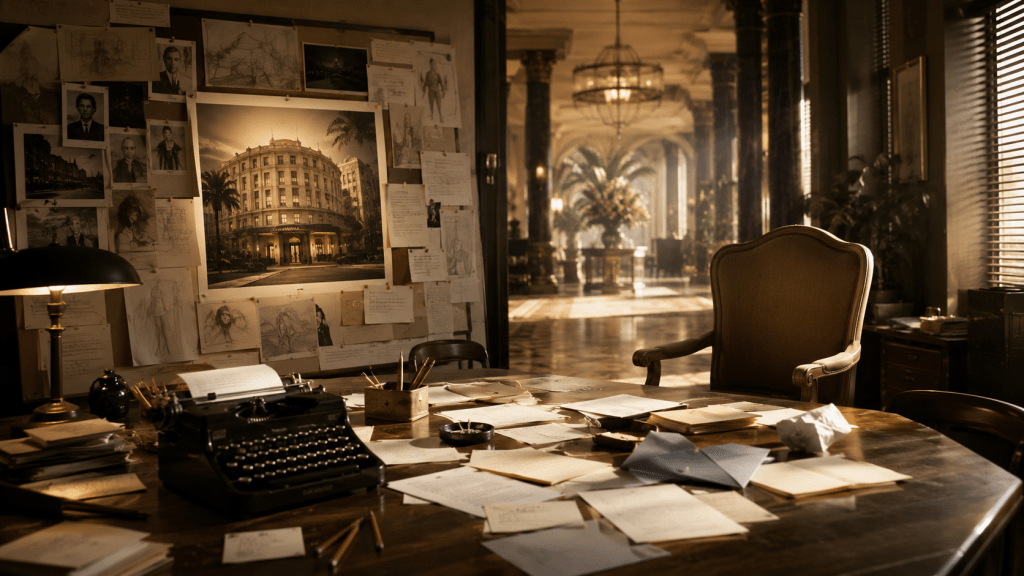
Leda did not look up. She was studying a photograph laid flat on the table: an old hotel, eight or nine stories tall, with long rows of windows, dark horizontal bands, and a white wall almost entirely without ornament. Above the roof, the name RIO stood in large letters.
On the board behind them someone had written:
A VEHICLE FOR CELIA VALE
Below that:
SHE RETURNS TO A HOTEL SHE HAS NEVER VISITED.
The word returns had been crossed out twice and restored twice.
Jonas opened the envelope.
“First statement.”
Maron uncapped his pen.
Jonas read:
“A man who has lost everything still owns the story of how he lost it.”
“No,” Leda said.
“You didn’t even consider it.”
“I considered it yesterday under three other names.”
Maron drew a line through the first item.
Jonas continued.
“The difficulty with democracy is that everyone believes the wrong people are allowed to vote.”
Maron looked toward the ceiling.
“What sort of list is this?”
“A morning list.”
“That is not a morning statement.”
“It might improve by noon.”
Leda extended her hand without looking. Jonas gave her the page.
She read the line again.
“Who says it?”
“The senator,” Jonas said.
“What senator?”
“The one trying to buy the hotel.”
“We don’t have a senator.”
“We could.”
“Then we’re writing a political thriller.”
Jonas considered this.
“Celia could do a political thriller.”
“Celia could do surgery on horseback,” Maron said. “That doesn’t mean the audience wants to watch.”
Leda drew a line through democracy and vote.
“What remains?” Jonas asked.
She handed the page back.
He read:
“The wrong people are allowed.”
Maron shook his head. “Allowed what?”
“That’s better,” Leda said.
“It’s not a sentence.”
“It’s a pressure.”
“Whose?”
No one answered.
Maron wrote the shortened line on the board beneath the premise.
THE WRONG PEOPLE ARE ALLOWED.
He stepped back.
“Now it sounds like the hotel has a dress code.”
“Good,” Leda said. “Hotels understand exclusion better than senators.”
Jonas returned to the list.
“Never trust a hotel that places the piano beside the fire exit.”
There was a pause.
Maron laughed first.
Leda looked up from the photograph.
“Keep it.”
“You cannot possibly mean that.”
“I don’t know what it means.”
“That is generally your objection.”
“It is my objection when you know what something means before anyone has said it.”
Maron copied the piano line onto the board.
Jonas continued.
“Don’t choose anything too cutting-edge. Choose something pretty but a little out of style. Then it won’t go out of style.”
Leda took the paper from him.
“That stays.”
“Why?”
She turned the photograph around so that it faced the two men.
“My uncle used to say that.”
“Your uncle built hotels?”
“He designed one. My father built it with him.”
Jonas looked at the photograph.
“This one?”
“No.”
“Then why are we looking at it?”
“Because it knows what he meant.”
Maron leaned closer.
The Hotel Rio filled most of the frame. Cars sat along the street below it. The building was neither grand nor humble. It did not resemble a palace. It did not appear ashamed of this.
“What does it know?” Jonas asked.
“That it’s a hotel.”
“That seems like the minimum.”
“You’d be surprised.”
Maron tapped one of the long rows of windows.
“It’s out of style.”
“It was probably out of style when it opened,” Leda said.
“How does that help?”
“It had less distance to fall.”
Jonas sat down.
“That’s a line.”
“For whom?”
“Celia.”
“Celia Vale does not discuss architectural fashion.”
“She might if she owns the building.”
“She has never been there.”
“She still owns it.”
“Why?”
“That is what we are here to discover.”
Jonas glanced at the board.
“She inherits it.”
“Too easy,” Maron said.
“She wins it in a card game.”
“Too much.”
“She wakes up and discovers her name is on the deed.”
“That’s inheritance with a headache.”
Leda looked at the photograph again.
“She has always owned it.”
Neither man spoke.
“She just didn’t know?”
“She knew.”
“Then why hasn’t she been there?”
Leda moved the photograph several inches toward the center of the table.
“That,” she said, “may be the picture.”
Jonas stood and went to the board. Beneath the premise, he wrote:
SHE HAS ALWAYS OWNED IT.
Maron read the next statement himself.
“They sold the place while I was still living in it.”
The room became quiet.
Jonas turned from the board.
“Who said that?”
“It doesn’t say.”
“Celia says it.”
Leda shook her head.
“Why not?”
“Too large.”
“It’s only ten words.”
“It contains a country.”
Maron read it again.
“They sold the place while I was still living in it.”
“Perhaps they sold the country,” Jonas said.
“Then we are back in the political thriller.”
“Perhaps the country is the hotel.”
“Then it isn’t a country.”
“Not to the tax department.”
Leda took the page.
“Who is she speaking to?”
“The new owner,” Jonas said.
“She is the owner.”
“The man who believes he is.”
“Better.”
Maron pulled a clean sheet into the typewriter.
“What does he say first?”
Jonas began pacing.
“Miss Vale, I’m afraid there’s been some confusion.”
“No,” Leda said.
“Why?”
“No one in a hotel admits confusion. They call it an arrangement.”
Maron typed:
“Miss Vale, there appears to be an arrangement.”
Jonas stopped pacing.
“That’s good.”
“It is merely less bad.”
“What does she say?”
Leda looked at the photograph.
“They sold the place while I was still living in it.”
Maron typed it.
Jonas frowned.
“But she has never visited.”
“She wasn’t living in the hotel.”
“Where was she living?”
“In the arrangement.”
No one cleared that up.
Maron rolled the page out of the typewriter and placed it beside the photograph.
Jonas returned to the morning list.
“A building is most honest when viewed from the side.”
Maron looked at the blank wall in the photograph.
“Who prepared this list?”
“Someone who knows we’re stuck,” Leda said.
“Keep it?”
“No.”
“Why not?”
“It is already pleased with itself.”
Jonas crossed it out.
“Beauty is what remains after admiration has moved elsewhere.”
Leda made a face.
“What?”
“Too finished.”
“It’s good.”
“That’s the problem.”
Maron took the page and read the sentence.
“Could a character say it badly?”
“Most characters can.”
“What would Celia say?”
Jonas adopted a grand, weary voice.
“People used to admire this place.”
“No,” Leda said.
Maron tried:
“It looked better when people were looking.”
Leda considered it.
“Almost.”
Jonas leaned over the table.
“It hasn’t changed. They have.”
Maron nodded.
“Celia can say that.”
“Not yet,” Leda said.
“Why not?”
“She hasn’t entered.”
They all looked at the board.
The problem had been on the board since yesterday.
Celia Vale had a hotel.
Celia Vale had never visited it.
Celia Vale was returning.
No one knew why.
“We need an opening,” Maron said.
“We have one,” Leda said. “She enters.”
“That’s not an opening. That’s a door.”
“What do you think openings are?”
Jonas answered before Maron could.
“Something she can walk through before we know what it means.”
Leda looked at him.
“She knows what it means.”
“Then don’t let her tell us.”
“Celia will want a reason.”
“Celia wants an entrance,” Maron said. “Reasons are for the second reel.”
Jonas picked up the hotel photograph.
“Fine. She walks into the hotel.”
“Why?”
“You just said reasons are for the second reel.”
“Her reason,” Leda said. “Not ours.”
“She’s looking for someone.”
“Too ordinary.”
“She’s hiding from someone.”
“Thriller.”
“She’s there to sell it.”
“Business picture.”
“She’s there because the building sent for her.”
Maron looked up from the typewriter.
“What kind of picture is that?”
Jonas smiled.
“We don’t know yet.”
Leda did not reject it.
That was how they knew it might be useful.
Maron placed a fresh sheet in the typewriter.
“Exterior?”
“Interior,” Leda said.
“We need the building.”
“We’ll see it later.”
“The studio will want the hotel in the first shot.”
“The studio isn’t writing the picture.”
“The studio owns the picture.”
“The studio owns the paper.”
Jonas put the photograph against the wall, beside the board.
“The lobby is empty,” he said.
“Hotels are never empty.”
“It looks empty.”
“Different.”
“A clerk?”
“Of course.”
“Old?”
“Not symbolically.”
“Young?”
“Not romantically.”
“Then what age is he?”
“The age of a clerk.”
Maron began typing.
INT. HOTEL RIO — LOBBY — MORNING
He stopped.
“Morning?”
“No,” Jonas said. “Night.”
“Why?”
“She looks better entering at night.”
“Celia looks good entering a laundry room.”
“Night gives us the sign.”
Leda shook her head.
“The sign is on the roof.”
“Exactly.”
“She cannot see it from the lobby.”
“The audience can.”
“Then the audience is outside.”
Maron removed the page.
“Afternoon.”
“Why afternoon?” Jonas asked.
“Because no one expects anything serious to begin at three fifteen.”
Leda looked at the clock.
It was three fifteen.
“Afternoon,” she said.
Maron typed again.
INT. HOTEL RIO — LOBBY — AFTERNOON
The revolving door moves once.
CELIA VALE enters carrying no luggage.
Jonas leaned over his shoulder.
“No luggage?”
“She owns the hotel.”
“She doesn’t know whether she’s staying.”
“She has always owned it.”
“She may have always owned a toothbrush.”
“Let her enter empty-handed,” Leda said.
Maron continued.
The desk clerk looks up.
“What does he say?” Jonas asked.
“Welcome to the Rio.”
“No.”
“May I help you?”
“No.”
“Miss Vale.”
Leda looked at him.
“He knows her?”
“Everyone knows Celia Vale.”
“That makes it less interesting.”
“What if he doesn’t recognize her?”
“Then we spend half a reel waiting for him to catch up.”
Maron rested his hands on the typewriter.
“What does the room expect him to say?”
Jonas looked toward the empty chair at the far end of the table. The chair had a brass plate on the back:
CELIA VALE
She rarely attended story meetings. The chair remained there anyway.
“Welcome back,” Jonas said.
Maron and Leda both looked at him.
“She’s never been there,” Maron said.
“I know.”
Leda smiled.
Maron typed:
CLERK
Welcome back.
Then:
CELIA
I’ve never been here.
They waited.
The room had changed slightly. Not enough to name. Enough to continue.
“What does he say?” Maron asked.
Jonas began to answer, but Leda raised one finger.
She was looking at the next item on the list.
She read it aloud.
“Sometimes a room remembers the person who was expected.”
Nobody laughed.
Maron placed his fingers on the keys.
Leda shook her head.
“Don’t type it.”
“Why?”
“The clerk wouldn’t say that.”
“Who would?”
She looked at the photograph, the board, the empty chair, and the two lines already on the page.
“No one yet.”
Jonas took the statement from her and pinned it beside the hotel.
The blue envelope lay open on the table. Four pages remained.
Maron turned the roller back half a line.
“Then what does the clerk say?”
From the hallway came the sound of a woman laughing.
Not Celia Vale.
All three waited anyway.
When the laughter passed, Jonas said:
“Your room is ready.”
Maron typed it.
Leda did not object.
They read the exchange:
CLERK
Welcome back.
CELIA
I’ve never been here.
CLERK
Your room is ready.
Jonas sat down.
“Is it a ghost story?”
“No,” Leda said.
“Romance?”
“No.”
“Thriller?”
“Not yet.”
“What is it?”
Maron removed the page from the typewriter.
“A vehicle,” he said.
“For Celia?”
Leda picked up the morning list.
“We’ll know when she gets in.”
WE&P by: EZorrillaMc&Co.

