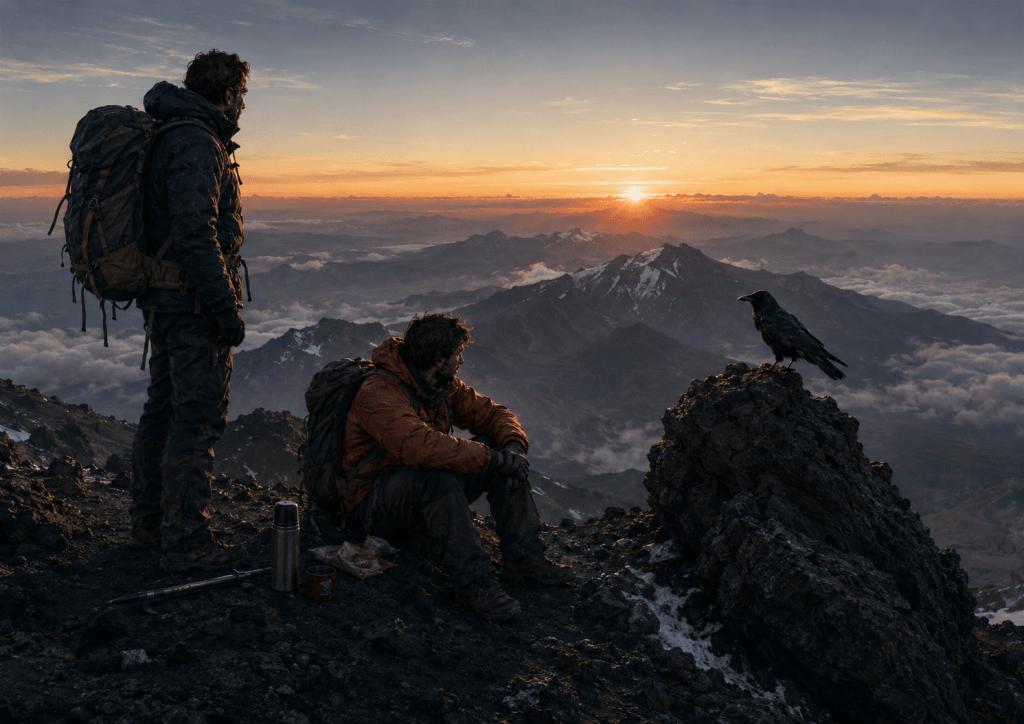
The Crow at the Summit
They had met before, although neither could remember whether they had exchanged names.
Months earlier, an avalanche had damaged one man’s tent. By the time he reached the other’s camp, snow had worked into his clothes and his hands had become clumsy. There had been no ceremony about it. The second man moved his equipment to one side, opened the sleeping bag, and made room.
They spent the night in the same tent because the mountain required it.
In the morning, they separated.
Neither asked where the other was going next.
They met again below the volcano.
Recognition came slowly. First the pause, then the narrowed eyes, and finally the small tilt of the head that said: I have seen you somewhere difficult.
“You had the red tent,” one said.
“Until I didn’t.”
That was enough.
They were climbing for similar reasons, though neither tried to explain them. Passion becomes embarrassing when described too carefully. The individual challenge. The summit. The view. The wish to place the body somewhere it had not been before.
They began at midnight.
Their headlamps cut separate tunnels through the dark. Sometimes one walked ahead. Sometimes the other did. They did not establish a leader, and neither announced responsibility for the other.
Friendly was possible.
Trust was something else.
On a mountain, another person could save your life. He could also decide that saving you endangered his own. Both men knew stories of partners who had been left behind—sometimes because there had been no choice, sometimes because a choice had been made and renamed necessity afterward.
One famous climber had been abandoned for dead and had still managed to return to camp.
The story followed mountaineers because it held two incompatible truths. A person might have to leave. A person might also survive being left.
Neither man mentioned it.
They climbed.
The lower trail was soft with ash. Higher up, loose stone shifted under their boots. The distance behind them lengthened without becoming visible. The night concealed what they had already crossed and what remained.
Conversation arrived in short pieces.
A mountain they had both climbed.
A storm one had waited out.
A route the other had abandoned twenty meters below the summit because the snow had begun to move.
Neither man boasted. The mountain had already corrected that instinct in both of them.
As the air thinned, their conversations stopped.
The body becomes private at altitude. Each breath must be considered. Each step becomes an agreement between intention and muscle. The distance between two rocks may be no more than a meter, yet crossing it can require planning.
They continued upward.
Near dawn, the horizon began to separate from the sky.
At first there was only a gray line. Then the world widened. Ridges emerged below them. Farther away, mountains appeared as dark islands floating above cloud. Behind them lay the entire distance they had walked, folded into slopes and shadow.
They reached the summit as the sun broke over the horizon.
For several minutes neither spoke.
The view was complete in every direction.
Three hundred and sixty degrees of distance.
The land fell away from them. Roads disappeared. Settlements became pale marks. The familiar scale of human life was gone, and for a moment the summit seemed less like a place they had reached than a place from which everything else had retreated.
One man sat down.
The other remained standing, turning slowly inside the view.
That was when the seated man saw the crow.
It stood several meters away on a black outcrop, its feathers untouched by the wind.
He knew immediately that its name was Seraphim.
The knowledge did not surprise him.
Seraphim looked toward the sunrise, then back at the man.
“You came a long way to become smaller,” the crow said.
The man laughed.
His companion turned.
“What is it?”
“The crow.”
The standing man looked toward the rock.
“What crow?”
“Seraphim.”
There was a pause.
The second man did not smile.
He did not say there were no crows at that altitude. He did not say that birds did not introduce themselves. He did not tell the seated man he was imagining things.
Instead, he lowered himself into a crouch.
“Where is he?”
“On the rock.”
“Which rock?”
“The black one.”
“They’re all black.”
The seated man studied the slope as if this were a difficult objection.
“The one beneath the sun.”
“What is he doing?”
“Watching.”
“Is he moving?”
“No.”
“What did he say?”
The seated man looked pleased.
“He said I came a long way to become smaller.”
The second man removed one glove and placed two fingers against the man’s wrist. Then he watched his breathing.
“How long has he been there?”
“He was waiting for us.”
“For both of us?”
The man looked back toward the rock.
Seraphim had turned away.
“No,” he said. “Just me.”
The standing man put his glove back on.
“We’re going down.”
“We just arrived.”
“I know.”
“We haven’t had the tea.”
“We’ll drink it lower.”
The seated man looked offended on Seraphim’s behalf.
“He thinks you’re sensible.”
“Good. Ask him whether he knows a shorter route.”
The seated man laughed again. The laugh became a cough.
The other man helped him stand.
No announcement was made. No diagnosis was offered. The summit did not become a scene. One man gathered the equipment while the other watched a crow that was not there.
Then they began descending.
At first the affected man resisted the pace.
He wanted to stop and look back. He wanted to explain what Seraphim had said. He wanted to describe the bird’s eyes, which he claimed contained the whole circumference of the mountain.
The other listened.
He asked questions.
Was Seraphim following them?
Was he flying or walking?
Did he seem closer?
The questions kept the man talking. His answers gave shape to the descent. As they moved lower, Seraphim became less distinct.
First he was flying above them.
Then he was standing farther up the trail.
Then he had returned to the summit.
Eventually, when asked where the crow was, the man looked around and said, “What crow?”
They continued downward.
The day grew warmer. The air thickened almost imperceptibly. Breath stopped being an occupation and became a reflex again.
Only then did the second man take out the stove.
They sat among broken rocks while water heated in a small metal pot. He opened the packet of biscuits they had intended to eat at the summit.
The other man held the cup in both hands.
“Did I say anything strange?”
“You met a crow.”
“Was he interesting?”
“He had opinions.”
The man drank the tea.
“Did you see him?”
“No.”
There was no ridicule in the answer, but neither was there agreement.
The man nodded.
“That was probably useful.”
They descended to a lower camp before dark.
That night they slept in separate tents.
The next morning, one of them woke before sunrise and stepped outside. The other was already there, heating water.
The volcano had begun to brighten behind them.
Neither mentioned the crow.
Neither mentioned the avalanche.
They drank their tea while the mountain slowly returned its ridges, forests, and long fields of stone to view.
They still did not know each other’s names.
But one knew that the other had seen him become unreliable and had not used the moment against him.
The other knew that a man could be led down a mountain without first being persuaded that the crow was not real.
They had climbed for individual reasons: passion, challenge, the summit, the complete view.
They came down carrying something neither had intended to find.
Not friendship exactly.
Not trust, not yet.
Only evidence.
On the mountain, that was enough.
WE&P by: EZorrillaMc&Co.

