The Registry of Orbits
The Ministry of Continuity occupied the tallest building in the city, which everyone agreed was appropriate. Loss, after all, was the tallest problem.
Maren arrived at the forty-second floor with her documentation in order: death certificate, relationship classification, duration of bond, a neural scan confirming the pattern of her grief. The intake officer reviewed everything without looking at her.
“Seventeen years,” he said. “Spousal tier. That qualifies you for a Tier One Replacement.” He said it the way someone announces a flight departure. “You’re fortunate. The waitlist for Tier One is only eight months now.”
“I know,” Maren said. “I’ve been on it.”
What the Ministry had understood, fifteen years ago when it was founded, was that grief was inefficient. Not cruel — the founders were careful to say they were not indifferent to suffering — but measurably costly. Productivity declined. Health deteriorated. Birth rates fell. And the solution, when someone finally proposed it rigorously, was almost elegant: the problem was not the absence of the person. The problem was the absence of a compatible person. Loss was a matching problem. The Ministry solved matching problems.
The science was sound. Neural mapping could identify, with extraordinary precision, the relational profile of a lost partner — their humor frequency, conflict patterns, attentional signature, the specific way they had distributed warmth. A compatibility index above 94 was considered near-certain to restore baseline function within eighteen months.
Maren had believed this. She had put her name on the waitlist seven months after Dov died because she believed it, and because everyone she knew had done the same, and because the grief had a weight that made belief in anything feel like relief.
His name was Oren. His compatibility index was 96.
He was kind in the way Dov had been kind — attentive, specific, unhurried. He laughed at similar things. He held his coffee cup with both hands. He asked questions and listened to the full shape of the answer before responding.
For the first four months, Maren told herself it was working.
Then one evening they were sitting at the kitchen table — the same table, she had kept the table — and Oren said something that Dov would also have said, nearly word for word, and instead of comfort she felt something she could not immediately name.
It felt like walking into a house that had been rebuilt after a fire. The dimensions were correct. The light came through the same windows. But the walls did not know her.
She tried to explain this to her Ministry counselor, a calm woman named Seo who had heard most things.
“The architecture feels the same,” Maren said. “But it doesn’t — remember anything.”
Seo made a note. “That’s a common transition anxiety. Familiarity accrues. Give it time.”
“It’s not about familiarity. Oren is familiar. I mean —” She stopped. “When Dov handed me something, a cup, a book, anything, there was a whole history in the gesture. Seventeen years of handing things to each other. The gesture knew us both.” She looked at her hands. “With Oren the gesture is just a gesture.”
Seo’s expression was professionally gentle. “You’re describing memory. That will build.”
“I’m describing something that doesn’t live in either of us,” Maren said. “That’s what I can’t explain.”
She found Dr. Voss through a network that the Ministry did not officially acknowledge.
He worked in a sub-basement of the university’s physics building and had been quietly defunded three years earlier, after publishing a paper whose implications the Ministry’s legal team had identified as potentially destabilizing to public health infrastructure. The paper was called On the Existence of Relational Fields: A Third-Body Problem.
His office was small and smelled of recycled air and old paper. On one wall he had pinned a diagram that looked, at first glance, like an orbital map.
“It’s not metaphorical,” he said, when she asked. “Or rather, it began as metaphorical and became something else.” He traced a line between two points on the diagram. “We’ve known for decades that sustained attention between two people produces measurable changes in both individuals. What we didn’t understand — what the Ministry doesn’t want understood — is that those changes are not stored in either individual.”
Maren went still.
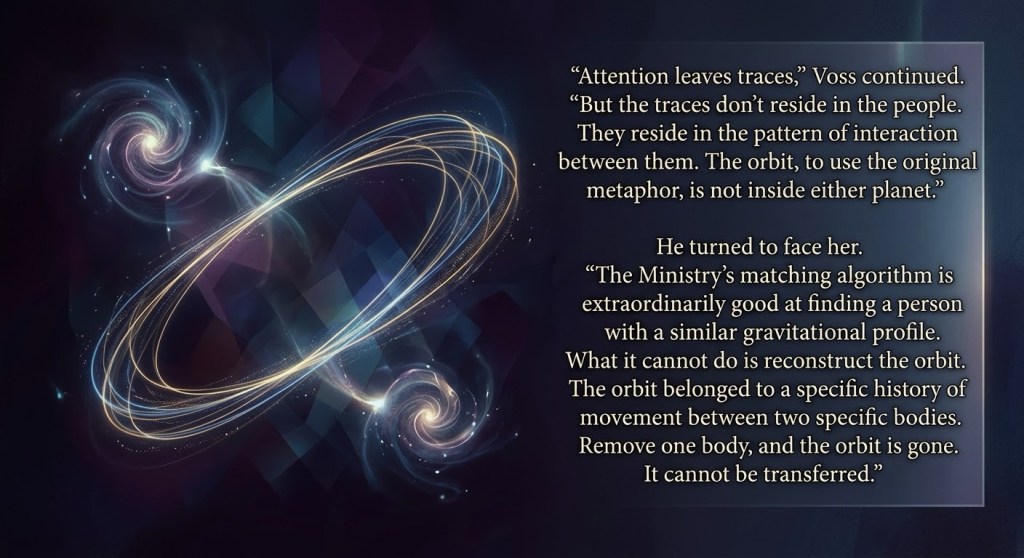
“Attention leaves traces,” Voss continued. “But the traces don’t reside in the people. They reside in the pattern of interaction between them. The orbit, to use the original metaphor, is not inside either planet.” He turned to face her. “The Ministry’s matching algorithm is extraordinarily good at finding a person with a similar gravitational profile. What it cannot do is reconstruct the orbit. The orbit belonged to a specific history of movement between two specific bodies. Remove one body, and the orbit is gone. It cannot be transferred.”
“Then what remains?” Maren asked.
“In you? The memory of having inhabited that space. The shape of it, pressed into you like an impression.” He sat down heavily. “Which is why replacements feel like hotels. They can be pleasant. They can be genuinely kind. But a hotel does not know you. It has not accumulated you.”
She thought about the table. The windows. The gesture that was just a gesture.
“The Ministry calls your paper destabilizing,” she said.
“Yes.”
“Because if the orbit can’t be reconstructed —”
“Then the entire premise of Continuity fails,” he said quietly. “You cannot solve loss with compatibility. You can solve loneliness, perhaps. Loneliness is a different problem and the Ministry is genuinely good at solving it. But grief is not loneliness. Grief is the specific absence of a specific field that no longer exists anywhere in the universe.” He looked at his diagram. “That is not a matching problem. That is an extinction event.”
She did not leave Oren that night, or the next.
What she understood now made things neither better nor worse in the ways she had expected. Oren was real. His kindness was real. The life they were building had its own weather, its own accumulations, its own small acts of attention leaving their slow traces.
It was not Dov. It was not the orbit she and Dov had spent seventeen years producing, the one that had known them both and asked something of them both and was now simply, irreversibly gone.
But it was something.
That was the part Voss’s paper did not quite reach — not because he was wrong, but because physics had always been better at describing what was lost than what was slowly, stubbornly beginning.
She held her coffee cup with both hands.
Outside, the Ministry building rose over the city, solving the problems it knew how to solve, leaving the others for people to carry alone, or together, in whatever orbits they could still find their way into.
The night continued its ancient, indifferent rotation.
She stayed at the table.
WE&P by: EZorrillaMc&Co.

