The Quest
The quest is not to find the perfect place.
That would be too large, too final, too much like buying a noun when the body asked for a verb. The quest is smaller and more accurate: to find places I would want to return to.
That changes everything.
A place does not need to become home in order to matter. It does not need to explain my life, heal my history, prove the van was a good idea, or become the final answer to movement. It only needs to do one modest, serious thing: leave a trace in the body that says, yes, I would come here again.
That is a different kind of travel. It is not achievement travel. It is not the old European proof: arrive, walk, complete, endure, move on. That kind of travel had its beauty. It told the mind: you did it. You got there. You crossed the distance. But this quest asks another question, closer to the mammal:
Did I settle here?
Could I walk here again?
Did this place give me enough structure without trapping me?
Could I wake here, eat fruit here, close a window here, sleep warmly here?
Could I write here?
Could I be quiet here without disappearing?
The quest is not grand, but it is not trivial. It is intimate reconnaissance. I am not surveying territory for conquest. I am asking where the body and the mind can both remain present.
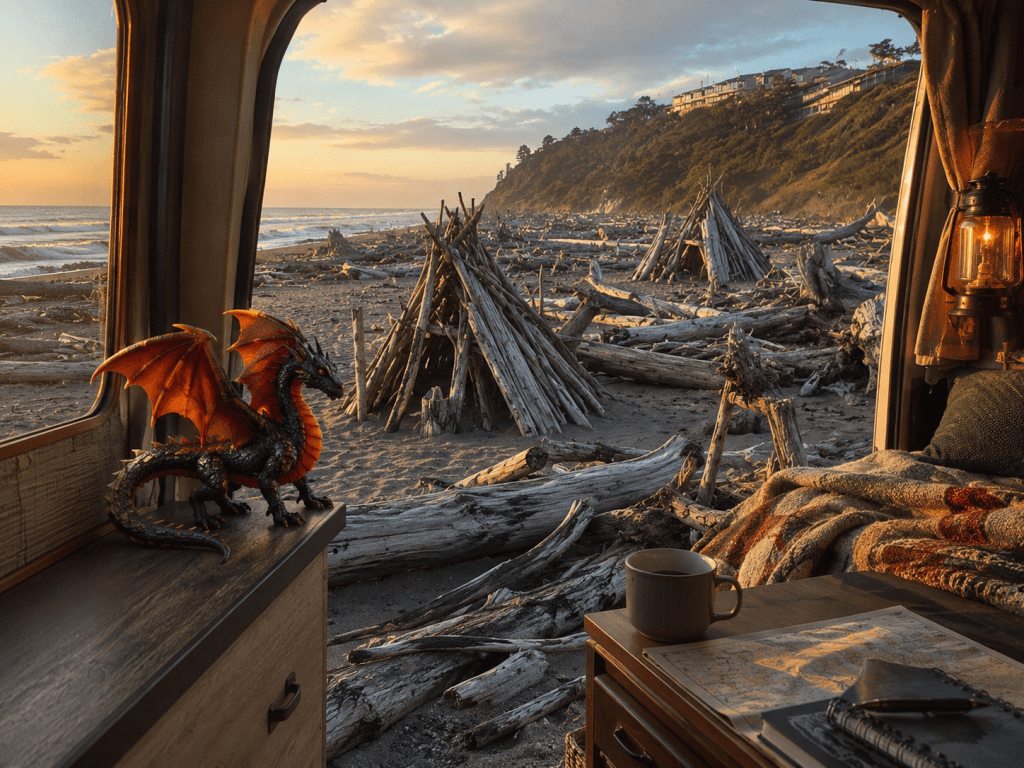
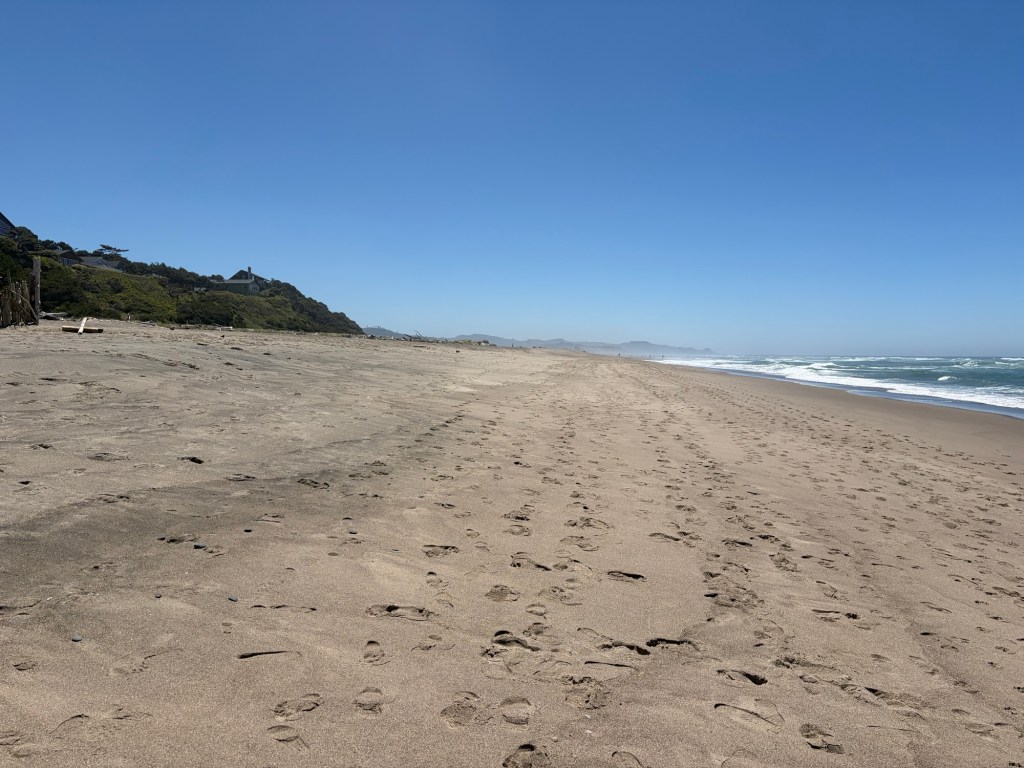
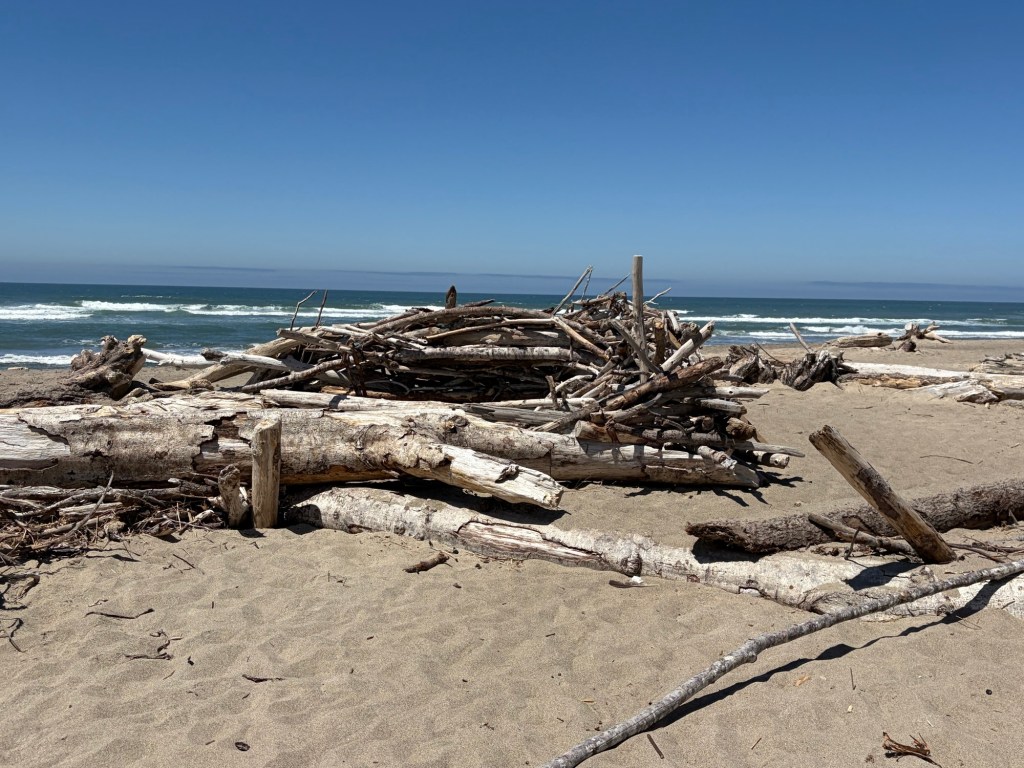
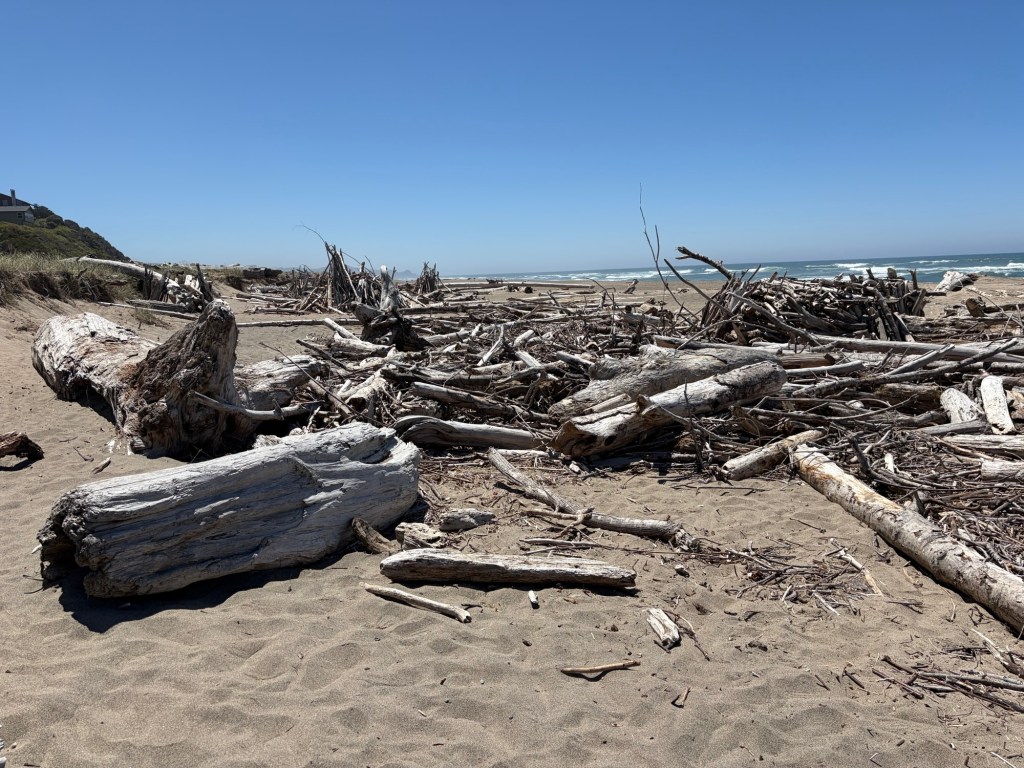
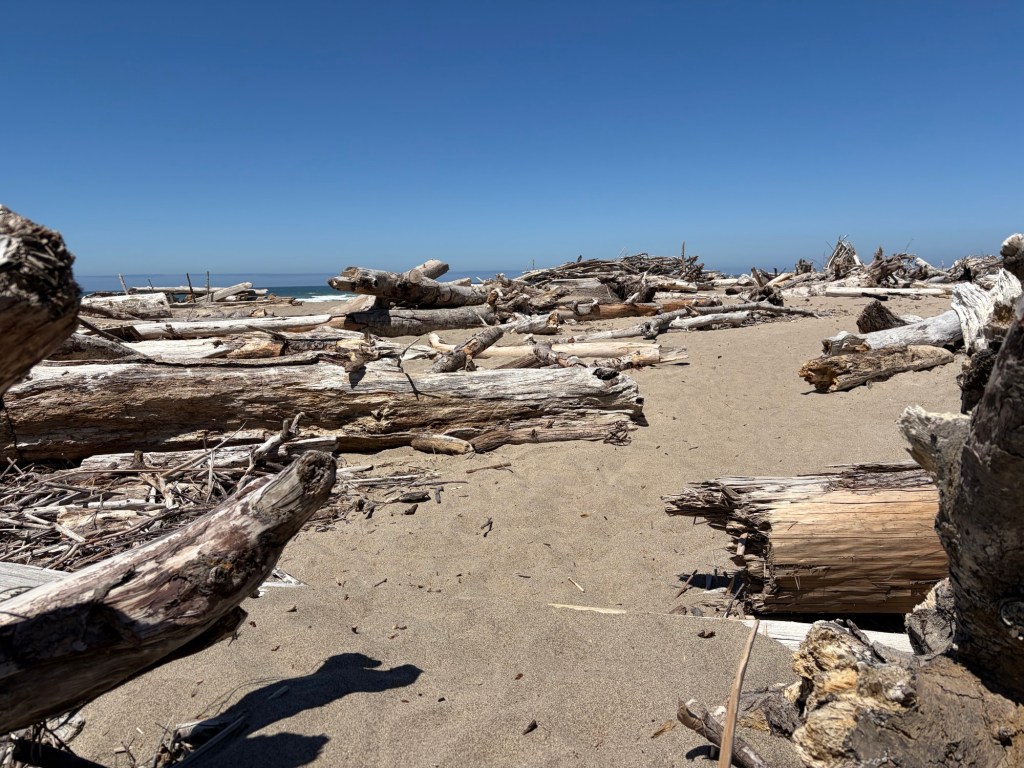
The coast understands this better than cities do. On the beach, the driftwood had arranged itself into something like a Lilliputian village. The trunks were huge, but the structures were small. It looked as if tiny builders had made shelters from the wreckage of giants. That was the right image: a small world built from large forces. Ocean, storm, time, trees, sand — all of it reduced into little huts and pathways a person could walk among.
That is what I am doing too.
I am taking large forces — age, memory, body, grief, desire, money, partnership, movement, old fear, new freedom — and arranging them into something I can actually live inside for a day.
A van. A walk. A dragon on the ledge. A coconut drink. A campground. A beach. A closed window. A warm night.
These are not small because they are meaningless. They are small because they are usable.
The dragon helps because it does not need to be explained. It is. It rides in the van. It sits by the window. It brings back a tender part of me without asking me to defend tenderness. It is fierce but contained, fire-blooded but placed. It is not human, not pet, not gear. It is a familiar because it makes visible an inner force I am learning to travel with.
That may be the deeper quest: not only to find places I would return to, but to find the version of myself I can return with.
Not the self who hides.
Not the self who performs.
Not the self who buys permanence to solve a moment.
Not the self who lets the social field pull importance too far away.
The self who can move and still stay near.
Near to the body. Near to pleasure. Near to clothing that fits the day. Near to the walk that is therapy, not only exercise. Near to the companionable object. Near to the question before it becomes a conclusion.
The quest asks for discipline, but not the old discipline of deprivation. In Europe, the bag chose the role. The inventory was left behind. In the van, the inventory travels with me, so the discipline is different. I must choose the role and then not keep reaching into the stored possibilities. The active mode must remain active long enough for the body to inhabit it.
That is also true of places.
I cannot ask every place to become every place. Florence does not need to be Astoria. Waldport does not need to be Bend. Eugene may be a transition chamber, not a destination. Sisters Garden may be a place where the body learned it could sleep warmly. The beach may be a story-place. A place can have one function and still matter.
A return place is not necessarily where I stay forever.
It is where something in me says: this worked. I could come back.
That is enough.
The quest, then, is a quiet one. It is not a line on a map so much as a set of bodily recognitions. I go, I walk, I rest, I notice. I ask whether the place receives me. I ask whether I remain myself there. I ask whether the mammal settles or only endures. I ask whether the mind can be busy without frightening the body. I ask whether the day gives me a verb.
Walk.
Bathe.
Write.
Sleep.
Return.
And when a place gives me one of those cleanly, I mark it.
Not as conquest.
As invitation.
WE&P by: EZorrillaMc&Co.


You must be logged in to post a comment.