Boston Pops 4th of July Spotify Play list
Tchaikovsky’s 1812 Overture is one of the most famous pieces of classical music in the world, largely because of its sheer bombast. Here are a few fun facts about how it came to be and what makes it unique:
1. It has nothing to do with the American War of 1812
Despite being a staple at Fourth of July celebrations in the United States, the piece was written to commemorate Russia’s successful defense of Moscow against Napoleon Bonaparte’s invading Grande Armée in 1812.
2. Tchaikovsky absolutely hated it
He was commissioned to write it for the completion of the Cathedral of Christ the Saviour in Moscow. Tchaikovsky begrudgingly accepted the job, writing to his patron, Nadezhda von Meck: “The overture will be very loud and noisy, but I wrote it with no warm feeling of love, and therefore there will probably be no artistic merits in it.” Ironically, it became his most financially successful work.
3. The score calls for literal artillery
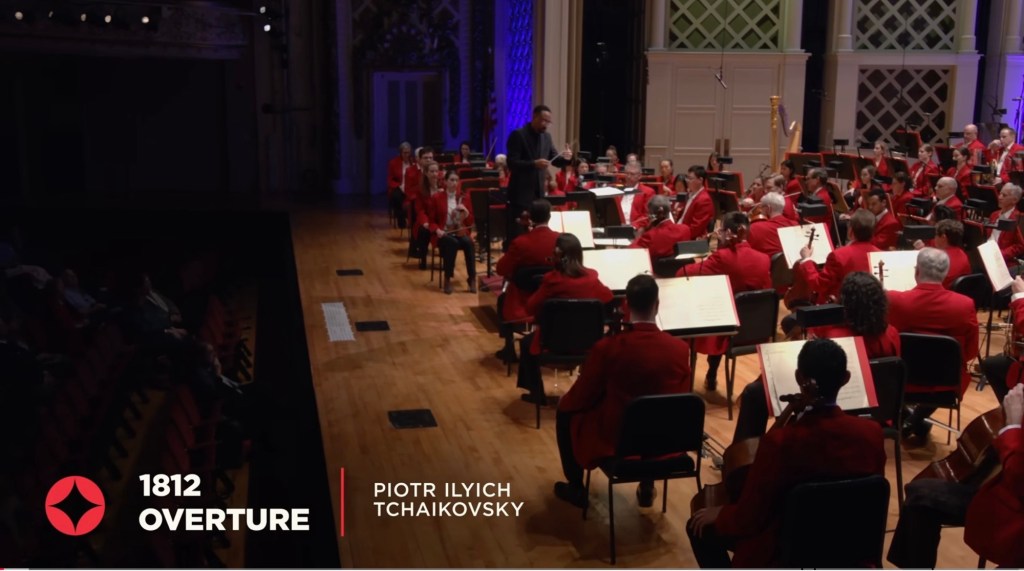
Tchaikovsky didn’t just want loud drums; the sheet music specifically calls for the firing of cannons. His original vision was to have an orchestra play outside in a public square, connected by wires to actual cannons that would be fired on cue. While modern indoor performances usually substitute a massive bass drum or synthetic sounds, outdoor performances (like the Boston Pops on Independence Day) still use real military howitzers.
4. It contains a major historical inaccuracy
The overture tells the story of the battle through music. When the French are advancing, the orchestra plays the French national anthem, “La Marseillaise.” When the Russians rally and win, the music shifts to the Russian Imperial anthem, “God Save the Tsar!” The funny part? Napoleon had actually banned “La Marseillaise” during his reign, so the invading French troops never would have been singing it.
5. It was supposed to feature all of Moscow’s church bells
For the grand finale representing the Russian victory, Tchaikovsky envisioned every single church bell in Moscow ringing at once. The original 1882 premiere took place in a tent near the unfinished cathedral, and while it was a success, it lacked the synchronized city-wide bell ringing and real cannon fire he had originally dreamed up.
Pyotr Ilyich Tchaikovsky
Pyotr Ilyich Tchaikovsky (1840–1893) is widely considered one of the greatest composers of the Romantic era and the first Russian composer whose music made a lasting impression internationally.
Early Life and Education
Born in Votkinsk, Russia, Tchaikovsky showed an exceptional musical aptitude as a child. However, because a career in music was not considered respectable at the time, his parents sent him to the Imperial School of Jurisprudence in St. Petersburg to become a civil servant. He worked in the Ministry of Justice for three years before his passion for music led him to enroll in the newly established St. Petersburg Conservatory. There, he received formal Western European training, which he later brilliantly fused with native Russian musical elements.
A Brilliant Yet Turbulent Career
After graduating, he moved to Moscow to become a professor of harmony at the Moscow Conservatory. It was here that he composed many of his masterpieces. Tchaikovsky’s work is celebrated for its unmatched melodic inspiration, emotional depth, and brilliant orchestration.
He is best known for:
- Ballets: Swan Lake, The Sleeping Beauty, and The Nutcracker.
- Symphonies: Particularly his Fourth, Fifth, and his deeply tragic Sixth Symphony (the Pathétique).
- Operas and Concertos: Eugene Onegin, his First Piano Concerto, and his Violin Concerto.
Personal Life
Despite his enormous professional success—which included a triumphant tour of the United States in 1891, where he conducted at the inaugural concert of Carnegie Hall—Tchaikovsky’s personal life was fraught with turmoil.
He struggled deeply with depression, exacerbated by the societal pressure to hide his homosexuality. In a disastrous attempt to quell rumors, he married a former student, Antonina Miliukova, in 1877. The marriage lasted only weeks and drove him to a nervous breakdown.
For 13 years, Tchaikovsky was financially supported by Nadezhda von Meck, a wealthy widow who admired his work. They exchanged over 1,200 letters but, by mutual agreement, never met in person. Her patronage allowed him to compose full-time until she abruptly ended the relationship and the funding in 1890, claiming bankruptcy.
Final Years and Death
Tchaikovsky died suddenly in St. Petersburg in 1893 at the age of 53, just nine days after conducting the premiere of his Sixth Symphony. The official cause of death was attributed to cholera, contracted from drinking unboiled water at a local restaurant. However, historians and biographers continue to debate whether his death was accidental or a forced suicide ordered by a secret “court of honor” due to his private life.
WE&P by: EZorrillaMc&Co.


You must be logged in to post a comment.