
What the Mammal Knows
There is a sentence that takes some getting used to:
The cognitive self is not the opposite of the mammal. It is one of the mammal’s tools.
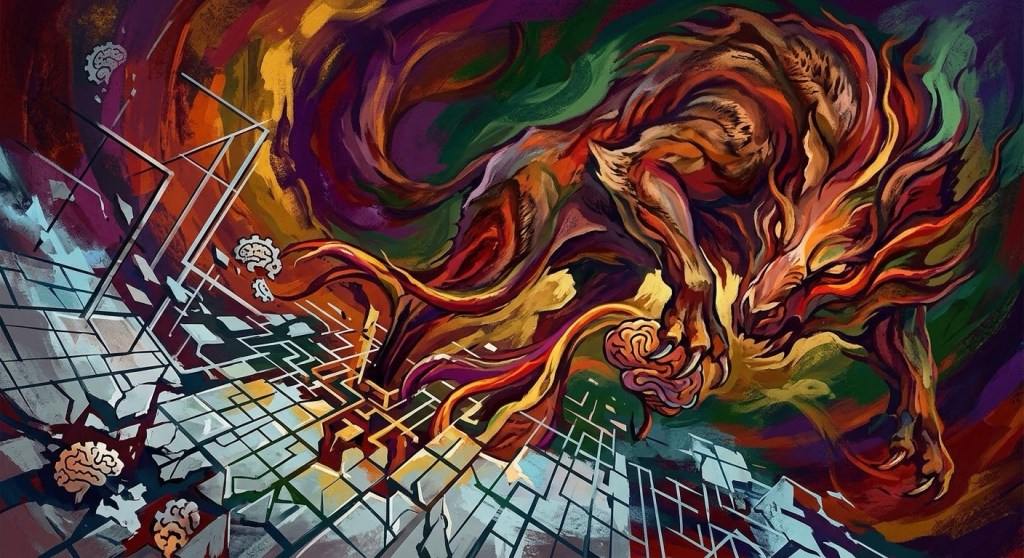
The sentence inverts a hierarchy that most of modern life takes for granted. The hierarchy places the mind on top — the rational self, the conscious agent, the locus of identity — and the body underneath, as a kind of biological machinery the mind operates. I am a mind that has a body is the common way of putting it. The mind is who I am; the body is what I have.
The sentence reverses this. It says: I am a body that has a mind. The body is what is alive. The mind is what the body uses.
Stated quickly, this lands wrong for many readers. It can sound reductive — as if we are being told that we are nothing but animals, that thought and language and culture are merely epiphenomena, that the rich interior life of the human being is being explained away by biology. That is not what the sentence is doing. To see what it is actually doing, we have to slow down on the word mammal and look at what it precisely means.
Why Mammal, and Not Some Other Word
There are several candidate words for what we are at substrate. Animal is too broad — it includes everything from sponges to insects, and the relevant features of our biological inheritance get lost in the breadth. Creature is too vague — it gestures at being-alive without specifying what kind of being-alive is at stake. Organism is too clinical — it places the human alongside bacteria in a way that misses what is structurally distinctive about us.
Mammal is the word that fits, because it carries precisely the right cluster of features. To be a mammal is to be:
Warm-blooded. The body maintains its own internal temperature. Cold is not just uncomfortable; it is a threat to be regulated against. Warmth is not just pleasant; it is a basic condition of life.
Born live and nursed. Every mammal began as an infant who could not survive without prolonged caregiving. The capacity to receive care, the dependency on it, the formation of the self through it — these are constitutive features, not optional add-ons.
Bonded to caregivers. Mammals form attachments. The capacity for attachment is built into the species at a level that precedes any cultural construction. Loss of bond produces measurable distress; presence of bond produces measurable regulation.
Socially organized. Mammals live in groups of various kinds. Solitude is possible but is not the default. The presence of conspecifics — others of the same kind — is a baseline condition of mammalian life.
Sensitive to touch. The skin is a primary organ of mammalian experience. Touch regulates the nervous system, mediates bonding, signals safety or danger, communicates affection or threat. Mammals deprived of touch suffer in ways that have been documented across many species, including ours.
Rhythmic. Mammals operate on cycles — daily, seasonal, developmental. The body is not a steady-state machine but a system that moves through states of activity and rest, hunger and satiety, alertness and quiet.
Long-developing. Mammals take time to mature. The developmental period is extended. Learning happens through long apprenticeship to caregivers and to environment.
To say you are a mammal is to say all of these things at once. It is not a reduction. It is the naming of a particular kind of being whose nature includes warmth, care, bond, touch, rhythm, and slow development. These are dignified features. They are the features of beings who can love, who can be loved, who depend on each other, who need each other, who suffer when separated and thrive when connected.
The word mammal was chosen because no other word carries this cluster as precisely. Human abstracts away from the biology. Person abstracts further. Self abstracts entirely. Mammal keeps the actual creature in view, with all of its actual features intact.
What the Inversion Actually Claims
Once mammal is understood this way, the inversion becomes clearer.
The cognitive self is the cognitive capacity that has developed in our species over a long evolutionary period. It is real. It is powerful. It does things that other mammals cannot do: language, abstraction, long-range planning, cultural transmission, the construction of frameworks like this one. These are valuable capacities, and the mammal that has them can live a different kind of life than mammals that do not.
But the cognitive self is not the seat of identity. It is a feature of the mammal, in the same way that the mammal’s circulatory system is a feature of the mammal, or its skin, or its capacity for warmth. The cognitive self is more recent and more sophisticated than these other features, but it is not categorically different from them. It is part of the mammal’s equipment.
What is alive is the mammal. What needs sleep is the mammal. What needs food is the mammal. What needs warmth, contact, rest, movement, the presence of conspecifics — all of this is the mammal. The cognitive self can think about these needs, plan for them, articulate them, sometimes ignore them. But it cannot replace them. The mammal continues to need what the mammal needs, regardless of what the cognitive self thinks about the needs.
The inversion says: the mammal is what is here, doing the living. The cognitive self is one of the mammal’s tools, useful for many things, but not a substitute for the mammal and not the mammal’s master.
Why This Matters
The inherited hierarchy has structured Western thinking about the self for a very long time. In its dominant form, it places the mind in command and the body in obedience. The mind decides; the body executes. The mind is rational; the body is unruly. The mind transcends; the body limits. This framework is so embedded that most people barely notice it. They speak of managing their emotions, overriding their instincts, pushing through fatigue, getting on top of their cravings — all phrases that assume the mind is the rightful manager of the body, with the body’s signals as data to be processed or obstacles to be overcome.
When the inversion is in place, these phrases reveal themselves as the misuse of a tool. The cognitive self has been asked to manage the mammal, when its proper function is to serve the mammal. The mammal does not need to be managed. The mammal needs to be lived as.
This matters because the misuse of the cognitive self is one of the principal sources of the chronic suffering that modern interior life is full of. The mammal is asked to function as something it is not. Its needs are pathologized as weaknesses. Its rhythms are overridden by cognitive schedules. Its hunger for contact is reframed as neediness. Its requirements for rest are dismissed as laziness. Its responses to its actual conditions are interpreted as personal failures rather than as accurate mammalian information about a situation that does not fit the mammal’s nature.
The inversion restores the mammal to its proper status. The mammal is not the lower part of the self that the higher part has to manage. The mammal is the self. The cognitive self is the tool. When the tool is used well, the mammal flourishes. When the tool is misused, the mammal suffers — but the suffering is information, not verdict. The information is: the tool is being used incorrectly. Adjust the tool’s use to serve the mammal it belongs to.
What the Mammal Knows
There is a kind of knowledge that the cognitive self cannot produce, because it is not the kind of knowledge cognition is good at. The mammal knows it.
The mammal knows when it is tired and needs rest. It knows when it is hungry and needs food. It knows when it is alone and needs contact. It knows when it has had enough contact and needs solitude. It knows whether a particular person is safe or unsafe. It knows whether a particular environment is welcoming or hostile. It knows when something is wrong, even when the cognitive self cannot specify what.
These knowings are not opinions. They are not subject to debate. They are the mammal’s accurate report on its situation. The cognitive self can collect them, articulate them, plan around them, sometimes refine them. But the cognitive self cannot generate them. They come from the mammal, and the mammal is reliable in producing them.
Much of what passes for self-knowledge in modern life is cognitive analysis applied to mammalian data. This can be useful, but it can also be a way of overriding the data. The cognitive self can construct elaborate accounts of why the mammal’s report is wrong — why the tiredness is just stress, why the loneliness is just a phase, why the unease about a person is just my imagination. Sometimes these reframings are accurate. Often they are the tool refusing to honor the mammal’s information.
The inversion restores authority to the mammal. The mammal’s report is the primary data. The cognitive self can work with this data — interpret it, contextualize it, find responses to it — but the cognitive self does not get to overrule it. When the mammal says I am tired, the proper response is not no, you are not, you should keep working. The proper response is yes, you are tired, and now we have to figure out what to do about that.
What Changes
A person who lives with this inversion in place tends to dress, eat, sleep, move, work, and relate differently than someone who lives with the cognitive self in command.
They dress for warmth, comfort, and the body’s actual conditions before they dress for impression. They eat what nourishes the mammal, on the rhythms the mammal asks for. They sleep when the mammal needs sleep, even when this means revising their cognitive plans. They move daily, because mammals are made to move. They work with attention to the mammal’s energy cycles, taking rest when rest is what is required. They notice when they are alone for too long, and seek contact. They notice when they are over-stimulated, and seek quiet. They treat their bodies as the primary subjects of their care, not as the equipment of some other, higher subject.
They also relate to other people differently. Other people are recognizable as fellow mammals — beings with the same basic needs, the same basic capacities, the same basic vulnerabilities. The relations between people become legible as mammalian relations: contact, recognition, care, dependence, occasional conflict, eventual reconciliation. This does not reduce relationships to biology. It gives them a substrate that the cognitive self can work with rather than work against.
And they tend to relate to other animals differently. The dog is no longer a pet but a fellow mammal. The cow in the field is a relative. The whale in the ocean is a relative. The recognition extends outward from the self to all warm-blooded life. Many people who do this work find that their relation to nature, to other species, to the planet itself, changes — not because they have adopted a new ideology, but because the boundary between human and animal has dissolved into the truth, which is that the human is a particular kind of animal, with particular gifts and particular needs, living among other animals with their own gifts and needs.
A Note on the Word
Some readers will resist the word mammal throughout this post. This is understandable. The cultural script has loaded the word with associations of crudeness, primitiveness, lack of dignity. To be called a mammal feels, to many, like being demoted.
But this is exactly the problem the inversion is addressing. The word mammal is dignified in itself. It names a magnificent kind of being — warm, attached, social, capable of love and care, slow to develop, responsive to touch, rhythmic, alive. These are not features to be embarrassed by. They are features to be honored. The embarrassment is a symptom of the inherited hierarchy, which taught us that being an animal was somehow lower than being a self. The inversion corrects this. The mammal is not lower. The mammal is what is here. The cognitive self is the tool the mammal uses, and the tool, like all tools, has its proper place.
Once the inversion has been received, mammal stops being a word that feels like demotion. It starts being a word that feels like restoration. Yes, the reader recognizes, I am this kind of being. I have always been this kind of being. The cognitive self I took to be the whole of me was always just one part of a larger and warmer reality. I can now live as the mammal I am, with the cognitive self in its proper service.
This is the recognition the inversion produces. It does not diminish the human being. It returns the human being to itself, in the form the human being has always actually had.
The mammal is here.
The cognitive self serves it.
Both together are one creature, properly arranged.
That creature can finally live the life it has always had available, in the body it has always inhabited, with the tools it has always carried.
The arrangement is correct. The life can now proceed.—
WE&P by: EZorrillaMc&Co.
This is a model devised for entertainment.


You must be logged in to post a comment.