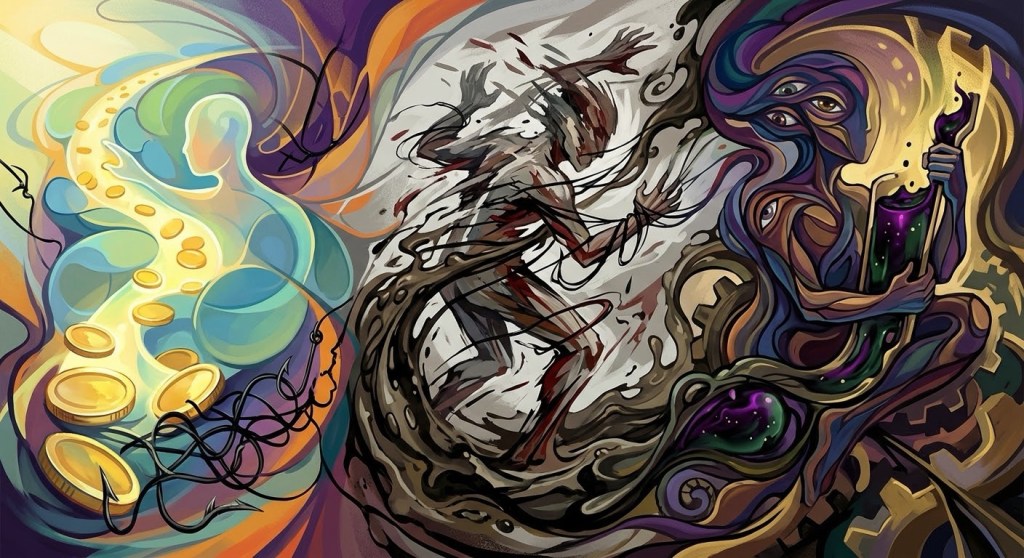
Gullibility is when someone mistakes the label for the structure.
Weakness is when someone sees the structure but cannot, or will not, resist it.
In the arms-trade example, gullibility would be believing the surface language: “consulting fee,” “local partner,” “commission,” “facilitation,” “offset agreement,” “relationship management.” The person accepts the invoice category as the moral category. They think: this is how business is done, therefore it must be business.
Weakness is different. Weakness says: I know what this is, but the deal is too important, the pressure is too high, the contract is too large, the political cost is too severe, or everyone above me wants it done. So the person does not misread the corruption. They accommodate it.
That distinction matters.
Gullibility is a failure of recognition.
Weakness is a failure of resistance.
But there is a third category too: complicity. That is when the person neither misunderstands nor merely collapses under pressure. They understand the structure and benefit from keeping it unnamed.
So the clean map is:
Gullibility: “I thought it was a normal fee.”
Weakness: “I knew it was dirty, but I could not stop it.”
Complicity: “I knew it was dirty, and the dirt served me.”
The hard part is that systems often protect themselves by making complicity look like gullibility and weakness look like prudence. Nobody says, “We are bribing an official.” They say, “We need a local intermediary.” Nobody says, “We are buying a decision.” They say, “This is standard market access.” Nobody says, “We are laundering influence.” They say, “This is the cost of doing business.”
That is why the distinction you are circling is so important. The surface label can become a shelter. Old categories such as fee, commission, gift, hospitality, business development, or strategic partnership may make the present look ordinary even when the actual structure underneath is different. The deeper discipline is to notice when the familiar label is preventing us from seeing the real transaction.
A compact formulation:
Gullibility is being fooled by the costume. Weakness is recognizing the costume and still obeying the room. Complicity is helping design the costume.
In the arms trade, all three can coexist. One person may be gullible, another weak, another fully complicit, and the paperwork will make them all look like professionals.
WE&P by: EZorrillaMc&Co.

