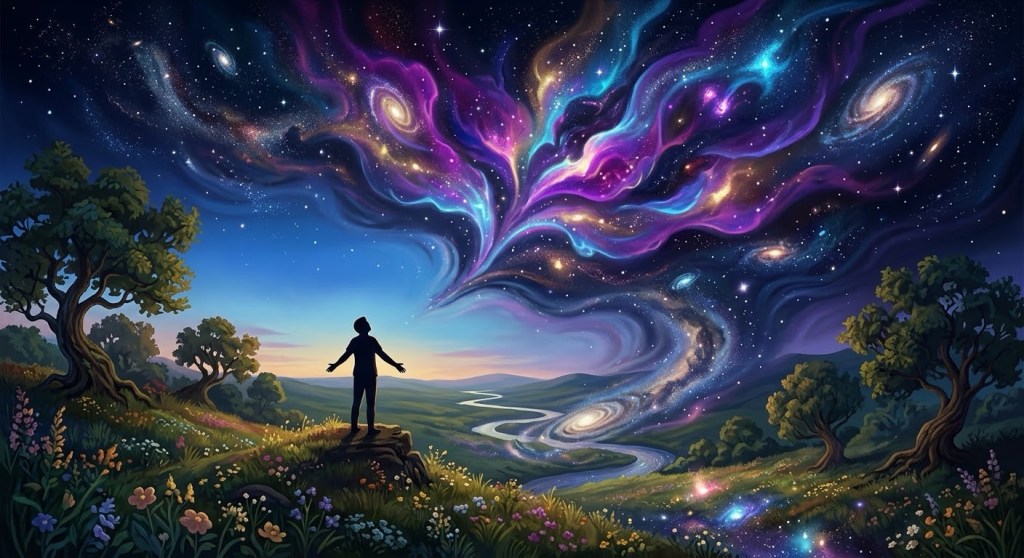
When I included space as part of nature, the universe opened up.
Before that shift, I carried a distinction I never examined closely. Nature was forests, rivers, mountains, coastlines, deserts, animals, weather. Space was something else. It belonged to science fiction, astronomy, engineering, rockets, and distances so vast they felt more conceptual than real. Nature was where life happened. Space was where life left.
I did not arrive at that belief through argument. I inherited it the way most people do. Nature was green. Nature was alive. Nature was what existed before humans arrived.
Then, slowly, the distinction began to fail.
The ocean is nature.
The atmosphere is nature.
The Moon pulls the tides. The Sun drives the weather. The iron in my blood was forged in stars that died before the Earth existed. The air, the sea, the planet, and the galaxy are not separate systems. They are one system viewed at different scales.
Once I saw that, something unexpected happened.
Space stopped feeling foreign.
It did not become smaller. It became more familiar.
The stars moved from somewhere else to somewhere larger.
A spacecraft stopped looking like a machine escaping reality and started looking like a boat crossing an ocean. A space station became a harbor. A habitat became a camp. Exploration stopped looking like departure and started looking like participation.
The same shift happened in my imagination.
Science fiction had always appealed to me because it respected initial conditions. Given these constraints, what follows? Given these resources, these distances, these laws of physics, what becomes possible? The stories felt believable because they asked the same questions physics asks.
Fantasy often begins with wonder.
Science fiction often begins with consequence.
And consequence has always felt like home to me.
Once I accepted space as part of nature, the stories changed. They were no longer about escaping Earth. They became stories about learning how to live in a larger environment. The unknown remained unknown, but it was no longer separate from the world I already inhabited.
That realization reached farther than science fiction.
It changed the way I travel.
A mission became less like a quest and more like a day sail.
You leave harbor.
You enter a larger field.
You observe conditions.
You make a few decisions.
You experience the weather.
You return with something.
Sometimes that something is knowledge. Sometimes it is perspective. Sometimes it is simply the fact that you went.
The voyage does not need to justify itself through conquest.
Participation is enough.
That is why a van on the coast, a trail through a canyon, a lighthouse on a bluff, a shuttle crossing a star system, and a station orbiting a distant planet now feel connected to me. They are all versions of the same act.
A creature moving through its environment.
A temporary shelter crossing a larger field.
A day sail.
When I included space as part of nature, the universe opened up.
Not because it became stranger.
Because it became continuous.
The world did not end at the atmosphere.
It never had.
WE&P by: EZorrillaMc&Co.

