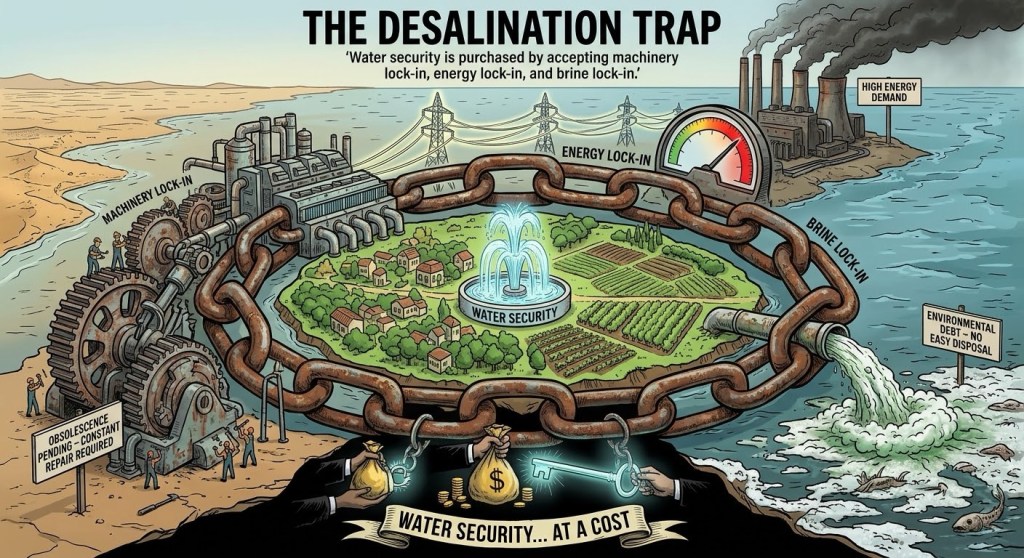
The Desalination Trap
A thirsty island does not experience desalination as an abstraction.
It experiences it as relief.
The reservoirs are low. The aquifers are strained. Rainfall has become unreliable. Tourism, population growth, agriculture, or industry keep demanding water the land can no longer provide on its own. At that point, a desalination plant can look less like a choice than an answer.
And in a narrow sense, it is an answer.
The plant takes seawater and produces fresh water. The crisis recedes. Taps run. Hotels open. Crops survive. Households stop living under immediate scarcity.
But desalination does not simply solve a water problem. It changes the form of the problem.
The island does not stop being water-poor. It becomes machine-watered.
That distinction matters.
A desalination plant is not a one-time cure. It is a permanent operating system. Once a region depends on it for a significant share of its water, the plant becomes part of the survival baseline. The community is no longer only asking, “Do we have enough water?” It is now asking, every day, whether the machinery, energy supply, maintenance contracts, chemicals, membranes, spare parts, skilled operators, intake systems, and discharge systems will keep working.
This is the first lock-in: machinery.
The plant must be maintained. Pumps fail. Filters clog. Membranes degrade. Intakes foul. Pipes corrode. Specialists are needed. Replacement parts must arrive. Budgets must keep funding the system. If the plant stops, the water stops.
What appeared as independence from rainfall can become dependence on machinery.
Then comes the second lock-in: energy.
Desalination is thirsty for power. Modern systems are more efficient than older ones, but they still require steady energy. For an island or coastal region without abundant renewable power, that often means fuel. Diesel, gas, imported petroleum, or grid electricity generated by fossil fuels may become tied directly to drinking water.
That is a severe conversion.
The region began with a water problem. It now has a water-energy problem.
Water security becomes fuel security. A rise in energy prices becomes a rise in water cost. A fuel supply disruption becomes a water emergency. A climate-stressed island may end up buying the very fossil-fuel dependence that worsens the planetary conditions making water scarcity worse in the first place.
Then comes the third lock-in: brine.
Desalination does not make salt disappear. It separates fresh water from seawater and leaves behind a concentrated waste stream. That brine must go somewhere. Often it is returned to the ocean, sometimes with treatment chemicals or temperature differences depending on the process.
Handled badly, brine can damage local marine environments. It can increase salinity near discharge points, sink toward the seabed, and stress ecosystems already under pressure. The island gets fresh water on land while exporting the concentrated residue back into the sea that surrounds it.
That is the third evil: pollution.
So the deeper structure is not simply “desalination produces water.”
It is this:
A water shortage is answered by a machine.
The machine requires fuel.
The fuel-powered process produces waste.
The waste returns to the ecology that made the solution possible.
This is why desalination can feel like a trap even when it is necessary.
The trap is not that the technology fails. The trap is that it works well enough to become indispensable.
Once the plant is built, communities may reorganize around the water it produces. Development expands. Population expectations shift. Agriculture or tourism grows into the new supply. Demand rises to meet the machine. Then the machine is no longer emergency infrastructure. It becomes the floor under ordinary life.
At that point, turning it off is not a policy adjustment. It is a crisis.
This is the same structure that appears in other forms of dependency. A short-term instrument is used to carry a long-term burden. A one-time decision creates rolling obligations. The present crisis is relieved, but the underlying condition is not removed. It is converted into a system that must be continuously fed.
Desalination can solve the immediate water problem while rolling the deeper dependency forward into machinery, fuel, and brine.
That does not mean desalination should never be built. That would be too easy, and in many places too cruel. Some regions genuinely need it. Some islands may have no clean path to water security without it. A coastal city facing drought may reasonably decide that desalination belongs in its water portfolio.
But the honest question is not only, “Does desalination work?”
It does.
The better question is: “What must keep working for desalination to keep working?”
That question changes the analysis.
It asks whether the region has renewable energy or only imported fuel. It asks whether maintenance can be sustained locally or must be purchased from outside vendors indefinitely. It asks whether brine can be managed responsibly or whether the ocean is being treated as an invisible ledger. It asks whether desalination is being used as a bridge toward resilience or as permission to continue growth beyond the region’s natural water limits.
The danger is not the plant itself.
The danger is mistaking a plant for freedom.
A desalination plant may provide water, but it also creates a standing claim on the future: future energy, future parts, future technicians, future budgets, future environmental tolerance. If those claims are not named, the public is sold a solution while inheriting an operating obligation.
That is the real desalination trap.
The island buys water once, then pays forever in machinery, fuel, and brine.
A clean public debate would say this plainly. Desalination is not escape from scarcity. It is a bargain with scarcity. It trades dependence on rainfall for dependence on infrastructure. It trades hydrological uncertainty for operational burden. It trades one kind of vulnerability for another.
Sometimes that bargain may be worth making.
But it should never be mistaken for a simple rescue.
The disciplined principle is this:
A technology that solves an immediate shortage may also create a permanent dependency.
That is not an argument against technology. It is an argument against false closure. The decision to build is only the first payment. The real question is whether the region can carry the rolling demand that follows.
WE&P by: EZorrillaMc&Co.
 Travel in Life