The Naming Version
By the time Tarin understood that the role no longer needed crisis, the day had already started.
That was the first thing he noticed.
No threshold.
No summons.
No assignment dropped into his hand with the weight of disguised instruction.
No need to make the day legible by calling it something larger before it had earned a name.
Morning on Spartan Three. Plain light. Systems report. A shuttle due for inspection at second bell. Fuel reconciliation from the previous two runs. A message from maintenance about a fault in one of the portside loading rails. Coffee gone warm enough to drink without waiting. The kind of day that, half a life ago, would have seemed too small to contain a self.
He sat at the narrow table in quarters with the report slate open and his boots on but unlaced, and watched that old reflex try once, weakly, to rise.
Narrate it.
Turn it.
Name the hidden version.
Find the larger frame.
He did not suppress the reflex. He simply saw that it was no longer required.
The life had outrun the need for advance explanation.
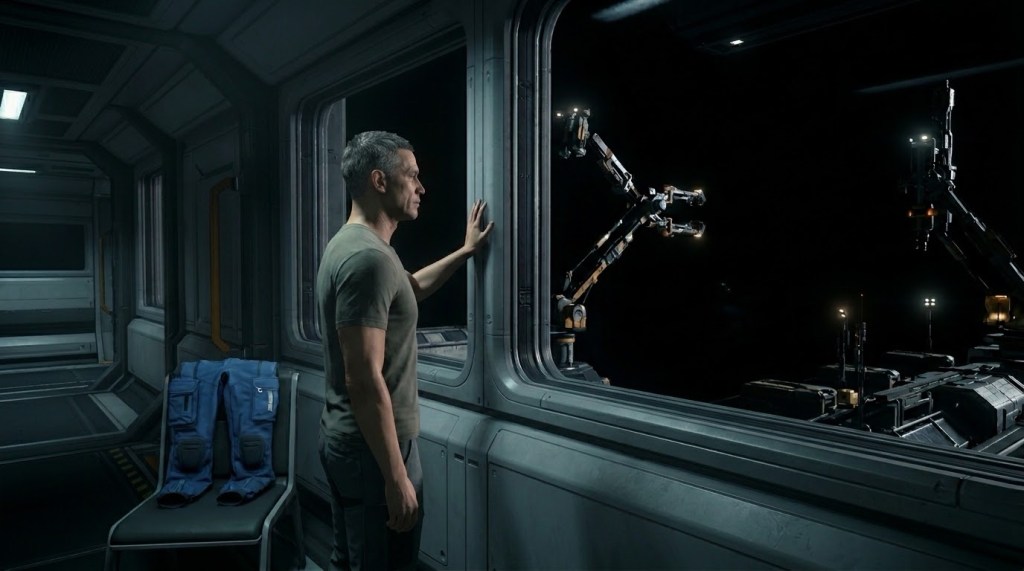
He looked across the room toward the folded clothing shelf. The blue pilot trousers were there, second stack from the left. Beside them, the black field pair. Above them, station chinos. Different cuts. Different uses. No mythology in the fabric, unless he brought it there.
That, too, had changed.
There had been a time when putting on one pair of trousers instead of another meant crossing into role with enough force that the body hesitated. The hesitation had been real. Not vanity. Not silliness. The body recognizing that clothes can stop being descriptive and begin to ask for conduct.
Now the choice was smaller and more settled.
Not because the clothes meant nothing.
Because they no longer had to carry the whole architecture by themselves.
He stood, pulled the blue pair from the shelf, and stepped into them without pause.
The old pilot motion came back at once when he sat to lace his boots: draw the fabric lightly up from the knees, make room at the joint, let the body sit without dragging itself against itself. He noticed the motion because he had once had to learn it. He no longer noticed it because it was strange.
Same life.
Ordinary use.
He tied the second boot and stayed seated a moment longer.
That was when the sentence arrived, plain enough not to need improvement.
He was no longer narrating a possible life.
He was naming the one he was already in.
It did not feel triumphant.
Nothing in him stood to salute it.
The sentence came with the quiet factuality of weather: this is what the air is doing now.
He had spent long enough in narration to know its virtues. Narration had built half the structure that held him. Captain, Commander, vessel, route, dock, frame, return. All of it had been useful. More than useful. Necessary. You could not practice a life until you had language sturdy enough to gather its parts.
But narration ran ahead of the days.
That was its job.
It pointed toward a self being assembled, selected, condensed, practiced.
Naming was different.
Naming did not run ahead.
It pointed at what the days were already confirming.
He dressed, sealed the report slate, and stepped out into the corridor.
Spartan Three in the early work cycle was one of the least theatrical environments in which a person could attempt self-deception. Lighting unchanged. Air movement steady. People already in motion for reasons that had nothing to do with him. A cargo assistant wrestling a seal case onto a trolley. Two med techs arguing softly over calibration ranges. Someone laughing once near the galley and then immediately regretting the volume. The station continued, as it always had, without arranging itself around his revelation.
Good.
That was part of the proof.
A false naming would have wanted witness.
A true one could survive indifference.
In the galley annex, Sayeed was already at the side counter with a cup in one hand and a maintenance diagram spread open on the wall screen. She had the look she always had when solving three practical problems and ignoring two social ones.
He took coffee from the dispenser and stood beside her without speaking until she said, “If this is about the loading rail, it’s not broken. It’s offended.”
“I’ll note that in the log.”
“You won’t. You lack courage.”
He drank, looked at the diagram, and said, “I think something changed.”
“Many things did. That’s how time passes.”
“In me.”
That got her to turn.
Not fast. Sayeed never turned fast for anything that mattered. She only gave important sentences the dignity of full attention once they had survived their first five seconds.
“And?” she said.
He considered telling it badly first. He had done that before with more than one truth: let the projection speak first, then refine it into accuracy. But this one did not need the rough draft. The living had already edited it.
“I stopped writing toward the life,” he said. “I’m in it now. Enough of it, anyway. Enough that I can name it from inside.”
Sayeed watched him for a moment that was long enough to become part of the answer.
Then she said, “Yes.”
No ceremony.
No congratulation.
No forcing the sentence to become larger because it was real.
He let out a breath he had not known he was holding.
“You knew?”
“I suspected.”
“And you said nothing.”
“You were still narrating. It would have sounded like instruction.”
He smiled despite himself.
That was, annoyingly, correct.
She returned her attention to the diagram, but only partly. “The trouble with narration,” she said, “is that it protects possibility from being checked. Useful in the beginning. Cowardly if extended too long.”
“I was not cowardly.”
“No,” she said. “Only careful. Excessively.”
He leaned against the counter, cup warm in his hand.
There was no need to defend the earlier stage. Narration had done real work. The roles, the naming, the selected clothes, the chosen interfaces, the vessel logic, the practices. None of it had been false. But it had all, in one way or another, pointed slightly forward. Toward ordinariness. Toward a self that would no longer need to propose itself so actively because it would already be underway.
And here it was.
Not finished.
Not secured forever.
Just actual.
Down on Bay Four, he completed the shuttle inspection without inward commentary. He checked seals, cleared the console diagnostics, logged fuel margins, ran his hand along one edge of the hatch where the thermal wear had roughened the surface just enough to catch skin. The ship did not need a story from him. It needed competence, attention, and the right order of actions.
That was another difference.
When he had still needed narration, ordinary tasks often felt too bare to hold him. He had to style them into legibility before he could inhabit them fully. Now the styling had receded just enough. Not disappeared. Receded. The interface remained, but it no longer stood between him and the life. It gave the life handles and then got out of the way.
A pilot, he thought, and this time the word did not feel like aspiration.
It felt like report.
By midday he had handled the loading rail problem, rerouted one outgoing manifest, and flown a short internal transfer between dock sectors because the assigned pilot had developed a stomach bug and refused to call it that. None of it was remarkable. That was precisely why it mattered.
The life was not proving itself by climax.
It was proving itself by repetition.
In the late cycle, after the station had quieted a degree and the traffic lanes thinned, he walked the upper service corridor that overlooked the outer docking arms. From there you could see the black spread beyond the station skin and, if the angle was right, the reflected glint of a shuttle moving home under minimal burn.
He stopped at the viewing panel and stood without arranging the moment into significance.
This had changed too.
There had been a time when every quiet vantage wanted to become a scene. A place from which to narrate what was coming, or to formalize what had just been learned. Now the black outside was only the black outside. Beautiful enough. Large enough. Not obligated to assist.
He rested one hand lightly against the panel seam.
The self-by-contrast places had taught him real things. Training stations, hard routes, rooms that did not fit, surfaces that pushed back until his shape became visible by pressure. He did not need to reject any of that. Those places had made him legible when he did not yet know how to feel himself without friction.
But there were other places too. The old apron at Spartan Two. The shuttle seat settling correctly under the body. The quiet in a cabin when the gear worked and the role fit and nothing larger was required. Places that received without distortion. Places that told him who he was by letting him fit.
And now language itself had joined the second category.
Not only friction-language. Not only the language that drafts a possible life against the pressure of what is not yet true.
Naming.
Plain enough to report what already held.
He stood there long enough for the station lights to shift toward evening cycle. Behind him, somewhere down the corridor, boots approached and passed without breaking stride. The life went on occurring around him at its ordinary speed.
When he returned to quarters, he folded the blue trousers at the end of the day with less care than he once would have. Not negligence. Familiarity. The role no longer required ceremonial handling to remain real.
Before sleep, he opened the log slate and wrote one line only.
Not a draft.
Not an entry reaching toward conclusion.
A report.
The life is here now. I can name it plainly from inside.
He read the sentence once.
It did not feel grand enough for the work that had made it possible.
That, too, was part of its truth.
He sealed the slate, set it aside, and turned out the light.
Tomorrow would ask for the same life again in smaller pieces. Fuel, route, clothing, ship, people, timing, body, return. No sentence would be needed for most of it. The naming had already done its work by revealing that the days themselves could now carry the truth without continuous explanation.
In the dark, before sleep took hold, he understood something final about the season that had just ended.
He had not failed to become the narrated version.
He had lived long enough inside it for the narration to become unnecessary.
That was all a scaffold could ask of the building.
And all a life, once actual, needed from language was this:
to be named accurately,
then lived.
He no longer needed to tell the life what it meant in order to live it. Morning would come with its small exact demands — clothing, route, fuel, bodies, return — and he would meet them from inside the shape they had already made. The role had not disappeared. It had settled far enough into ordinary use that naming could fall silent. Outside the station glass, the dark held without comment. Inside, the life held too.
WE&P by: EZorrillaMc&Co.
 Travel in Life