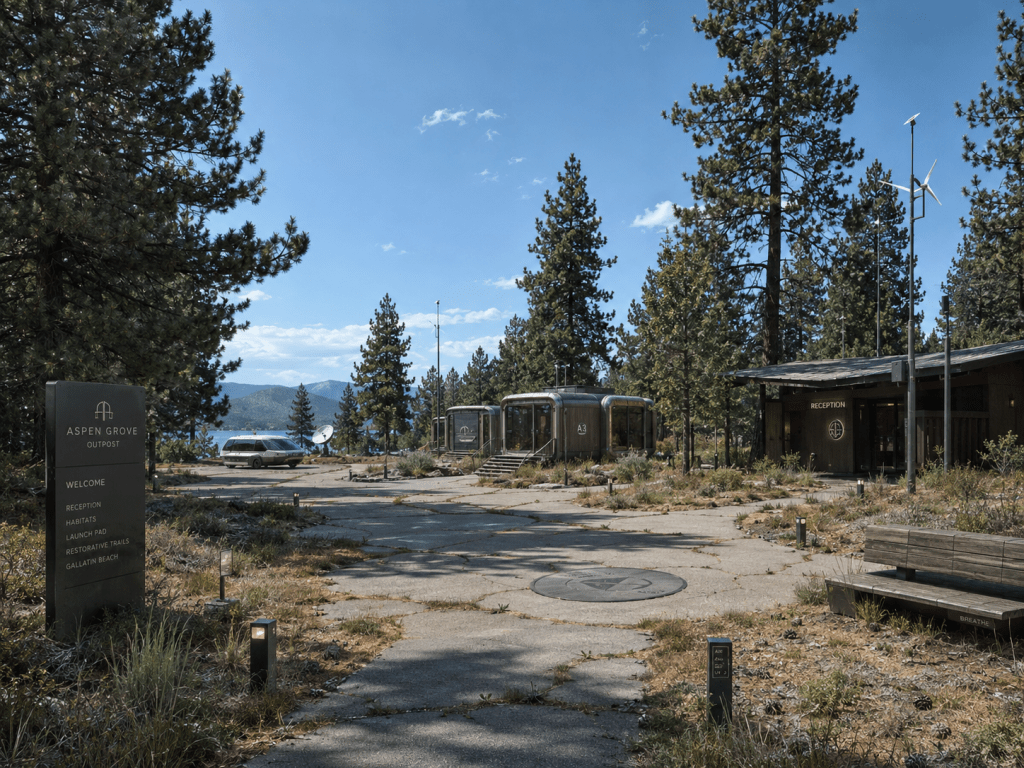
The shuttle had already begun its descent when Sayeed stopped pretending the transfer would be quick.
“Repair window’s longer than the manifest says,” she said, eyes on the side display rather than on him. “Two hours if they’re honest. More if they’re Spartan Two.”
Tarin kept one hand light on the controls and the other near the attitude trim. Below them, the station had just come into view through the forward glass: low structures, docking arms, a spread of thermal scars across the outer skin that made the place look less built than cauterized.
“In that case,” he said, “I admire their optimism.”
Sayeed made a sound that was not quite laughter.
The techs in the rear compartment were strapped in beside the cases, quiet now that the flight had become real. Coolant rigs. Pressure packs. Bone mesh. Repair tools secured in gray crates with orange seals. Whatever had failed at Spartan Two had failed low enough to require medical supplies and precise enough to require specialists.
Tarin had stopped asking for the whole story years ago. Cargo usually told him enough.
He adjusted their approach by half a degree.
“Who’s receiving?” he asked.
“Station maintenance chief. One medic. One quartermaster who will act as if this is our fault.”
“So, standard hospitality.”
“Mm.”
He glanced sideways at her.
Sayeed had unsealed the top clasp of her field jacket but not loosened it. Her slate rested against one thigh, live with diagrams she had not looked at for the last four minutes because she already knew them. That was how he could tell the job mattered. When it did not, she kept reading.
“You’re going in with them,” he said.
“Yes.”
“And I stay with the ship.”
“You say that like abandonment.”
“I say it like clarification.”
Now she did look at him, only briefly.
“You’re the return pilot, Tarin. That is not decorative.”
“No one said decorative.”
“You were implying neglected.”
“I was implying parked.”
The corner of her mouth moved, then decided against commitment.
Below them, Spartan Two grew larger without becoming friendlier. Tarin had trained there half a life ago, when the corridors still smelled of sealant and overheated wiring, and every senior officer seemed to believe that urgency could replace coherence. Memory had made the place bigger than it was. Training grounds often expanded that way after you left them. They took up more room in recollection than they ever had in space.
From here, under flat light, the station looked exactly as unromantic as it should have.
Good.
He preferred ugly places that did not pretend otherwise.
“Do they know how long you’ll need?” he asked.
“We gave them a range.”
“That bad?”
“That undefined.”
He nodded toward the rear. “And the medical load?”
“Precautionary.”
“That’s not an answer.”
“It is on stations.”
He let that pass.
The shuttle entered the outer marker cleanly. A soft tone pulsed once through the cockpit, then settled into the quieter sequence of final approach. Tarin’s hands adjusted almost without thought. Velocity. Drift. Alignment. The old pilot part of him liked this phase best: enough constraint to be exact, not enough yet to be crowded.
The younger of the two techs leaned forward slightly from the rear compartment.
“You’ve flown Spartan Two before?” he asked.
Tarin did not turn. “Once or twice.”
Sayeed, beside him, said, “He trained here.”
He disliked the shift in silence that followed that answer. Not the fact of the training. The weight other people gave it. As if once a place had formed part of you, it remained obliged to explain you forever.
“Half a life ago,” he said.
The tech settled back.
Outside, the southern apron lights came up in a staggered line, faint against daylight. Tarin checked the readouts again, though he did not need to. Stable. Cargo balance unchanged. Wind negligible. Spartan Two transmitting with its usual combination of competence and resentment.
He felt the first hint of the old wobble then, not strong enough yet to deserve a name.
Not fear. Not reluctance.
Something more irritating.
The mind beginning to cast for scale.
How long would he be stuck there. Whether there would be time to do anything useful. Whether the wait would flatten into boredom. Whether Spartan Two was still the sort of place that made a man account for himself even while doing nothing at all.
He recognized the motion and disliked it on sight.
Too early for that.
He let the thought pass and stayed with the descent.
Sayeed must have noticed something in his face, or perhaps only the quality of his silence.
“It’s a hold, not a sentence,” she said.
“I know.”
“You deliver. You wait. You bring us back.”
“That does sound disappointingly finite.”
“It is supposed to.”
The shuttle crossed over the outer arm and aligned with the apron.
There it was again, lightly this time: the temptation to make the trip something larger before it had even landed. To ask whether there would be a broader route after the handoff, whether the old survey range still existed, whether there was some way to enlarge the frame so the day might feel less like a transfer and more like a mission.
He saw it, and because he saw it early, it lost some of its force.
Deliver. Hold. Return.
That was enough. Or rather, it would have to be enough before it became anything else.
The station surface rose to meet them, ugly and exact.
Sayeed touched two fingers to the side panel and brought up the final docking confirmation. “Once we’re down, maintenance takes the aft cases first. Med gear second. If the repair team’s smart, they’ll want the power diagnostics before they uncrate the mesh.”
“And if they’re not smart?”
“They work at Spartan Two,” she said. “So let’s allow for mixed outcomes.”
That earned a breath from him that nearly became a laugh.
Better.
The shuttle settled lower. Tarin could see ground crew now: three figures in pale work shells, one quartermaster already standing with the posture of someone prepared to be dissatisfied by timing, weather, gravity, or other people.
“Your admirers await,” he said.
“They’re yours until I step out.”
“Cruel.”
“Accurate.”
He brought the shuttle in with a clean final correction, a touch of left drift canceled just before contact. The landing struts took the weight with a soft double jolt, more felt through the seat than heard.
For a moment nothing happened.
Then the systems shifted modes. Exterior clamps armed. Apron pressure sync offered and was refused. Rear compartment lights brightened. One of the techs unsealed his harness before the indicator finished changing.
Tarin kept his hands on the controls a second longer than necessary, eyes forward.
Spartan Two sat where it had always sat, stripped of memory now by direct view. Smaller than training. Harder at the edges. Less haunted, maybe, simply because the place no longer had to carry the burden of becoming.
Sayeed unfastened her harness.
“Two hours if they’re honest,” she said again.
“More if they’re Spartan Two.”
“Exactly.”
She stood, collected her slate, then paused with one hand against the back of his seat.
“Stay with the ship.”
The words landed more deeply than they should have, precisely because she had not tried to improve them.
He looked up at her.
“Pilot,” he said.
Something in her expression eased, just enough to count.
“Pilot,” she agreed, and went aft to join the others.
Tarin listened to the first sounds of unloading begin behind him: straps released, cargo shifted, the low practical voices of people whose work had already moved on to the next necessary thing.
He sat alone in the front of the shuttle, hands resting lightly now, Spartan Two spread flat beyond the glass, and felt the day narrow into its actual shape.
Not command.
Not less.
Hold with the ship.
That was the frame.
WE&P by: EZorrillaMc&Co.

