The Return Version
They were halfway to Spartan Two before Tarin understood that this was not a repeat of the medical run.
Not because the shuttle felt different. Same narrow cockpit. Same forward glass. Same soft vibration under the seat when the lane held steady. Same blue pilot trousers, tougher at the knee, cut for sitting, bracing, standing, returning. The difference was in the cargo and in the people behind him.
Not emergency cases this time.
Tool crates. Cable spools. Diagnostic cores. Sealant cartridges. Two station technicians from Spartan Three, one already asleep against the harness, the other reviewing repair maps with the expression of a man preparing to be disappointed by someone else’s prior work. Sayeed sat in the copilot seat with her slate dark across one thigh, which usually meant she had already read everything that mattered.
Tarin kept the shuttle on course and said, “This one at least has the dignity to admit it’s repair.”
“It has the dignity to leak in a documented way,” Sayeed said.
“That’s rare.”
“It’s Spartan Two. Their failures are either obvious or mythologized. This one was considerate enough to become obvious.”
He glanced at her.
“You’re in a mood.”
“I’m in a shuttle.”
“That usually improves you.”
“Only when the pilot is quiet.”
He let that pass.
Below them, nothing yet but distance and the thin gradation of light over the outer structures. Spartan Two would not be visible for another few minutes. The tech in back turned a page on his slate too hard. The sleeping one did not wake.
This time Tarin knew the frame before it had to teach him.
Deliver the technicians. Hold with the ship. Wait through repairs. Bring them back to Spartan Three when Sayeed released the shuttle.
Simple enough.
Only now, knowing it was simple, he could also feel the old temptation to enlarge it. Not strongly. Not enough to trouble the hands. Just the familiar cast of mind that wanted a role either grander or emptier than it was. Make it a mission. Make it a mere errand. Anything but exactly itself.
He watched the thought arrive and did not take it.
The last trip had given him something useful: not a revelation, not a cure, only a proof. A frame did not have to become large to become real. It only had to fit.
Sayeed must have noticed some version of this in him.
“You’re calmer this time,” she said.
“I’ve lowered my standards.”
“No. You’ve stopped trying to turn the shuttle into a referendum.”
“That too.”
One corner of her mouth moved, not enough to count as a smile in any official register.
He flew another minute in silence, then said, “How long?”
She tapped the slate awake. “Three hours if they’re lucky. Four if the fracture in the conduit spread when they shut down. Longer if maintenance chief Daran starts giving speeches.”
“That name again.”
“He enjoys being disappointed before events warrant it. It gives him continuity.”
“Useful quality in a station man.”
“Less useful in a listener.”
He nodded toward the rear compartment. “And I wait.”
“You stay with the ship.”
“Yes, yes.”
Sayeed angled her head slightly. “You say that now as if you believe it.”
“I’m trying out aspirational condensation.”
That got her attention.
She looked at him fully then, not suspicious, exactly, but alert in the precise way she reserved for sentences that might be either very stupid or very good.
“Are you.”
“I think so.”
“Pilot version?”
“Pilot version.”
He kept his eyes on the route display while he said it, because that made it easier to hear whether it was true.
The old failure modes were still there if he wanted them. He could make the trip theatrical in his head, turn a technician run into frontier drama, imagine himself some romantic courier in a hard little ship carrying civilization between wounded stations. Or he could strip it dead and reduce it to weight, fuel, time, waiting, return, a list of actions with no charge in them at all.
Both were available.
Neither was useful.
What the last trip had shown him was the strip between them. Close enough to be true. Styled enough to be inhabitable. Not pretending. Not flat.
He had flown boats and shuttles and ugly routes between necessary places for most of his adult life. Weather, provisioning, body state, fuel, return window, mechanical tone, timing. None of that had been invented. The role only selected it, compressed it, made it visible all at once.
The title followed the vessel. That had turned out to be true in more ways than he liked.
Sayeed said, “You’re thinking too hard for approach.”
“I’m not at approach.”
“You’re rehearsing a paragraph.”
He did not deny it.
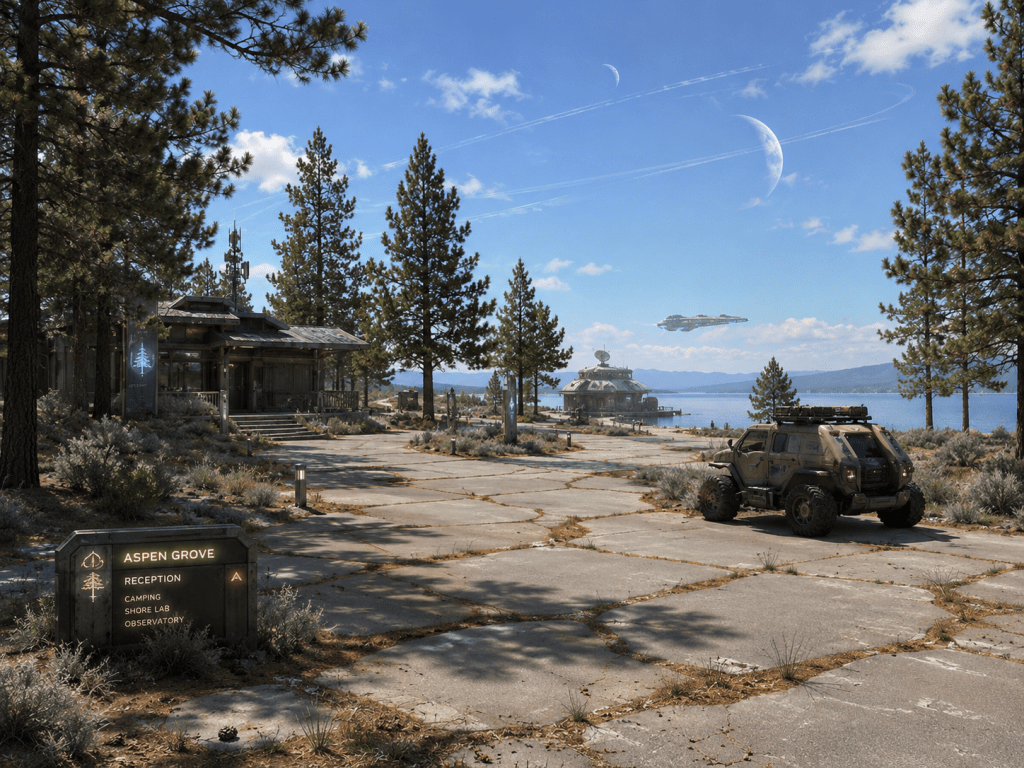
Below them, Spartan Two came into view, low and broad and no more beautiful than last time. Hard docking arms. Thermal scars. Functional ugliness with enough weathering to make the edges almost honest.
Tarin felt something quieter than pleasure move through him.
Recognition through use.
Not because Spartan Two was attractive. Because it fit what it was for, and now he could arrive without demanding it become anything else.
He brought the shuttle down cleanly.
This time the handoff took longer on the ground. Cases unloaded. Tool crates checked against a manifest. Maintenance chief Daran turned out to be even less decorative than promised: a narrow man with the spiritual fatigue of someone born thirty years old.
“You’ll need to stay available,” Daran said, looking at Tarin as though he had personally cracked the conduit.
“I’m the return pilot,” Tarin said.
“Yes. That.”
Sayeed had already moved on with the techs.
“Three to four hours,” she said over one shoulder.
“Optimism again,” Tarin said.
She kept walking. “Use it while it lasts.”
He did.
The first hour he stayed with the shuttle properly. Powered down nonessentials. Logged battery margin. Checked coolant stability. Ran a short sustainment cycle through the field shelf. Heated broth, not because he was hungry yet but because the gear had to be tested and because sequence mattered. He stood in the side hatch while the unit worked and watched the old apron spread out in flat light.
The second hour was where the choice appeared.
He could remain by the ship and let the waiting curdle into a virtue. Or he could walk.
The last time, the apron itself had been enough. The clean fit of role, ship, gear, and return had closed the loop. This time the loop had closed earlier. Which meant there was slack.
He checked the shuttle once more, sealed the hatch, keyed local comms to his wrist unit, and stepped out across the old training ground.
On foot, Spartan Two altered.
Not dramatically. That would have been easier to understand.
At shuttle distance, the station was function and silhouette. On foot, it became a place composed of small permissions and refusals. Service paths cut through basalt and dust. A low bench outside a sealed auxiliary shed, not inviting, merely available. Old guide markings half weathered off a retaining wall. A stretch of cracked surface where scrub had come up patient and unembarrassed through the breaks. Pipes run overhead in one corridor, buried in another, as if the station had changed its mind halfway through construction and then gotten tired.
He walked without hurry.
That was new too.
A younger Tarin would have turned the walk into reconnaissance. Inventory, judgment, tactical reading, some excuse to remain in command of what was only being offered. Now he let the place come in at its own speed.
Some places told him who he was by not fitting him. Spartan Two had once done that in abundance. Training ground, hard surface, refusal, correction, velocity without comfort. He had known himself there by contrast.
This was different.
Not because Spartan Two had softened. It had not. The station was still ugly, procedural, underloved. But now he no longer needed its resistance to read himself. He could walk a path between structures, look out toward the long open basalt beyond the southern array, and feel not the old friction but a kind of fit.
Not joy exactly.
Extension.
The place did not ask much. That was what he had not known how to read when he was younger. He had mistaken lack of demand for lack of meaning.
A maintenance hatch stood open near the conduit yard. Somewhere ahead, metal rang twice and stopped. Voices moved behind a wall and flattened into station noise. None of it arranged itself around him. None of it cared that he was there to find a thought.
Good.
The game, he realized, had never been departure from the life. That was the childish misunderstanding. Nor was it mere logistics with better clothes. The role was the life, selected and condensed until the right things stood out together.
Styled true, he thought, and nearly laughed at himself.
He circled back toward the shuttle after another half hour, not because he was done, only because the walk had already given what it could without becoming greed. The ship sat where he had left it, low and practical, exactly large enough to take everyone home. He liked it more for that.
When the recall signal came through, it was Sayeed’s voice.
“Repair complete. Daran remains himself. Prepare for return.”
“Confirmed.”
The technicians boarded with the post-repair quiet of men whose work had required enough concentration to burn through conversation. One dropped into the rear harness and shut his eyes immediately. The other smelled faintly of heated insulation and relief.
Sayeed climbed into the copilot seat, sealed her harness, and exhaled once as if setting something down internally.
Tarin waited until they were clear of the station and back in lane before he said, “It’s different on foot.”
Sayeed adjusted the side display.
“Yes,” she said.
He thought that might be all of it. Then she added, “Most places are.”
He flew another minute with that.
“I thought I knew what Spartan Two was.”
“You knew what it was for.”
He glanced at her.
“And now?”
She rested one hand lightly against the edge of the console. “Now you know it can hold more than one reading.”
He considered the forward glass, the lane lines, the steady instruments.
“Some places tell you who you are by not fitting you,” he said. “Others by letting you fit.”
Sayeed was quiet long enough for him to hear that the sentence had landed.
“Yes,” she said at last. “And now you can use both.”
In the rear compartment, one of the technicians snored once, softly, then corrected course.
Tarin smiled despite himself.
The shuttle held steady. Spartan Two diminished behind them without drama. Ahead, Spartan Three waited in the same practical way the ship itself waited: not as verdict, not as myth, only as the next place the frame would become ordinary again.
He felt the blue fabric at his knees, the slight pull where the seam wanted to settle, and adjusted it with the old pilot motion before it could become discomfort.
Same life.
Denser form.
He set his hands more firmly on the controls.
Not escaping it.
Not flattening it.
Flying it home.
WE&P by: EZorrillaMc&Co.

