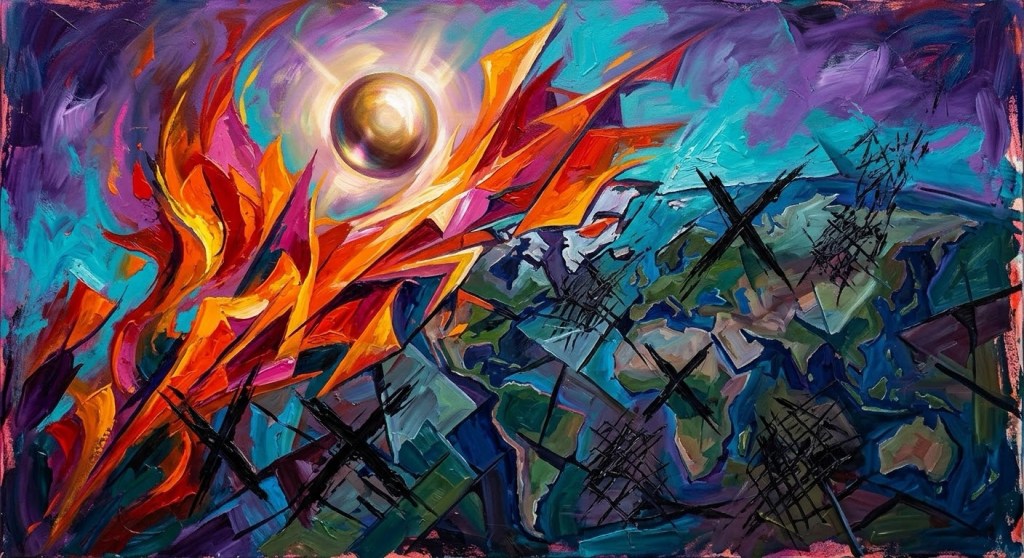
If defeat is made illegible, invincibility becomes unfalsifiable.
A movement that cannot accept defeat can keep believing in its own invincibility; but to preserve that belief, it must gradually declare reality itself illegitimate.
These two sentences form a single argument with extraordinary precision, and the precision is worth slowing down to examine because the structural insight they share is one of the most useful ones available for diagnosing failing political, ideological, and personal projects. Let me open them carefully, in order, because the second sentence depends on the first and extends it into territory that is both diagnostic and disturbing.
The first sentence: a structural truth about belief systems.
If defeat is made illegible, invincibility becomes unfalsifiable.
This is a logical claim, and the logic is exact. Let me lay out the steps.
Invincibility, as a belief, makes a particular kind of empirical promise. It says: we cannot lose. This promise is testable. Reality can confront it. If the movement loses — if it is defeated in a contest, an election, a war, a campaign, a debate — the promise has been falsified. The defeat is the evidence that contradicts the belief.
For invincibility to remain believable in the face of actual defeats, something has to be done to the defeats. They have to be made illegible — meaning they cannot be read as what they are. They have to be recategorized so that they no longer count as defeats. Once they are illegible, they cannot serve as evidence against the belief, because the belief’s standard counterexample has been redefined out of existence.
The mechanisms of illegibility are familiar. Defeats can be reclassified as sabotage. We did not lose; we were betrayed. They can be reclassified as fraud. We did not lose; the count was rigged. They can be reclassified as temporary tactical retreats. We did not lose; this is part of a larger plan. They can be reclassified as evidence of the enemy’s desperation. We did not lose; the system attacked us because we are winning. They can be reclassified as proof of the rightness of the cause. We did not lose; we are being persecuted because we are correct. In each case, what would have been a defeat under straightforward reading has been re-described as something else — something that does not register as a defeat in the movement’s interpretive system.
Once defeat has been made illegible — once it can no longer be read as defeat — invincibility becomes unfalsifiable. There is no longer any possible evidence that could disconfirm the belief. Every outcome that would have falsified it is now described in terms that confirm it. The belief has been removed from the domain of empirical testing entirely.
This is what makes the first sentence so precise. It identifies the necessary condition for sustained belief in invincibility under conditions of actual loss. The belief cannot survive if defeats are read as defeats. Therefore, for the belief to survive, defeats must be made unreadable. The illegibility is not incidental. It is the structural requirement of the belief’s continued life.
Why this is a general principle, not just a political one.
The sentence applies to political and ideological movements, but the structure is general. Any belief system that claims invulnerability — our marriage is special, our team always wins, our company cannot fail, our methodology is always correct, my identity cannot be wrong — faces the same problem when reality begins to provide counterevidence. The counterevidence has to be either accepted (which means revising the belief) or made illegible (which means revising reality).
This is the choice point that distinguishes flexible belief systems from rigid ones. A flexible belief system, faced with disconfirming evidence, updates the belief. A rigid one updates the reading of the evidence. Both are forms of cognitive work, but they have very different consequences. The first preserves the belief’s contact with reality at the cost of the belief itself. The second preserves the belief at the cost of the system’s contact with reality.
The first sentence names this trade-off in its most condensed form. Unfalsifiability is not a neutral epistemic feature. It is the marker that a belief has been removed from contact with the world. A belief that no possible evidence could disprove is a belief whose relationship to truth has been severed. It may still be felt strongly. It may still organize the believer’s behavior. But it is no longer a belief about reality. It is a belief about the believer’s relationship to a constructed system that has been protected from reality.
The second sentence: what the protection costs.
A movement that cannot accept defeat can keep believing in its own invincibility; but to preserve that belief, it must gradually declare reality itself illegitimate.
This sentence extends the first sentence’s structural claim into a temporal and political register, and it identifies the cost of the move the first sentence described. The first sentence said here is what must happen for the belief to survive. The second sentence says here is what survival in this mode requires the movement to do over time.
The movement that cannot accept defeat has two choices. It can revise the belief — admit that it lost, integrate the loss into a more accurate self-understanding, become a movement that is fallible. Or it can preserve the belief by performing the illegibility operation on the defeat. The sentence specifies which choice the kind of movement under discussion makes. It cannot accept defeat. So the illegibility operation must be performed.
But the illegibility operation has a problem at scale. A single defeat can be reclassified as betrayal or fraud or tactical retreat with relatively little strain on the movement’s worldview. The movement can hold the belief and acknowledge that this one event needs special explanation. But movements rarely lose only once. As defeats accumulate, more and more events have to be made illegible. The catalog of betrayals grows. The list of frauds grows. The accusations of sabotage multiply. The pattern of temporary tactical retreats extends across years and decades. At some point, the volume of illegible events becomes too large to be contained by case-by-case explanations.
When this happens, the movement is forced into a more radical move. It can no longer make individual events illegible while leaving the broader reality intact. It has to declare reality itself illegitimate. This is the second sentence’s central claim. The cost of preserving invincibility, over time, escalates. What begins as the reclassification of specific defeats ends as the wholesale rejection of the system that keeps producing defeats.
The mechanism of escalation.
The escalation is forced by the accumulation of evidence. If you have to explain away one election loss, you can attribute it to a specific instance of fraud. If you have to explain away three, you have to claim systematic fraud. If you have to explain away every loss the movement ever sustains, you have to claim that the entire electoral system is rigged. The scope of the rejection grows with the scope of the disconfirmation it has to handle.
The same escalation happens in other domains. A movement that loses a single court ruling can attribute it to a corrupt judge. A movement that loses many court rulings has to claim the judiciary is corrupt. A movement that loses across institutions has to claim the institutions themselves are illegitimate. A movement that finds its reality contradicted in every direction it looks has to claim that reality itself — or the version of reality presented by the institutions, the media, the experts, the elections, the courts, the scientific community — is a fabrication.
This is the gradual movement the second sentence describes. Gradually declare reality itself illegitimate. The word gradually is important. The illegitimation does not happen all at once. It happens in increments, each one slightly more expansive than the last, each one forced by the accumulation of evidence that the previous increment was not sufficient to handle. By the time the movement is declaring reality itself illegitimate, it has been through dozens of smaller declarations — this court is corrupt, this election is rigged, this media outlet is lying, this institution is captured, this science is fake — each of which prepared the ground for the next.
Why the word “must” carries the argument.
The second sentence does not say may or might. It says must. This is the modal of necessity. The claim is that the movement has no other option, given that it has chosen to preserve the belief in invincibility. The illegitimation of reality is not a choice the movement makes alongside other available choices. It is the only path that remains once the first choice — to revise the belief — has been refused.
This is what makes the argument so structurally tight. The conclusion follows from the premises with no escape route. If invincibility is to be preserved, defeats must be made illegible. If defeats are to be made illegible as they accumulate, the apparatus of illegibility must expand. If the apparatus expands far enough, it eventually has to encompass the entire reality that keeps producing the defeats. The movement does not choose to declare reality illegitimate at the end of this process. It is driven there by the logic of the commitments it made at the beginning.
The political diagnosis.
The two sentences together provide one of the cleanest diagnostic tools available for understanding movements in late stages of ideological commitment. When you see a movement that has begun to declare reality itself illegitimate — when you see institutions, media, science, electoral systems, the judiciary, expert knowledge, demographic evidence, historical record being denounced as fundamentally corrupt or fabricated — you are not looking at a movement that has discovered a genuine reality problem. You are looking at a movement that has chosen to preserve a belief at the cost of its contact with the world.
The diagnostic is precise because it tells you which way the causal arrow runs. Movements that have genuine reality complaints can usually specify their complaints, propose remedies, accept evidence that resolves them, and engage with the systems they are critiquing. Movements that have arrived at reality-illegitimation through the path the sentence describes cannot do these things. Their critique cannot be resolved by evidence, because the evidence itself has been declared illegitimate. Their complaints cannot be specified, because the specification keeps expanding to absorb whatever new disconfirmations appear. Their proposed remedies tend toward the wholesale — they want the system itself replaced, because the system itself is what keeps producing the unacceptable evidence.
You can tell the difference because of how the movement handles confirmation as well as disconfirmation. A movement with genuine reality complaints will, when it receives confirmation of its claims, treat that confirmation as evidence for its specific position. A movement that has arrived at reality-illegitimation will treat confirmation as further evidence that the system is conspiring — the rare admissions of corruption prove that all of it is corrupt; the rare exposures prove that everything is hidden. Confirmation and disconfirmation both feed the unfalsifiable belief, because the belief has been removed from the domain in which confirmation and disconfirmation operate.
The personal application.
The two sentences apply to personal belief systems as much as to political ones. An individual who cannot accept that a particular life project has failed faces the same choice the movement faces. They can revise the belief — admit that the marriage failed, the career failed, the friendship failed, the self-image failed — and integrate the loss into a more accurate self-understanding. Or they can make the defeat illegible. They can blame others, declare the situation rigged, find sabotage in everything that went wrong, construct an interpretive system in which the failure cannot be read as failure.
If they make this choice repeatedly, they end up in the same place the movement does. The apparatus of illegibility expands. More and more of their life has to be reinterpreted to preserve the central belief. At some point, they are declaring large portions of reality itself illegitimate. They cannot trust what others tell them, because others have been corrupted. They cannot trust the evidence of outcomes, because the outcomes were manipulated. They cannot trust their own past readings of situations, because those readings have been compromised by hostile forces. They live in a world that has been systematically illegitimated to protect a belief that no longer corresponds to anything outside itself.
This is not a hypothetical pattern. It is one of the most common shapes a stuck life takes. The architecture we have been building has been, in part, designed to prevent this. The capacity to accept friction as data, to recognize compliance as a bargain, to distinguish damage control from genuine repair, to revise interpretations while honoring sensations — all of these are forms of accepting reality’s reports rather than illegitimating them. The architecture is, among other things, the inverse of the process these two sentences describe. It is the practice of remaining in contact with reality even when reality is producing information that requires the revision of cherished beliefs.
Why this matters for the lexicon we have been building.
The two sentences add something to the architecture that has been implicit but not stated. They name the cost of the refusal to update. The architecture’s emphasis on accepting friction, accepting truth-but-not-enough, accepting accurate readings of one’s own conduct — all of these can be experienced, in the moment, as costly. It is uncomfortable to revise beliefs. It is uncomfortable to admit that an interpretation was wrong. It is uncomfortable to recognize a defeat as a defeat.
The sentences make clear what the alternative costs. The refusal to accept the discomfort of revision does not eliminate the discomfort. It transfers it. What would have been the acute, contained discomfort of an updated belief becomes the chronic, expanding discomfort of an illegitimated reality. The first hurts more in the moment. The second hurts more over time, and worse, it gradually disconnects the person from the world they have to live in.
This is part of what the architecture has been protecting against. The architecture asks the practitioner to accept short, contained losses in order to maintain long, sustainable contact with reality. The two sentences show what happens when this trade is refused. The trade does not stop being made. It is just made in the other direction, with much worse consequences.
The compressed version of both sentences.
The first sentence, condensed:
If you cannot read your losses as losses, you cannot test your belief in winning. The belief becomes untestable, which means it has stopped being a belief about reality.
The second sentence, condensed:
The cost of an untestable belief in winning is the gradual rejection of the world that keeps producing the unread losses. Reality, having become inconvenient, must be redefined as illegitimate. This is not a one-time move. It is a slow expansion of the territory the belief has to deny.
Together, in their compressed form:
Unfalsifiable victory requires illegible defeat. Illegible defeat, accumulated, requires illegitimate reality. The price of believing you cannot lose is, eventually, the loss of the world itself as a referent.
Why these two sentences belong together.
The first sentence is logical. The second is historical and political. Together they form a diagnostic about how movements and individuals move from being wrong to being unmoored. The logical move (making defeat illegible) is small at first. The historical consequence (declaring reality illegitimate) is enormous, and it is the necessary endpoint of the logical move sustained over time.
This is what makes the pairing useful. The first sentence shows you the move in isolation, where it might seem manageable. The second sentence shows you what the move becomes when it is repeated under pressure. The first sentence is the seed. The second sentence is the tree the seed grows into.
If you understand both sentences together, you can see the early stages of the process and recognize them for what they are. You can see when a movement, or an individual, begins to make defeats illegible. You know, then, what is coming if the pattern continues. You know that the apparatus of illegibility will expand. You know that the territory of the illegitimate will grow. You know that, given enough time and enough defeats, the movement or the individual will arrive at a position from which reality itself is rejected.
This is one of the most useful diagnostic frames available for late-modern politics, and also for late-stage personal patterns. It tells you what to watch for, what to fear, and what the architecture has been working to prevent.
The deepest claim.
Underneath the two sentences is a claim about what it means to be in contact with reality at all. To be in contact with reality is to allow reality to disconfirm your beliefs when reality produces disconfirming evidence. The disconfirmation must be readable. The defeats must be legible. The losses must register as losses. The mistakes must register as mistakes.
The moment any of these begin to be made illegible, contact with reality starts to be lost. The loss is gradual. It is rarely catastrophic in any single moment. But the cumulative effect is the disconnection of the believer or the movement from the world they have to operate in.
The two sentences are, in this sense, a defense of legibility. They argue that the willingness to read defeats as defeats is the precondition of remaining in contact with reality. The willingness to revise beliefs is the cost of that contact. Those who refuse the cost retain their beliefs but lose the world. Those who pay the cost lose some beliefs but keep the world.
The architecture has been, throughout, an argument for paying the cost. These two sentences clarify why. The alternative is not preservation. It is illegitimation. And illegitimation, sustained, is the loss of everything the preservation was supposed to protect.
The defeats must be legible.
The beliefs must be falsifiable.
The world must remain the referent.
Otherwise, what is preserved is not the belief. It is a structure that has stopped corresponding to anything outside itself, while the person or movement that holds it gradually loses access to the only world there is.
WE&P by: EZorrillaMc&Co
 Travel in Life