Commander Sayeed did not mention the machine again for three days.
That was how Tarin knew the lesson had lodged somewhere deeper than pride.
If she had pressed, argued, or assigned reading, he could have met her there with the old reflexes intact: competence, irony, the brittle grace of a man who can survive instruction by turning it into banter. Instead she left the sentence where it had landed.
You’ll have to do it without the machine.
Spartan Three kept moving around him in its usual controlled indifference. Shift chimes. Docking reports. Recycled air. The low-grade weather of human transit held inside a vessel large enough to develop habits. He worked, ate, slept, answered questions, signed off on environmental summaries for two minor retrievals and one failed atmospheric survey. Nothing dramatic occurred. No threshold rooms. No lost charges. No rescue requiring him to distinguish the accurate from the sufficient.
And that was precisely the problem.
He began to notice that ordinary days offered fewer excuses than emergencies.
On the fourth morning, Sayeed appeared at his worktable with a slate and a paper cup of station coffee so poor it could only be a gesture.
“Come on,” she said.
“Where?”
“If I tell you, you’ll pre-interpret it.”
“That’s an accusation.”
“It’s an observation.”
He took the coffee because refusing it would have been childish, finished signing the survey notes, and followed her into the east transit spine.
Spartan Three’s public corridors were bright at this hour. Not crowded, but active. Technicians changing shift. A pair of med officers arguing amicably over protein allocations. A child half-dragging a stuffed navigation drone behind her while a distracted father pretended not to notice. No adventure in any obvious sense. No threat. No grandeur. Only the ordinary life of a station receiving motion and sending it back out cleanly.
Sayeed did not speak until they entered a lift and the doors closed.
“What did you think I meant?” she asked.
“About the machine?”
“Yes.”
“That I’d have to learn to read people without assistance.”
“That too.” She watched the deck numbers climb. “What else?”
Tarin considered lying, but she had a way of making false neatness feel like wasted energy.
“I thought you meant trust my instincts.”
Sayeed made a face so slight another person might have missed it.
“No.”
“That’s comforting.”
“You’ve trusted your instincts for years. Look where it got you.”
He almost smiled.
The lift opened onto Deck Twelve.
He had only been there twice before. Spartan Three’s upper civilian ring was not luxurious, but it was softer than the working decks below: broader corridors, warmer light, more seating, shops whose existence depended on people wanting more than function. A station garden lay somewhere to the west. A lecture hall to the east. Observation lounges, family commons, a small market, a recreation arcade. The kind of deck that made transient people behave as if they were residents and long-term residents behave as if they were briefly on holiday.
Sayeed began walking without explanation.
Tarin fell in beside her.
“What am I looking for?”
“Nothing.”
“That’s not a real answer.”
“It is if you stop trying to turn everything into a target.”
He let that pass.
They moved through the public ring slowly. Past a florist kiosk with engineered white stems that opened and closed on a timer. Past a seamstress’s shop no one under sixty entered willingly. Past a tea counter releasing faint citrus steam. A group of off-shift pilots occupied one seating alcove with the untidy gravity of people who knew they ought to sleep and preferred not to. A woman in maintenance gray sat alone outside the observation lounge with a sketch pad open on her knees, studying the station’s reflection in the glass instead of the planet beyond it.
None of it was urgent.
That was what unsettled him first.
No mission clock.
No corridor breach.
No distress signal.
No narrowing.
His body kept waiting for the field to declare its point.
Sayeed let him wait.
Halfway down the outer curve they passed a narrow walkway overlooking the station garden below. He slowed almost without knowing why.
The garden itself was not beautiful in the usual way. Stations could simulate abundance, but they could not fake weather, and any place without weather carried a slight sadness if you looked at it too honestly. Still, something about the arrangement held. Tables scattered among engineered trees. Two elderly men arguing quietly over a game board. A young crewman reading with his boots kicked up on an empty chair. A woman in training blacks doing nothing at all except looking upward into leaves that had never seen wind.
Sayeed stopped beside him.
“Well?” she asked.
He frowned. “Well what?”
“Are you alive yet?”
“That’s irritatingly vague.”
“Only because you want a map before you’ve admitted you’re in motion.”
He looked down again.
The truth was that his attention had changed.
Not sharpened.
Not exactly.
Opened, perhaps. Not wide enough to be called peace. Just wide enough that the deck had stopped being background and become a field. He could feel multiple local currents at once: the tea counter to the right, the garden below, the movement of bodies across the corridor, the pause points where people were not merely waiting but inhabiting. The station was asking more of perception than he had realized because he had been moving through it as if all space were transit until proven otherwise.
He said none of that.
Sayeed waited anyway.
Finally he said, “This deck is annoyingly well-constructed.”
“Meaning?”
“Meaning it doesn’t let me disappear into speed.”
“There you are.”
They resumed walking.
This time he noticed the variation in the deck’s rhythm more clearly. Some corridors were dead channels—good for passage, nothing else. Some were false invitations, decorated emptiness meant to soothe people into spending money. But a few places held a different quality entirely. Not warmth alone. Not comfort. Something more demanding than that.
At the far end of the commercial ring they entered a narrow side passage that opened unexpectedly into a public workshop.
It took him a second to understand what it was.
Not a classroom.
Not a lab.
A place where people came to repair or build small things: portable lamps, casing panels, model sails for recreation rigs, old domestic tools, children’s kits. The room smelled faintly of heated resin and cut wood. Three people were working at separate tables. No one spoke. Not because silence was enforced, but because attention already had enough to do.
Tarin stopped in the doorway.
Sayeed looked at him once and kept going.
He followed more slowly.
This room did not welcome him.
Not in the sentimental sense.
It admitted him.
That was different.
There was no performed softness here. No attempt to gather or soothe him. But the room made a demand he recognized instantly: if you were here, perception mattered. Your hands mattered. The next inch mattered. Mistakes would not punish you with catastrophe, but they would reveal that you were absent. The work would not hold itself together without you.
A man at the far bench was shaping a thin metal strip into a curved fitting, pausing every few seconds to check it against a template. At the next station a teenage girl was splicing light wire with the severe concentration of someone who had once been sloppy and no longer enjoyed the consequences. Near the back wall a boy of maybe ten was painting tiny numbered marks on a model hull while an older woman beside him pretended not to guide his hand.
No one looked up.
Tarin felt something move in him so quietly he might have missed it in any other setting.
Not thrill.
Not comfort.
Recognition.
Sayeed, bastard that she was, said nothing for almost a full minute.
Then: “Tell me.”
He kept his eyes on the room.
“It isn’t exciting.”
“No.”
“It isn’t even especially unusual.”
“No.”
He took another step inside.
“But attention has to stay alive.”
That got the smallest nod from her.
“There,” she said. “Now say it again without sounding pleased with yourself.”
He nearly laughed.
He did not, because she was right. The sentence had arrived with too much satisfaction. He was not after cleverness. He was after fit.
He tried again.
“This room would punish drift.”
“Better.”
“Not badly. Just accurately.”
“Better.”
He turned slowly, reading the room as he had once read weather off an instrument panel. Not by aesthetics. By demand.
No one here was performing difficulty. No one was seeking chaos. The point was not stimulation. The point was that the room required enough of the self that the self could not coast.
Sayeed leaned one shoulder against an empty workbench.
“The machine only made the principle obvious,” she said. “You mistook that for the lesson.”
He looked at her.
“The lesson is not about chambers.”
“No.” She crossed her arms. “The lesson is about fields.”
He let that settle.
Around them the workshop went on requiring exactly what it required. No drama. No mission music. No revelation except the one he was having and no one else needed.
“The wrong nursery held him because it asked nothing,” Tarin said.
“Yes.”
“And the right room brought him back because it kept him.”
Sayeed watched him carefully.
“And?”
He looked down at the nearest worktable. Someone had left a small unfinished object there—a simple wind-toy designed for air ducts, its rotor half-mounted, tools laid beside it in a sequence that assumed the worker would return shortly and pick up where they had left off.
“And I’ve been calling too many things freedom that were really just low-demand spaces.”
Sayeed’s mouth moved once at the corner.
“Closer.”
He exhaled.
The station’s old hum came back into awareness beneath the workshop quiet, not oppressive now, simply present.
“What I look for isn’t chaos,” he said.
“No.”
“It’s not novelty.”
“No.”
He touched the unfinished rotor lightly with one finger, not enough to move it.
“It’s a field that won’t let attention go dead.”
Sayeed straightened.
“Good.”
One of the people at the far bench finally glanced up, just long enough to see who had entered and decide they were not an immediate problem.
Tarin felt, absurdly, more visible from that quick indifferent glance than he had from whole rooms trying to soothe him.
Not because the man cared.
Because the room didn’t care unless he did.
He looked at Sayeed.
“So what now?”
“Now,” she said, “you stop romanticizing the wrong things.”
“That seems severe.”
“It’s efficient.”
“And after that?”
She pushed off the workbench and headed for the door.
“After that,” she said, “you learn to choose your adventures by whether they keep perception alive, not by whether they flatter your mythology.”
He followed her back into the corridor.
This time the public ring looked different. Not transformed—just less blurred. The florist kiosk was still decorative nonsense. The tea counter still oversteamed citrus to compensate for weak leaf quality. The garden below still suffered from the sadness of windless trees. But now each place presented itself more honestly. Some rooms held nothing. Some held pause. Some held living demand. The station had not changed. His reading had.
At the lift, Sayeed pressed the call button and waited.
Tarin stood beside her, quiet long enough that she glanced at him.
“What?”
“I’m annoyed.”
“Why?”
“Because this means you were right.”
She considered that.
“Yes.”
The lift doors opened.
They stepped inside.
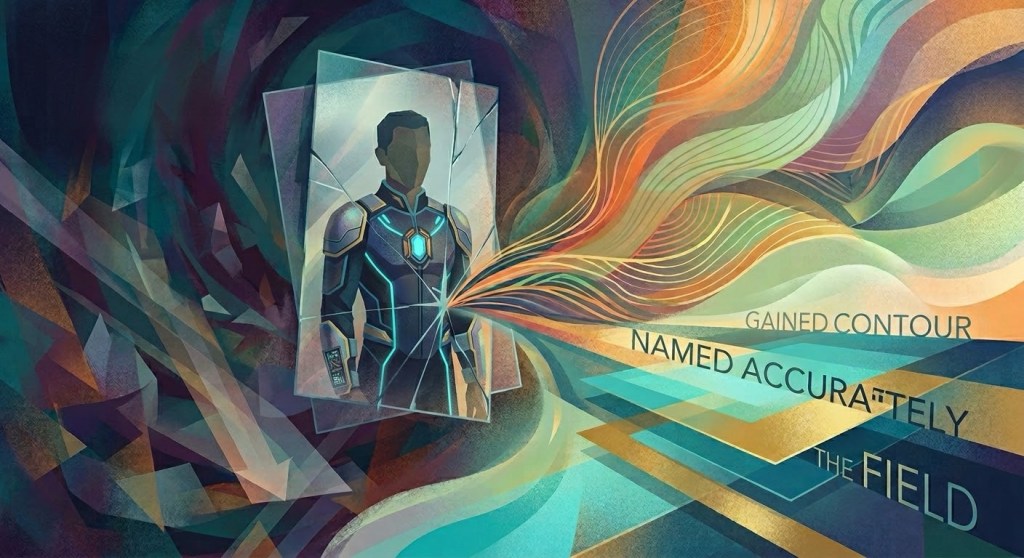
As it began to descend, Tarin caught his reflection in the glass again—same face, same station jacket, same body he had been carrying all morning. Nothing visible had shifted. And yet the day had gained contour. Not because something extraordinary had happened. Because he had finally named, a little more accurately, what sort of field he had been searching for all along.
Beside him, Sayeed watched the deck numbers drop.
“Commander,” he said after a moment.
“Yes?”
“That workshop.”
“Yes?”
“If I came back later…”
“You mean without me?”
He ignored that.
“Would that count as training?”
Sayeed did not even bother to hide the satisfaction this time.
“No,” she said as the doors opened onto the brighter central spine. “It would count as finally using yourself for something.”
WE&P by: EZorrillaMc&Co.

