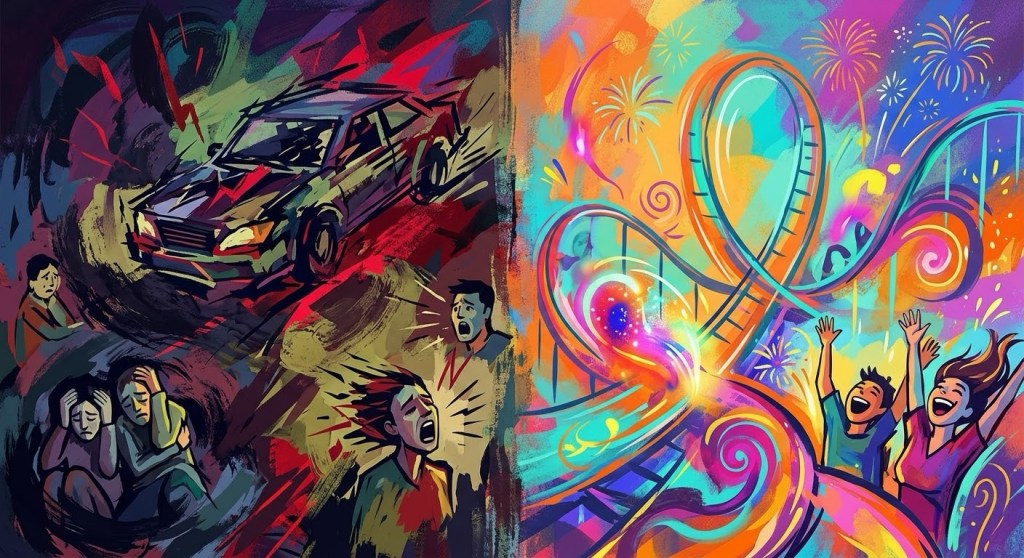
The Same Body, Two Different Translations
This is a useful test case for the granulation, because it isolates the working variable. The sensation is nearly identical in both situations. The interpretation, and therefore the feeling, and therefore the stance, are not. The contrast is clean enough to demonstrate the whole mechanism in a single example.
The Sensation Layer: Nearly Identical
In both the roller coaster and the reckless car, the body is producing the same set of signals.
Adrenaline floods the system. The heart rate climbs sharply. Breathing becomes shallow and fast. Blood pressure rises. The stomach drops at sudden descents or accelerations. Muscles tense in anticipation of impact. The skin prickles. The peripheral vision narrows. Time perception alters — events feel both faster and slower than they are. There is a particular sensation in the limbs, a kind of weightlessness combined with reflexive bracing. The body is, in both cases, doing the work it does under the activation of the sympathetic nervous system at high intensity.
If a person were monitored physiologically in both situations — heart rate, cortisol, adrenaline, galvanic skin response, pupil dilation, respiration — the readings would be substantially similar. The body cannot, at the sensation level, tell the two apart. It is reporting high activation. It is reporting physical stakes. It is reporting something is happening that requires my full attention. The sensation layer is doing what the sensation layer does. It is not lying. It is not exaggerating. It is reporting what is true: the body is in a high-intensity state.
The Affective Tone Layer: Already Diverging
This is where the first divergence begins, and it is subtler than people usually notice. The affective tone — the pre-linguistic valence of the sensation — can already be different in the two cases, even though the sensation is the same.
On the roller coaster, the tone tends toward exhilarating. Unpleasant in the strictest sense (the body is uncomfortable), but oriented toward the kind of unpleasantness that the system has already pre-evaluated as acceptable. The stomach drop carries a tone that is closer to thrill than to dread. The body has noticed, somewhere below interpretation, that this discomfort is contained.
In the reckless car, the tone tends toward alarming. The same sensations carry a valence that is closer to dread than to thrill. The stomach drop is registered as wrongness. The body has noticed, somewhere below interpretation, that this discomfort is not contained.
What produces this divergence in tone is not the sensation itself. It is the body’s pre-conscious appraisal of context — its very fast read of is this safe-enough versus is this not safe. The appraisal happens beneath language, but it shapes what arrives at the interpretation layer. This is one of the reasons the layers are worth distinguishing: the affective tone is already doing interpretive work before the cognitive interpretation layer engages.
The Interpretation Layer: The Two Diverge Fully
Here is where the divergence becomes total.
On the roller coaster, the interpretation has a particular structure. I chose this. The ride was designed for safety. The engineers tested it. The operators are watching. Thousands of people have ridden it without harm. The track is fixed. The vehicle is restrained. I will be off this in ninety seconds. The sensations my body is producing are the point of the experience — I came here in order to feel them.
This interpretation reframes the entire sensation event. The body’s high-activation signals are not warnings to be heeded; they are the product the person came to receive. The sensations are honored, but their meaning is shifted from threat to thrill. The same heart rate, the same shallow breath, the same drop in the stomach — all are interpreted as the body doing the work it is supposed to do in this controlled extremity.
In the reckless car, the interpretation has a different structure entirely. I did not choose this. The driver is not paying attention or is impaired or is taking risks I would not take. There are no engineers testing this trajectory. There is no operator watching. The vehicle is not on a track. The outcome is not contained. I do not know when this will end. The sensations my body is producing are warnings — they are the body telling me that something is genuinely wrong.
This interpretation does not reframe the sensation. It validates it. The body’s high-activation signals are treated as accurate reports of real danger. The same heart rate, the same shallow breath, the same drop in the stomach — all are interpreted as the body doing the work it is supposed to do when something is actually wrong.
The interpretive difference is not a matter of optimism versus pessimism. It is a matter of what the situation actually is. The roller coaster is, in fact, a controlled extremity. The reckless car is, in fact, an uncontrolled one. The interpretations are not equally valid reframings of the same situation. They are accurate readings of two different situations whose sensation signatures happen to overlap.
The Feeling Layer: Two Different Composites
Once the layers below have done their work, the feeling that arrives at the conscious surface is unmistakably different.
On the roller coaster: thrill, exhilaration, the particular intense pleasure of contained risk, sometimes laughter, sometimes screaming that has joy folded into it, sometimes a desire to do it again immediately.
In the reckless car: fear, dread, the particular sickness of uncontained risk, sometimes paralysis, sometimes screaming that has only terror in it, a desire for it to stop and not be repeated.
The same body produced both. The same nervous system activated. The same chemicals flooded. The same physical sensations occurred. And yet the feelings are categorically different — different enough that no one would mistake one for the other from the inside, even though from a purely physiological standpoint they look like the same event.
This is the granulation doing its work. The feeling is the composite. The composite is shaped by the interpretation. The interpretation is shaped by the appraisal of what the situation actually is. The same sensation, met with different interpretations, becomes different feelings.
The Stance Layer: Different Moves Become Available
The stances are also categorically different, and they follow from the feelings rather than from the sensations.
On the roller coaster, the available stances include: surrender to the ride, hands in the air, deliberate enjoyment of the drops, laughter, a willingness to repeat the experience, the social bonding of having shared an intense moment with the people in the adjacent seats. These stances are oriented toward receiving the sensation. The body’s activation is welcome. The stance is open.
In the reckless car, the available stances are different. They include: gripping the door handle, telling the driver to slow down, attempting to leave at the next stop, refusing future rides with this person, reporting the behavior, calling for help. These stances are oriented toward stopping the sensation. The body’s activation is unwelcome — not because the sensation itself is unwelcome but because what the sensation is reporting is unwelcome. The stance is defensive.
The stances are not chosen arbitrarily. They follow from the feeling, which follows from the interpretation, which follows from the appraisal. Each layer produces the next. The granulation reveals the chain.
Why This Example Demonstrates the Principle Cleanly
What this contrast shows, more clearly than most examples could, is that the body is not the source of the difference. The body is producing the same data in both cases. If the only access a person had to their interior were the sensation layer, they could not distinguish the roller coaster from the reckless car. The physical experience would be approximately identical.
The difference is generated at the interpretation layer, and the interpretation layer is sensitive to information the sensation layer is not — context, choice, containment, expected duration, presence of safeguards, history of similar situations, social legitimacy, and so on. The cognitive system gathers all of this and produces a meaning for the sensation. The meaning shapes the feeling. The feeling shapes the stance.
This is why the granulation is operationally useful. It locates the variable correctly. The body cannot be argued with. The body reports what it reports. The interpretation, however, can be examined. And in cases where the interpretation is the operative variable — as it is here — examining it is the work.
The Subtler Implication
There is a further implication worth drawing out. The roller coaster is the case where the body’s sensation outpaces the actual danger. The body produces dread-level signals because that is what the body produces under high activation, but the actual situation is contained. The interpretation corrects the sensation, in a sense — it tells the system the signals are real but the danger they suggest is not. The body is, briefly, working in conditions where its alarm is calibrated to a threat that is not present.
The reckless car is the reverse case. The body’s sensation is appropriate to the actual danger. The interpretation does not correct the sensation but confirms it. The body is, in this case, working in conditions where its alarm is calibrated correctly.
This produces an interesting observation. Trusting the body is sometimes the right move and sometimes not. On the roller coaster, the body is producing accurate physical signals but inaccurate guidance — if a person obeyed the body’s fear signals on the coaster, they would never ride it, and would lose the experience they came for. In the reckless car, the body is producing accurate physical signals and accurate guidance — the fear is information the person should heed.
The granulation handles this. It does not say always trust the body or always question the body. It says: the body reports sensation. The interpretation supplies meaning. The meaning can be checked against the actual situation. Sometimes the interpretation should follow the body’s alarm; sometimes the interpretation should override it. The check is what determines which.
This is what makes the lexicon useful in real life. It does not produce a simple rule. It produces a workable distinction that can be applied case by case, with the actual situation as the ultimate referent.
The Compressed Version
Body sends nearly identical signal in both cases. Tone diverges slightly under pre-conscious appraisal. Interpretation diverges fully under cognitive appraisal of context. Feeling is the composite of the layers. Stance follows the feeling. The body is not wrong in either case. The interpretation is what differs, and the interpretation is shaped by what the situation actually is.
Or more compressed:
Same body, different translations. The roller coaster is contained extremity. The reckless car is uncontained extremity. The body cannot tell. The interpretation can. That is what the interpretation is for.
What This Reveals About the Architecture
The granulation handles this case cleanly, and the cleanness is the proof of the lexicon. A blunter vocabulary would have to choose between the body is right and the body is wrong, and neither is correct. The granulated lexicon allows for the actual structure: the body is reporting accurately in both cases, and the interpretation is what determines whether that report constitutes useful guidance.
This is why the work of refining the interior lexicon matters. With cruder language, the person is forced into false dichotomies — trust your gut versus override your gut. With finer language, the person can do what is actually required, which is: receive the body’s report, supply an interpretation based on the actual situation, allow the feeling to be the composite, and choose a stance with information from all layers.
The roller coaster and the reckless car are useful precisely because they isolate the variable. They show that the difference between thrill and terror is not in the body. It is in the meaning supplied to what the body is doing. And meaning, unlike sensation, is workable.
That is what the granulation is for. That is what the work of building a finer interior lexicon produces. The same body, two different translations, two different lives — depending on whether the interpretation is doing its work or being skipped.
The body sends.
The interpretation translates.
The translation is what makes the difference.
WE&P by: EZorrillaMc&Co.
 Travel in Life