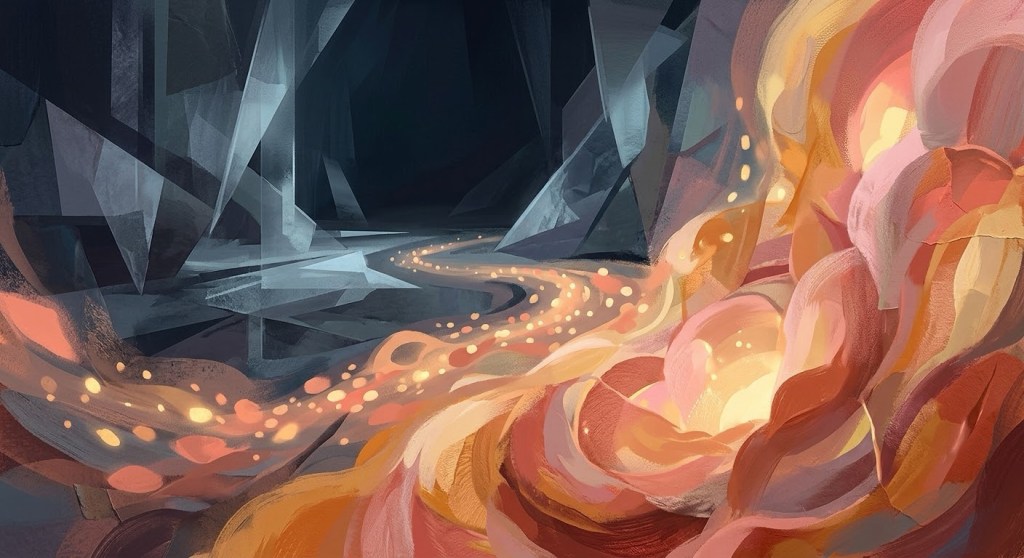
His first clue was wrongness.
Not danger. Not pain. Wrongness.
The charge’s voice came through the relay in fragments, broken by interference and the low electrical hiss that meant the chamber on the other end was still unstable.
“It’s a nursery,” the man said. “I know it is. The walls curve the same way. The light is low. The cots are here. But it doesn’t fit.”
Tarin crouched beside the threshold console and glanced once toward Commander Sayeed, who stood behind him with her hands folded at the small of her back, watching the diagnostic braid scroll over the screen.
“Keep him talking,” she said.
Tarin touched two fingers to his headset. “Tell me what is wrong with it.”
A long pause.
Then, carefully, as if the man were describing weather inside his own chest:
“It’s near me, but it doesn’t receive me. It feels… self-contained. It would be fine if I disappeared. It’s there, but it doesn’t care that I’m there.”
Tarin closed his eyes for a moment.
Not fear, he thought.
Not panic.
Worse, in its own way. A room that should have held softness was presenting indifference. Not hostile. Not violent. Simply untouched by his presence.
“That’s good,” Tarin said.
The charge laughed once, weakly. “I don’t think it is.”
“It’s good because it’s specific.”
Across from him, the threshold display rotated a schematic of Deck Nine substructures, then a second overlay beneath it: sensory misalignment map, unstable. Seven recovery suites. Three pediatric holds. Two botanical nurseries. One old educational annex decommissioned eighteen years ago and later repurposed for sleep-training studies.
The station had too many rooms designed to soothe people. Most were quiet, low-lit, curved around the body instead of squared against it. On a normal day the differences between them would not matter much. Under a frame split, the differences were everything.
Sayeed stepped closer.
“What’s the affective tone?” she asked.
Tarin repeated the charge’s words without looking up. “Near but unreceptive. Present without invitation. Warm architecture, wrong atmosphere.”
Sayeed nodded once. “Not rescue, then. Identification first.”
Tarin keyed the console. The system opened the passive sensation lattice and began comparing chamber signatures, not by use category, but by relational tone: containment, receptivity, vigilance, neutrality, attachment-weight.
Most people misunderstood Spartan threshold work. They thought the system located bodies by coordinates and recovered them by force. But the hard cases were never just spatial. The hard cases were interpretive. A person disappeared not only because they were elsewhere, but because somewhere else had claimed the body’s agreement.
“Charge,” Tarin said, “I need more.”
The reply came slower now, breath threaded through it. “The room doesn’t threaten me.”
“Good.”
“It just doesn’t… keep me.”
That made Tarin look up.
Sayeed’s expression did not change, but one eyebrow lifted slightly. There. Useful.
Tarin turned back to the console. Three chamber signatures dropped out immediately. Too procedural. Too watched. One dropped because it was too bright. Another because its ambient systems signaled active nurture — too much welcome, wrong by an order of magnitude.
The field narrowed.
Two candidates remained.
He stood.
“Where are you going?” the technician at the rear station asked.
“To feel it,” Tarin said.
“Subjective verification?” the tech said, clearly trying not to sound doubtful.
“Would you prefer inaccurate objectivity?”
That shut him up.
Sayeed gestured toward the corridor. “I’ll take the east side.”
Tarin nodded and headed west at a quick, controlled pace.
Spartan Three’s lower decks never really slept. Even in reduced lighting the station hummed with filtered air, coolant circulation, distant lift motors, the hidden work of a vessel that remained alive by never fully resting. Tarin passed a med lock, a food prep alcove, an unused briefing room with its lights half-dead and its table stacked with folded emergency cots. Then the first chamber.
Nursery Annex 9-W.
The door opened on low light and gentle color. Curved walls. Soft floor. Air temperature slightly above standard. Perfect, if you wanted to soothe an exhausted body into letting go.
He stopped in the threshold and let the room touch him.
No.
Too much welcome. Too much readiness to receive. This was not the split. This room would gather a person. The lost charge had not been gathered. He had been mislocated.
Tarin stepped back out and moved on.
The second room sat farther down, past an old education wing that had been retrofitted three times and loved by no one. The plaque at the entrance still bore an obsolete department code.
Adaptive Quiet Nursery 9-K.
The door slid open reluctantly.
The room beyond was almost the same size as the first, and superficially similar: low cots, curved walls, warm-spectrum lighting. But the warmth stopped at the surface. The air distribution was cleaner, drier. The walls had the faint sheen of wipe-clean polymer rather than the matte softness of rest architecture. The cots were placed with efficiency, not invitation. It was a room built for regulation studies, not comfort. It knew how to observe distress without entering it.
Tarin stood very still.
There.
Near.
Contained.
Unmoved.
A nursery by design.
An indifference by tone.
He keyed his wrist slate. “Found the collision point.”
Sayeed’s voice came back immediately. “Confirmed. I’m routing your feed to the charge.”
A beat later the man’s breath sounded in his ear again, thinner now with relief.
“Yes,” he whispered. “That’s it. That’s the one.”
Tarin stepped into the chamber and let the door close behind him.
The room tightened almost imperceptibly. Not mechanically. Interpretively. He could feel why the man had gotten stuck here. This was exactly the kind of place that, under the wrong state, could be mistaken for safety just because it was not overtly hostile. A person could drift into its calm and then discover too late that calm without welcome was not the same thing as being held.
“You found the room by its indifference and distance,” Tarin said. “Find the way back through what feels welcoming and close.”
Silence.
Then the charge said, almost helplessly, “I don’t know if I can.”
“You can.”
“That sounds like the sort of thing people say when they don’t know.”
“It is,” Tarin said. “But I also know the next step.”
Sayeed’s voice entered the channel, low and clear. “Do not ask him where he wants to go.”
Tarin almost smiled. “I wasn’t going to.”
“Good.”
He turned slowly in the chamber, letting his body read what the machine was reading. The threshold lattice did not need exact memory. It needed a stable companionable signature — a tone strong enough to orient return. Not the whole story. Not biography. Just enough fit to make one door warmer than the others.
“Tell me,” Tarin said, “what in you doesn’t merely notice you. What stays.”
No answer came for several seconds. Tarin could hear the man breathing, hear him trying not to overthink the question.
Then:
“Something that waits.”
Tarin stood still.
“More.”
“It doesn’t crowd. It’s just… there. It knows me when I come back.”
The machine accepted that. One of the unreadable braids on his slate brightened.
“Go on.”
“It would be glad. Not loudly. Just… it would move toward me.”
Now the system had something real.
The chamber map on Tarin’s slate shifted. Not a coordinate lock. A relational one. Three receiving rooms on the station brightened faintly, then two fell away. One remained.
Recovery Chamber 7-A.
Pending occupancy: none.
Threshold tone: companionable / awaiting / stable.
Sayeed spoke again. “That will work.”
Tarin did not move yet.
“Charge,” he said, “the room you’re in is accurate, but it isn’t enough. Don’t leave it by fighting it. Leave it by preferring something truer.”
A long inhale.
A longer exhale.
Then the man said, quietly, “I know the other one.”
Tarin felt the chamber shift around him. Only one degree, but enough. The room lost some of its hold.
Good.
Not gone.
Demoted.
He opened the live bridge to Chamber 7-A. On the display, its ambient profile came up: warmer air, lower system vigilance, softer return cues, delayed lighting gradient. A room built not merely to contain distress but to receive a body back into itself.
“Stay with that,” Tarin said. “Not the wrong room. The right arrival.”
The charge breathed again. Faster now. Not panic. Recognition.
“It’s closer.”
“Yes.”
“It stays.”
“Yes.”
The machine completed the bridge.
For an instant the chamber around Tarin split, just visibly enough to make his chest tighten — this cold, self-contained room overlaid with the other one’s warmer waiting field. Same station. Two meanings claiming the same act of entry.
Sayeed had been right. The difficult part was never transfer.
It was arrival.
The system chimed once.
On the slate, the charge’s signal resolved cleanly into Chamber 7-A.
No heroic flare. No dramatic rescue.
Just coherence reasserting itself.
Tarin stood in the indifferent nursery a moment longer, feeling the afterimage of the wrong frame cooling around him.
Then he keyed the channel one last time.
“You there?”
The answer came drowsy, almost embarrassed.
“Yes.”
“How does it feel?”
Another pause.
Then the man said, “Like the room knew I was coming back.”
Tarin let out a breath he had not realized he was holding.
When he stepped back into the corridor, Sayeed was already waiting at the corner junction, one shoulder against the wall, as if she had never doubted the ending enough to hurry toward it.
“Well?” she asked.
“He found the wrong room first,” Tarin said.
“That happens.”
“He found the way back through the part that would keep him.”
Sayeed nodded once, as though this were a technical report and not the recovery of a human being.
“Good.”
They started walking toward the lift.
After a few steps Tarin said, “You knew the first signal wouldn’t be enough.”
“I hoped it wouldn’t be all he had.”
He glanced at her. “You’re very calm about all of this.”
“That’s because panic is only useful when something is on fire.”
“And if something is on fire?”
“Then,” Sayeed said, pressing the lift call, “I become slightly faster.”
The doors opened.
He stepped in beside her.
For a moment neither of them spoke. The lift began to rise through the station’s inner spine, carrying them back toward the brighter decks where people mistook movement for progress and noise for life.
Then Sayeed said, almost idly, “The next lesson is harder.”
“Of course it is.”
“You’ll have to do it without the machine.”
Tarin stared at the closing doors.
Somewhere above them, in a room built to receive return, one lost man was lying in the correct atmosphere, being held by something simple enough that he could mistake it for luck.
Tarin looked at his own reflection in the lift glass.
“What if I prefer the machine?” he asked.
Sayeed’s mouth moved once at the corner.
“Then,” she said, “you’ve learned nothing at all.”
WE&P by: EZorrillaMc&Co.

