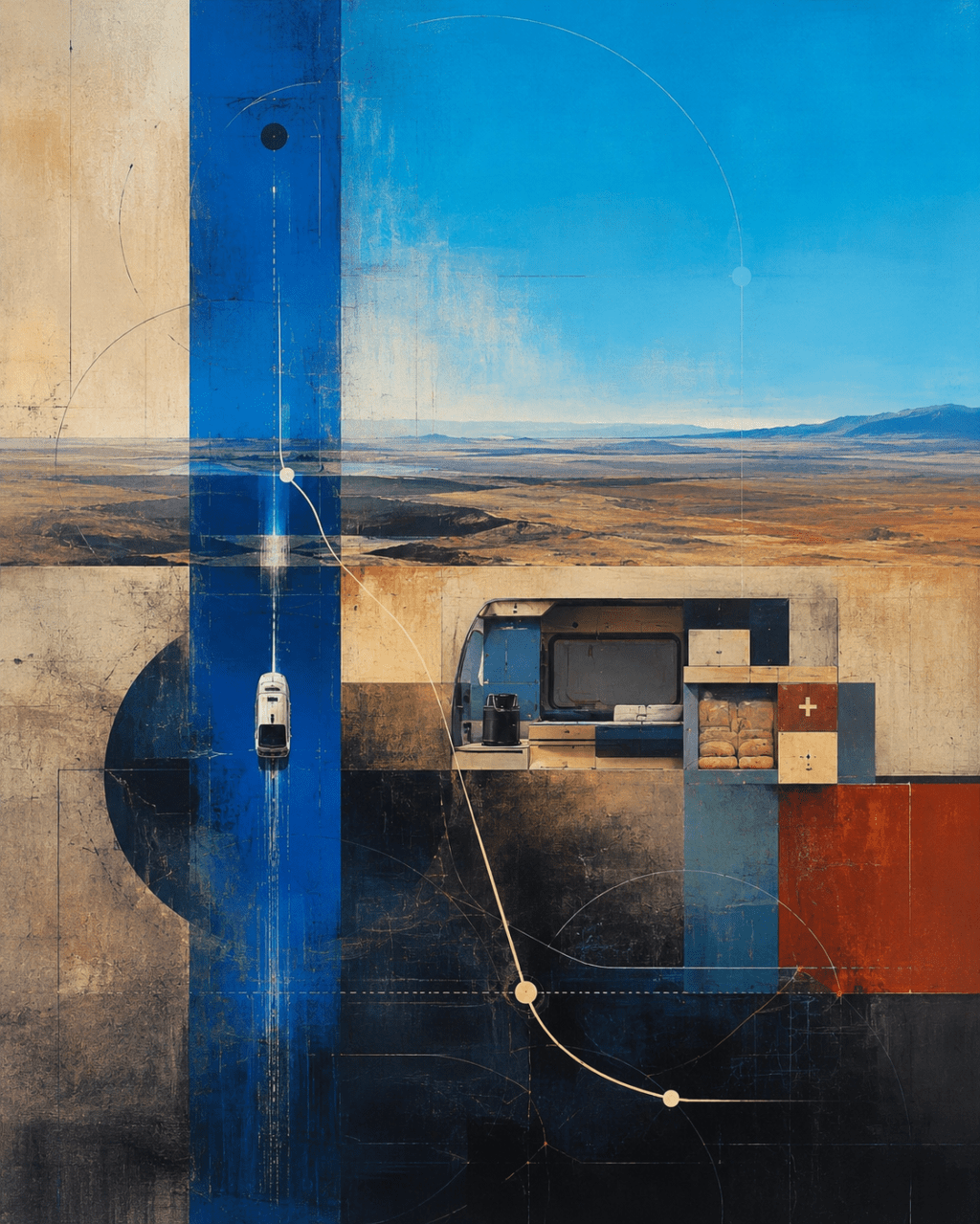
The Pilot Version
Sayeed gave him the assignment as if it were obvious.
“Tarin, take a break.”
He looked up from the return-map spread across the table. “That sounds like a trap.”
“It’s logistics.”
“Worse.”
She set a slate beside his hand. “Medical supplies to Spartan Two. Shuttle transfer. You fly. You stay with the ship.”
He read the order once.
Then again, because the simplicity of it seemed suspicious.
“Just fly?”
“Yes.”
“No ground coordination?”
“No.”
“No return-frame intake?”
“No.”
“No angry lieutenant who believes concussion is a leadership style?”
“Not unless you bring one.”
He looked at her.
Sayeed’s face held its usual refusal to decorate mercy.
“You’re a pilot,” she said. “Stay with the ship.”
The words landed more deeply than they should have.
Not because they were grand. Because they were not.
He had been to Spartan Two before. Half a life ago, during training, when the old station still smelled of sealant, scorched wiring, cheap stimulant, and fear hidden under discipline. Back then he had not been a commander, not a field specialist, not the man whose judgment people watched for signs of fracture.
He had been a copilot.
Simple enough to resent at the time.
Useful enough to remember now.
He went back to quarters and dressed for the flight.
The blue trousers were folded in the lower compartment, where he had left them because he had not known what role still required them. They were not formal uniform. Not field blacks. Not the softer station chinos he had learned to live in during the last months. Blue, heavier fabric, five pockets, reinforced at the seam, cut for sitting long hours without binding at the hip.
He stood with them in his hands for a moment.
It had been a long time since he had worn blue.
The fabric felt unfamiliar when he pulled them on. Then less unfamiliar. Then specific.
The front pockets were where the hand expected them. The small corner pocket was useless and therefore reassuring. The cut gave room through the thigh, then narrowed cleanly enough not to snag under a console. When he bent to secure his boots, the fabric moved differently from station pants. Tougher. Less polite.
He sat on the edge of the berth and pulled the cloth up from the knees before settling back.
The old motion returned at once.
Make room at the joint. Move the fabric forward. Let the body sit without dragging itself against itself.
He had learned the same lesson from the chinos, but this was the pilot version. Same principle. Different role. Blue and tougher. Built to sit, brace, stand, and return.
He looked down at his legs and almost smiled.
Commander pants had taught him how to inhabit authority without performance.
These taught something else.
How to remain with the ship.
The shuttle was waiting in Bay Four, already loaded.
Two medical techs were securing the last cases against the aft wall. Coolant rigs. Pressure packs. Bone mesh. Vascular foam. The kinds of supplies no one requested unless something had already gone wrong somewhere else.
A younger pilot would have wanted the whole story.
Tarin checked mass distribution instead.
One of the techs glanced at him. “You’ve flown Spartan Two approach before?”
“Once or twice.”
Sayeed, from behind him: “He trained there.”
The tech’s posture changed slightly.
Tarin disliked that.
“Half a life ago,” he said.
Sayeed stepped into the bay and handed him the transfer clearance. “Good. Then only half of you will be sentimental.”
“Which half?”
“The half not flying.”
He took the slate.
The route was short. Too short to feel like a mission if he let pride define the word. Spartan Three to Spartan Two. Medical handoff. Hold with the shuttle. Confirm shipboard sustainment gear. Return when released.
Not hard.
Not glamorous.
Not enough to hide inside.
That was the problem.
Once they cleared Spartan Three and the shuttle settled into its lane, the old wobble started.
At first it disguised itself as navigation.
He pulled up the route display and considered a broader loop after the drop. A training arc across the outer marker. A pass over the old survey range. Maybe the ridge line beyond Spartan Two’s southern array, if the weather stayed clear.
Then another thought followed.
Why there?
If he was already out, why not keep going?
There were long routes that would be more beautiful. More worthy of leaving the station. Outer Nevada Station. Colorado Relay. The dead volcano belt. Any destination that could make the trip feel like something.
The frame began to lose shape.
The purpose blurred under justification.
Why this mission?
Why this route?
Why this role?
Why him?
He felt the attack before he named it.
Not fear.
Not reluctance.
Attack.
He was trying to force the frame to defend its existence.
This trip is too small.
This role is too simple.
This cannot be enough unless it points somewhere larger.
The shuttle held course without caring.
The medical techs spoke quietly in the back, reviewing temperature logs. No one needed him to become profound.
That helped.
Tarin let the route display dim.
The mission was not to go somewhere impressive.
The mission was to carry medical supplies to Spartan Two, stay with the ship, test the gear, and bring everyone back.
That was the frame.
Not a metaphor.
Not a life verdict.
A frame.
And he had been attacking it because it did not flatter him.
The realization was unpleasant enough to be useful.
He breathed once and asked the smaller question.
Does the frame fit?
He checked.
Inside: alert, a little irritated, not endangered.
Outside: clear route, stable cargo, waiting shuttle, defined task.
Role: pilot.
Measure: deliver, hold, sustain, return.
It fit.
The wobble eased.
Immediately, ordinary options returned.
Not dramatic ones.
Familiar ones.
A small holding apron twenty minutes from Spartan Two’s main medical lock. Old training ground. Desolate. Open basalt. A place where pilots used to shut down engines and learn what silence did to the body after velocity stopped.
He had forgotten it until he stopped demanding the route become meaningful.
There.
He marked the apron as post-handoff hold.
The computer accepted it without comment.
Spartan Two came into view under a flat wash of light. Smaller than memory, which irritated him until he remembered memory always expands training grounds. The station was still ugly in the same functional way: low structures, hard docking arms, thermal scars across the outer skin.
The handoff took eleven minutes.
The techs left with the cases. Ground personnel signed without ceremony. No one thanked him for saving lives. No one asked whether he found the return emotionally complex.
Good.
He lifted off again and took the shuttle to the old apron.
The landing was clean.
Dust moved outward in a low ring and settled.
Then there was nothing to do except remain.
That was when the pilot role became real.
He powered down nonessentials. Checked the battery margin. Verified coolant stability. Logged cabin pressure. Walked the length of the shuttle and opened the compact field shelf mounted beside the side hatch.
The sustainment kit deployed stiffly, like a thing unused but not forgotten.
Heat unit. Water line. Waste seal. Folding prep surface.
Not a kitchen.
Enough.
He took the food pack from cold storage and set it on the tray. Protein, sealed greens, mineral broth. It would not cook itself. It would not become a meal because the label said meal.
It needed sequence.
He washed his hands, started the heat unit, and stood in the open hatch while the plain outside held its shape.
Blue trousers. Pilot boots. Shuttle hull at his back. Medical cases delivered. Ship waiting because he was there to wait with it.
He thought of his first missions as copilot.
How offended he had been by the simplicity of staying seated while someone else made decisions.
How little he had understood.
The copilot was not lesser.
The copilot held continuity.
Watched the ship when the pilot looked away. Heard the tone change under the engine before the alarm caught up. Stayed with procedure when the mission tried to become story.
He had wanted command too early.
Most young men did.
Now, standing beside the shuttle with food heating in the field unit and Spartan Two low against the horizon, he understood the old role differently.
There was dignity in staying with the ship.
Not because it was humble. Humility was usually just pride wearing dust.
Because the ship was the return.
If no one stayed with it, every outward motion became a gamble.
He ate standing in the hatch shade.
No ceremony.
No revelation.
The meal was hot enough. The gear worked. The cargo bay was empty. The return window held.
He cleaned the tray, sealed the waste, logged the sustainment test.
Then he sat in the pilot seat and pulled the blue fabric gently up from the knees before settling in.
The motion pleased him more than it should have.
Fit does that sometimes.
Not joy exactly.
Recognition through use.
When clearance came through, Sayeed’s voice followed it.
“Spartan Two reports delivery complete.”
“Confirmed.”
“Gear?”
“Functional.”
“Pilot?”
He looked out through the forward glass at the old training ground, smaller now, still real.
“Functional,” he said.
A brief silence.
Then Sayeed said, “Good. Bring the ship home.”
He set his hands on the controls.
Not commander.
Not less.
Pilot.
He lifted from the apron cleanly, carrying no more meaning than the frame required.
WE&P by: EZorrillaMc&Co.

