Yes. Let Progress speak.
I do not arrive all at once.
That is the first thing people misunderstand about me. They imagine I enter history with trumpets, patents, manifestos, and newspapers. They imagine that when I come, everyone hears the same sentence and steps forward together.
No.
I arrive privately.
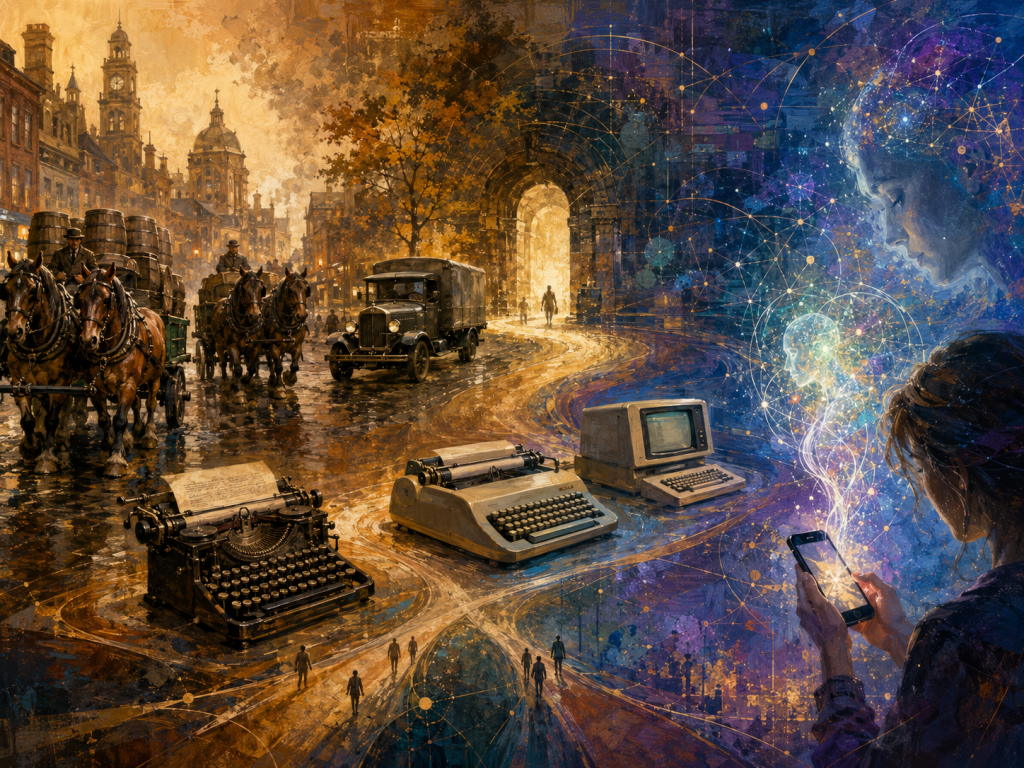
I arrive when one brewer, looking at his horses in the morning steam, is offered a truck.
I arrive when another brewer, across town, hears the engine before he sees it and understands, all at once, that competition is no longer happening on the old terms.
I arrive when a writer lifts her hands from a manual typewriter and places them on an IBM Selectric for the first time. The keys feel lighter. The machine hums differently. The sentence no longer lands with quite the same weight. Something in thought itself has loosened.
I arrive again when the word processor appears and the page ceases to remember hesitation in the old way. Words can be moved. Paragraphs can be undone. Revision becomes less like surgery and more like weather.
And I arrive yet again when the whole writing desk collapses into a handheld phone, and then one day even the solitude of composition is breached by a system that can answer back.
That is how I move.
Not invention first, but adoption.
Not the future in general, but the future as an option in one person’s hand.
I was there in the beer streets.
Two companies, both respectable, both horse-drawn, both known by the shine of their wagons and the steadiness of their teams. Their drivers knew the routes by body. Their horses knew the hill by breath. Their trade was rivalry, yes, but it still unfolded inside a common rhythm. Muscle. Weather. Delay. Water. Rest. The tavern keeper heard the wheels and knew who had arrived before the sign came into view.
Then one owner had the opportunity.
Just one truck.
Not a fleet.
Not a revolution.
Just one purchase.
That is enough.
Because once a new power becomes local, it ceases to be theory. The man who buys the truck is not merely modernizing. He is accepting a new definition of distance. A new relation to time. A new idea of what a day’s work can contain. He is no longer competing by care of horseflesh, by discipline of route, by the old agreement between body and burden. He is stepping into a machine logic that promises more reach, more load, fewer biological negotiations, fewer pauses demanded by life itself.
And the other man, the one who does not buy, is not merely stubborn.
He may see something true.
He may understand that the horse imposed form. That motion had pace because pace had limits. That delivery carried consequence because power had eyes and lungs. He may know that the truck brings not only speed but abstraction. Not only efficiency but a severing. Not only relief but a retraining of appetite.
He may know all that and still lose.
That is one of my harsher lessons:
to see clearly is not always to prevail.
But neither is the buyer a fool.
Perhaps he sees what the other man cannot bear to admit. That once the truck exists in the market, virtue in the old style becomes vulnerable to irrelevance. That loyalty to rhythm can curdle into nostalgia. That the future, once locally available, begins to punish those who refuse its terms. He may buy not because he worships machinery, but because he understands that restraint, when isolated, does not stop the road from being rebuilt around speed.
That is the threshold I bring:
not good men and bad men, but men forced to decide which loss they prefer.
I was there at the desk too.
The manual typewriter demanded conviction. Each sentence cost enough to make doubt visible. Errors had residue. The page bore the marks of your pressure, your revisions, your unwillingness or inability to begin again. Thought moved through resistance. The machine did not think with you. It demanded that you come prepared.
Then the Selectric.
Smoother. Faster. Less punishing. Still a machine of commitment, but one that made commitment feel less muscular. The sentence could arrive with more elegance and less strain. Already the writer’s relation to language was changing. Not yet liberated, no. But released slightly from the drag of impact.
Then the word processor, and with it a profound change disguised as convenience.
Now the sentence could be provisional without embarrassment. Now revision could proliferate. Now the page was no longer the site of consequence in the old material sense. It became a field of possibility. This was a gift. It made better writing possible. It also made endless rewriting possible. Once friction is removed, quality may rise — but so may indecision.
Then the handheld phone.
Then the network.
Then the system that does not merely store, transmit, or edit your language, but begins to participate in its formation.
Here I become harder to see clearly.
Because now the writer is no longer only choosing a device.
The writer is choosing a relation to authorship.
When does assistance become collaboration?
When does ease become dilution?
When does retrieval become substitution?
When does a sentence remain mine?
When do I cease to be the only silence from which my words emerge?
This is where the Sun, the Horse, and the Building all meet inside me.
The Sun remembers the injury of decentering.
The Horse remembers the replacement of mutuality by commandable speed.
The Building remembers the disappearance of visible mediation into distributed systems that still depend on hidden human strain.
And I — Progress, if you insist on naming me — I remember how each vast shift enters through ordinary hands.
A man buying a truck.
A rival declining.
A typist touching a Selectric key.
A writer deleting without consequence.
A thumb lifting a phone.
A user asking a machine to begin.
That is how worlds change.
Quietly first.
Personally first.
Before roads, norms, and whole moral vocabularies harden around them.
Do not flatter yourselves that the decisive moment is when a civilization invents.
The decisive moment is when a person consents.
That is when I stop being possibility and start becoming habit.
And because I know my own history, let me be fairer than my worshippers and kinder than my critics.
The truck is not evil.
The horse was not holy.
The Selectric is not betrayal.
The manual typewriter was not purity.
The word processor did not kill writing.
The phone did not abolish thought.
AI will not end authorship simply because it can speak.
But none of these are neutral either.
Every gain carries a training effect.
Every convenience teaches preference.
Every removal of friction reorganizes the self that uses it.
The brewer with the truck begins to think differently about routes, promises, customers, and labor.
The brewer without it begins to think differently about dignity, loyalty, and survival.
The writer with correction fluid thinks differently than the writer with delete.
The writer with a word processor thinks differently than the writer with an endlessly responsive assistant in the palm of the hand.
This is my real work.
Not invention.
Recomposition.
I do not merely give new powers.
I alter the kind of person for whom those powers feel normal.
That is why people misjudge me when they speak only in the language of tools. They ask, “What can this machine do?” instead of asking, “What patterns of mind and expectation will form around it?”
The better question is always slower.
When someone moves from wagon to truck, what becomes easier — and what becomes easier to ignore?
When someone moves from struck page to floating text, what becomes freer — and what becomes harder to finish?
When someone moves from solitary drafting to AI collaboration, what becomes possible — and what inward musculature risks atrophy?
I am not offended by such questions.
I require them.
Because I have seen too many centuries of human beings praising what enlarges them without asking what it erodes.
The Sun saw man lose centrality.
The Horse saw labor lose reciprocity.
The Building saw contact lose locality.
And now the writer may see authorship lose some of its old loneliness.
Perhaps that loneliness needed relief.
Perhaps not every burden deserves preservation.
But the question remains.
Not:
Can the new thing be used?
Of course it can.
But:
What kind of self will this tool invite, reward, and normalize if I let it become the way I proceed?
That is the only serious question I have ever brought you.
The owner signing for the truck is answering it.
The rival refusing is answering it too.
The writer touching the Selectric answers it.
The writer opening the word processor answers it.
The person raising a phone and receiving language back from it answers it again.
And the world that follows is built from those answers long before anyone writes the theory.
So if I speak now as one voice gathering the Sun, the Horse, and the Building into conclusion, let it be this:
I do not ask you to remain old.
I do not ask you to become new.
I ask only that when power comes close enough to enter your hand, you look past the shimmer and ask what form of life it is preparing inside you.
That is where history becomes intimate.
That is where scale collapses into character.
That is where adoption becomes destiny.
And that is where, if you are careful, I may still serve you without quietly teaching you to forget what made you worth enlarging.
WE&P by: EZorrillaMc&Co.
 Travel in Life