
The threshold chamber sat below the main transport annexes, buried deep enough in Spartan Three that the station’s rotational hum became almost imperceptible.
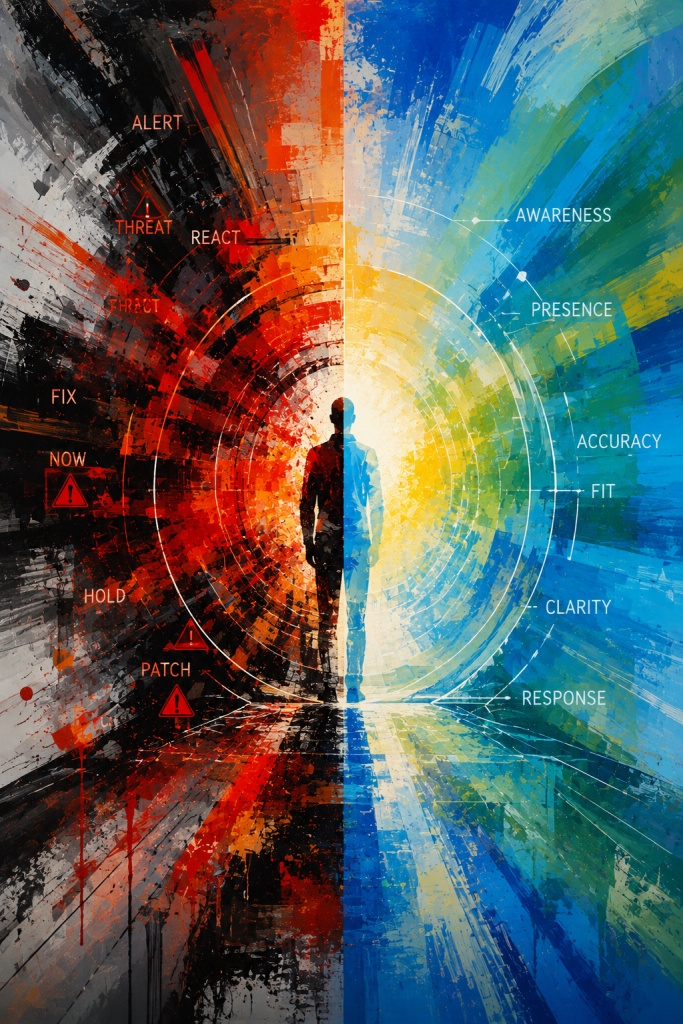
No windows. No ambient traffic. Just matte walls, recessed lighting, and the faint electrical breath of systems waiting to measure people more carefully than most people wished to be measured.
Tarin stood just outside the chamber doors with his hands in the pockets of his station jacket, watching a technician recalibrate one of the floor rings.
“You’re late,” Commander Sayeed said.
“I arrived at the correct time.”
“That’s the definition civilians use.”
The technician hid a smile and pretended to keep working.
Sayeed stood beside the chamber entrance holding a slim diagnostic slate against one forearm. Uniform today. Dark command coat. No visible insignia beyond the silver line at the collar. Formal enough to remind the room who she was. Relaxed enough to imply she did not need the reminder herself.
Tarin glanced through the open chamber doors.
The room beyond looked disappointingly ordinary.
Circular floor. Soft white walls. No visible machinery except the transport plate at center and a ring of biometric nodes recessed overhead.
“That’s it?” he asked.
“You were expecting more drama.”
“I was hoping for less.”
“Good. That means you’re teachable.”
The technician finished the calibration and stepped away. “Threshold room is clean, Commander.”
“Run passive only,” Sayeed said. “No correction overlays.”
The technician hesitated. “For him?”
“For everyone.”
That earned Tarin a quick glance from the tech before the man collected his tools and left.
The doors sealed behind him with a muted hydraulic lock.
Quiet settled over the chamber.
Sayeed walked inside first.
“Most people misunderstand Spartan transport,” she said. “They think the difficult part is surviving disassembly.”
“It isn’t?”
“No. Matter reconstruction has been stable for eighty years.” She stepped onto the outer ring of the platform and turned toward him. “The difficult part is arrival.”
Tarin entered the room more slowly.
“The frame split.”
“Yes.”
“I thought that was an anomaly.”
“It is. But only because most people never notice what their bodies are doing.”
She gestured lightly toward the transport plate.
“Stand there.”
He obeyed.
The plate felt warm through the soles of his boots. Not heated. Responsive.
Overhead, one of the recessed nodes flickered awake.
“No transfer today?” he asked.
“No transfer.” Sayeed folded her arms. “Today you learn entry.”
“That sounds unpleasantly philosophical.”
“It’s posture work.”
“That sounds worse.”
A corner of her mouth moved.
“Your problem,” she said, “is that you still enter rooms tactically.”
“I’ve stayed alive that way.”
“Yes.” Her tone remained flat. “And now the habit arrives before observation.”
He leaned back slightly. “You make survival sound embarrassing.”
“No. I make outdated survival embarrassing.”
That landed cleanly enough he couldn’t argue with it.
Sayeed stepped onto the platform opposite him.
“Transport thresholds amplify pre-coherence,” she said. “The system reads orientation before cognition stabilizes. Most people arrive where they intended physically while entering psychologically somewhere else entirely.”
“And Spartan just lets this happen?”
“Spartan records it. Usually without interference.” She tilted her head slightly. “Military transport is less interested in comfort than accuracy.”
“That sounds like something procurement officers say before funerals.”
“That’s because procurement officers survive by speaking in passive voice.”
Despite himself, Tarin laughed.
The sound loosened something small in his chest.
Sayeed noticed immediately.
“There,” she said.
“What?”
“That.”
“The deeply attractive sound of sarcasm?”
“The shift.” She tapped two fingers lightly against her own sternum. “Your body stopped preparing to defend itself against the room.”
He frowned.
“I didn’t feel anything.”
“You relaxed your jaw three millimeters.”
“That’s disturbing.”
“It’s measurable.”
“That’s more disturbing.”
She stepped closer—not intimate, not confrontational. Operational proximity. The kind designed to reduce ambiguity rather than create it.
“You’re still thinking restraint happens after activation,” she said quietly. “As though discipline means controlling what rises.”
“That’s usually how discipline works.”
“No.” Her eyes stayed on him with irritating steadiness. “That’s damage control.”
He opened his mouth to object.
Then stopped.
Because part of him knew she was right.
Sayeed continued before he could recover momentum.
“The body rehearses danger automatically. Spartan training reinforced that intentionally. Fast interpretation saves lives.” She lifted one shoulder minimally. “Until the old frame keeps arriving first simply because it is practiced.”
“The harder frame.”
“The older frame,” she corrected.
Silence settled briefly between them.
Then she said, “Waltz in.”
Tarin blinked once.
“I’m sorry?”
“You heard me.”
“I was hoping I hadn’t.”
Sayeed ignored that.
“A waltz is not force,” she said. “It’s cooperative momentum. You don’t attack the movement. You enter it already listening.”
“That sounds dangerously close to poetry, Commander.”
“That’s because you associate precision with harshness.”
She stepped off the platform and circled him once slowly—not inspecting him, exactly. Reading orientation.
“When you entered the greenhouse two nights ago,” she said, “you entered tactically.”
“I was hiding.”
“Yes. Poorly.” She stopped in front of him again. “But once you recognized the actual frame, you adjusted.”
He thought about that.
No shift closer.
No performance.
Remaining accurate to the moment.
Sayeed watched the realization arrive.
“There’s a difference,” she said, “between surviving a frame and participating in one.”
“That sounds suspiciously like trust.”
“It’s more specific than trust.”
“What is?”
“Fit.”
The word settled into him strangely.
Not emotionally.
Structurally.
Sayeed gestured toward the chamber around them.
“This room amplifies whatever enters first. Fear. Defensiveness. Appetite. Shame. Anticipation.” Her gaze sharpened slightly. “Most people think the answer is suppression.”
“And it isn’t.”
“No. The answer is tuning.”
She stepped back onto the platform.
“Again,” she said.
“There hasn’t been a first time.”
“There has. Your entire life.”
That irritated him enough to tighten his shoulders automatically.
Sayeed nodded once.
“Good. Now you can feel it happen.”
Damn her.
He exhaled slowly.
Not relaxation.
Observation.
The jaw first. Then the shoulders. Then the subtle narrowing behind the eyes he had stopped noticing years ago because it never fully left anymore.
Sayeed said nothing.
That helped more than instruction would have.
He adjusted his stance slightly.
Not softer.
More accurate.
The room changed immediately.
Not physically.
Relationally.
The chamber no longer felt like assessment. Or threat. Or performance. Just a place built for transition.
Sayeed saw the shift register across the overhead diagnostics.
“There,” she said quietly. “Now walk in.”
“I’m already standing here.”
“No.” Her tone remained calm. “Now enter.”
Tarin looked at her for a long moment.
Then he understood.
The threshold wasn’t spatial.
It was interpretive.
Slowly, without dramatics, he let the room become what it actually was instead of what old reflexes prepared it to be.
The effect was almost embarrassingly small.
And absolute.
His breathing settled downward. The pressure behind the eyes eased. Attention widened instead of narrowing.
Not safe.
Not unsafe either.
Simply accurate.
Across from him, Sayeed’s posture shifted one degree in response—not relaxation exactly. Recognition.
“There,” she said.
Tarin frowned faintly. “That’s it?”
“For now.”
“That feels very anticlimactic.”
“Most important corrections are.”
He stood quietly on the platform while the chamber hummed softly around them.
Then, unexpectedly, he laughed once under his breath.
“What?”
“I just realized,” he said, “that I’ve spent fifteen years arriving before I got anywhere.”
Sayeed considered him for a moment.
“Yes,” she said.
No softness.
No consolation.
Just the clean acknowledgment of something becoming true at the correct speed.
The chamber lights dimmed fractionally as the station cycled into night operations.
Sayeed stepped off the platform first.
“Come on,” she said. “You’re buying the coffee.”
“I thought the coffee here was institutional.”
“It is.”
“Then why would I buy it?”
“Because,” she said, heading for the doors, “you’re finally learning how to enter a room without treating it like an impact site.”
And despite himself, Tarin followed with his shoulders no longer braced for collision.
WE&P by: EZorrillaMc&Co.


You must be logged in to post a comment.