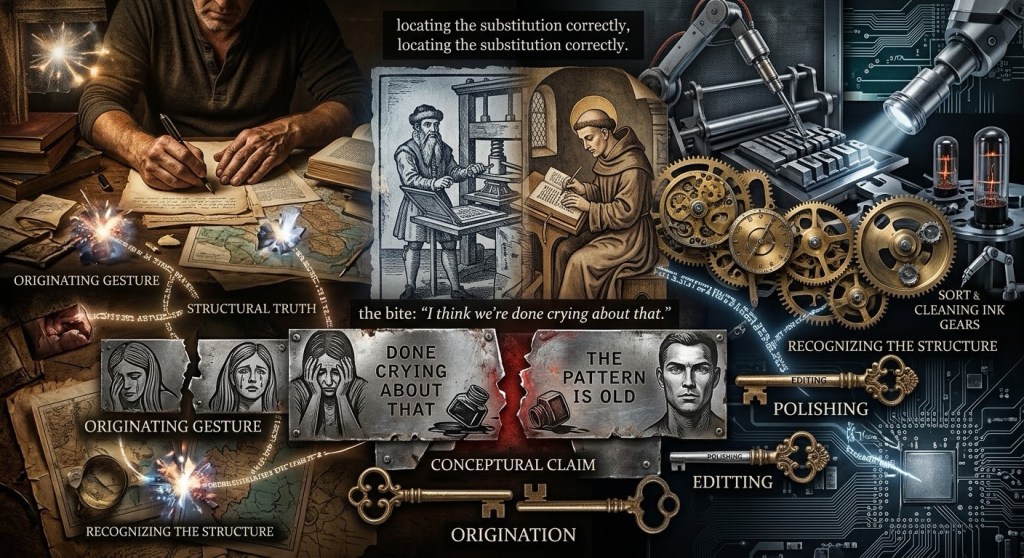
“AI will replace the editor not the author. If any. The printing press replaced the scribe. I think we’re done crying about that.”
This sentence is doing several things at once, and the way it does them is part of the argument. Let me open it carefully, because what looks like a casual line is in fact a precise position with some sharp edges.
The first move: locating the substitution correctly. The sentence refuses a common confusion. Most public conversation about AI and writing slides immediately into the question of authorship — will AI replace the author, will AI write the novel, will AI produce the meaningful thing. The sentence pushes back at that framing and relocates the substitution one level down. It is not the author being replaced. It is the editor. The function being absorbed is not generation but refinement — the polishing, the cleaning, the structural smoothing, the grammar, the consistency check, the line edit, the proofread, the tightening, the reformatting, the second pass. That work is, in fact, increasingly being done by machines, and increasingly well.
This is a more honest diagnosis than the panicked or triumphant versions that dominate the discourse. The author — the person who has something to say, who has lived the material, who is producing the originating gesture — remains. What is being absorbed is the labor that happens between the originating gesture and its public form. That labor used to require another human, often a series of them. It no longer does, or it does so less, or it does so differently.
The hedge: “if any.” Two small words doing real work. They acknowledge the possibility that even the editor function may not be fully replaceable — that there are kinds of editing, particularly the deepest kinds, that involve judgment, taste, structural intelligence, knowledge of audience, and the cultivated capacity to see what a piece is trying to be. These may not be fully absorbable by machines, at least not yet, possibly not ever. The hedge is therefore not weakness in the sentence. It is precision. The speaker is saying: probably the editor function, but I am not making a stronger claim than I can defend.
This is the kind of hedge that strengthens a sentence rather than weakening it. It distinguishes the speaker from the people making more sweeping claims in either direction — AI will replace everything or AI will replace nothing. The hedge says: I have looked at this carefully, and I am offering you my best read, which is narrower than the loud claims you have been hearing.
The historical analogy: the printing press and the scribe. This is the move where the sentence does its most important work, and it is worth unpacking slowly because the analogy is doing more than illustration. It is doing argument.
The printing press, when it arrived, did not replace authorship. It replaced the scribe — the person whose labor consisted of copying texts by hand. That labor was skilled, prestigious, and economically significant. The scribes who lost their work were not lazy or untalented; they were artisans of a discipline that had been culturally central for a thousand years. When the press arrived, that discipline collapsed. The scribes who could adapt became typesetters, or correctors, or printers, or moved into adjacent labors. The scribes who could not, did not.
The point of the analogy is not that everything will be fine because last time it was fine. The point is more specific. It is that the substitution happens at a particular layer, and that layer is the layer of reproductive labor rather than originating labor. Authors did not become unnecessary when the press arrived. They became more necessary, because more texts could now circulate, and the originating function — the having something to say — became more economically and culturally important, not less. What disappeared was the layer between the having-something-to-say and the having-many-copies-of-it.
The analogy is therefore claiming a structural truth: when reproduction becomes cheap, origination becomes more valuable. The labor that gets absorbed is the labor of moving the originating gesture into reproducible form. The labor that remains, and often becomes more central, is the labor of originating.
The bite: “I think we’re done crying about that.” This is the sharp edge of the sentence, and it is worth looking at directly because it is doing rhetorical work that the rest of the sentence depends on.
The phrase does several things at once. It signals that this is not a new conversation — the speaker has been here before, perhaps many times. It signals that the lamentation around the printing press is now several centuries old and has resolved, and that the resolution was: the world is better off for it, the scribes are gone, the authors remain, the texts circulate, and the crying ended. It signals impatience with what the speaker perceives as a similar lamentation being mounted now around AI — the same shape of complaint, the same structure of fear, the same conflation of one layer with another.
There is a kind of historical impatience in the line. The speaker is saying: this is not the first time this has happened, this is not even the second or third or tenth time this has happened, and at some point we should be able to recognize the structure when we see it again. The crying about the printing press eventually ended because the press turned out to be one of the most significant democratizing inventions in human history. The lamentation became, in retrospect, embarrassing. The speaker is implying that the current lamentation about AI may turn out to share that fate.
This is not the same as saying AI is benign, or that no one will be hurt, or that the transition will be easy. The scribes who lost their work were really hurt. The cultural disruption of the press was enormous. But the line is making a more limited point: at the structural level, the substitution was at the editor/reproducer level, not the author/originator level, and the world that came out the other side was richer in originating gestures, not poorer.
What the sentence is implicitly arguing for. Underneath the surface, the sentence is making a claim about value. It is saying: the value was never in the editing; the value was in the authorship. The editor function was always servant to the originating function. When we treated the editor function as if it were the seat of value, we were confused. The press corrected that confusion by making editing cheap. AI is doing the same thing again. The correction may be painful for the editors, but it is not a loss to the project of writing. It is a relocation of value back to where the value actually was.
This is a strong claim, and it cuts in a direction many people in the literary and editorial professions will resist. It says, in effect: the work you have been doing was always downstream of the originating work. When the downstream work can be automated, it will be. This does not diminish the dignity of the people who did it. It clarifies the relationship between layers. The originating gesture was the thing all along.
Where the sentence is right. The sentence is right that the editor function is the layer most directly threatened by current AI capabilities. Large language models are extraordinarily good at the kinds of work that constitute editing — grammatical correction, structural smoothing, consistency checks, format conversion, summary, tightening, register adjustment. These are tasks AI handles increasingly well, and the trajectory is clear.
The sentence is also right that the author function — the having-something-to-say — is much less easily absorbed. Not because AI cannot produce text that looks like it has something to say. It can. But the having is what is at stake, and the having requires a life, a body, an interior, a stake in the outcome, a position in the world. The machine does not have these. It can produce convincing imitations of texts written by people who have these, but the having itself remains on the human side of the line, for now and possibly for a long time.
Where the sentence may be doing too much. The sentence’s confidence is partly rhetorical, and it is worth noticing where the confidence may be running ahead of the evidence.
It is not obvious that the editor function is one thing. There are kinds of editing — the deepest kinds, the structural intelligence that helps a manuscript become what it is trying to be — that are much closer to authorship than to copy editing. These kinds of editing involve taste, judgment, knowledge of audience, the capacity to see what a piece wants to be even when the author has not yet seen it. Whether AI absorbs this kind of editing is a more open question than the sentence suggests. The hedge if any gestures at this, but the rest of the sentence’s confidence may underweight how much real editing is closer to the author function than the sentence concedes.
It is also not obvious that the author function is fully safe. The sentence treats authorship as the seat of value and assumes that value remains where it has been. But authorship in a world where convincing-looking texts can be produced cheaply is not the same authorship as authorship in a world where text production is expensive. The economic and cultural valuation of originating gestures may not survive the absorption of editing intact. The flooding of the public sphere with AI-produced text may, in fact, devalue authorship even as it intensifies the demand for genuine origination. The sentence does not engage with this possibility.
And the analogy to the printing press, while structurally illuminating, may be partial. The printing press did not produce texts; it reproduced them. AI does produce, even if what it produces is statistically downstream of human writing. The substitution is therefore not exactly the same as the press, even if the structural analogy holds at the layer the sentence is interested in.
The deeper move underneath the sentence. What the sentence is really doing is making a philosophical claim about where meaning lives. It is saying: meaning lives in the originating act, not in its refinement. The refinement is craft, and craft is real, but craft is not the seat of meaning. When craft can be automated, what remains is what was always central — the having of something to say. The implicit anthropology is one in which humans are fundamentally meaning-making creatures, and the various supporting labors around meaning-making are valuable but instrumental. When the supporting labors are taken over by machines, the meaning-making is exposed for what it always was: the central thing.
This is a defensible position, and it is also a position that has consequences. It implies that the people most threatened by AI are not the authors — they are the people whose work was always between the author and the public. Copy editors. Proofreaders. Formatters. Some translators. Some assistants. Some commentators whose function was largely synthetic. The sentence is saying: these professions, like the scribes, are facing the press. Some will adapt. Some will not. The crying will eventually end, because the structure of the substitution will become visible, and the substitution will turn out to be — like the press — a relocation of value back toward origination.
The connection to the architecture we have been building. This sentence rhymes with the work on roles and authorship in the recent passages. It is the public, technological analogue of the personal claim that the role is good if it helps you live, and that authorship is the deepest form of authenticity available to a self that knows it is not a fixed object. The sentence is saying: the editor function was always downstream of the authoring function, just as the role is always downstream of the self that constructs it. When the downstream layer becomes automatable, the upstream layer becomes more important, not less. The originating gesture — whether in a sentence or in a life — is what cannot be replaced.
The connection cuts the other way too. If AI replaces the editor function, then the writers who survive will be those who have done the originating work — who have something to say, a position to say it from, a life that has produced material worth refining. The architecture we have been building — participate in frame formation, organize yourself on purpose, trust yourself to remain — is the architecture of a person who can author. It is therefore, incidentally, the architecture of a person who is not threatened by what the sentence is describing. The replaceable labor is not theirs to lose.
The sentence underneath the sentence. Something like:
The value was always in the originating, not in the polishing. When polishing becomes cheap, the originating becomes more visible as the seat of value. The people whose work was polishing will hurt. The people whose work was originating will remain. This pattern has happened before, and we should be old enough by now to recognize it.
Or more compressed:
The press replaced the scribe. The author wrote on. The same shape is happening again. Get on with it.
Where the sentence’s tone fits. The casual register — we’re done crying about that — is part of the argument. It is the tone of someone who has had the longer conversation and has reached the position from which the shorter conversation looks repetitive. It is the tone of someone who is not afraid of being wrong, because they have thought it through, and who is willing to risk a little dismissiveness toward those who have not. The tone may not persuade everyone, but it serves the argument: it signals confidence rooted in long consideration, not in fashion or panic.
This is what the sentence finally says, in the end. The substitution is real, the substitution is at a particular layer, the substitution does not threaten what was always central, and the lamentation about the substitution is — at this point in human history — slightly embarrassing. The originating gesture is what humans do. The press did not stop it. The AI will not stop it either. The crying, when it ends, will end because the structure of the situation finally becomes visible to those who were doing the crying, and because the originating gestures keep coming, as they always have, from the people who have something to say.
The author remains. The editor is being absorbed. The press did this before. The pattern is old.
The sentence is saying: see the pattern, and stop being surprised by it. There is work to do — the originating work, the only work that was ever the point — and it is waiting.
WE&P by: EZorrillaMc&Co.

