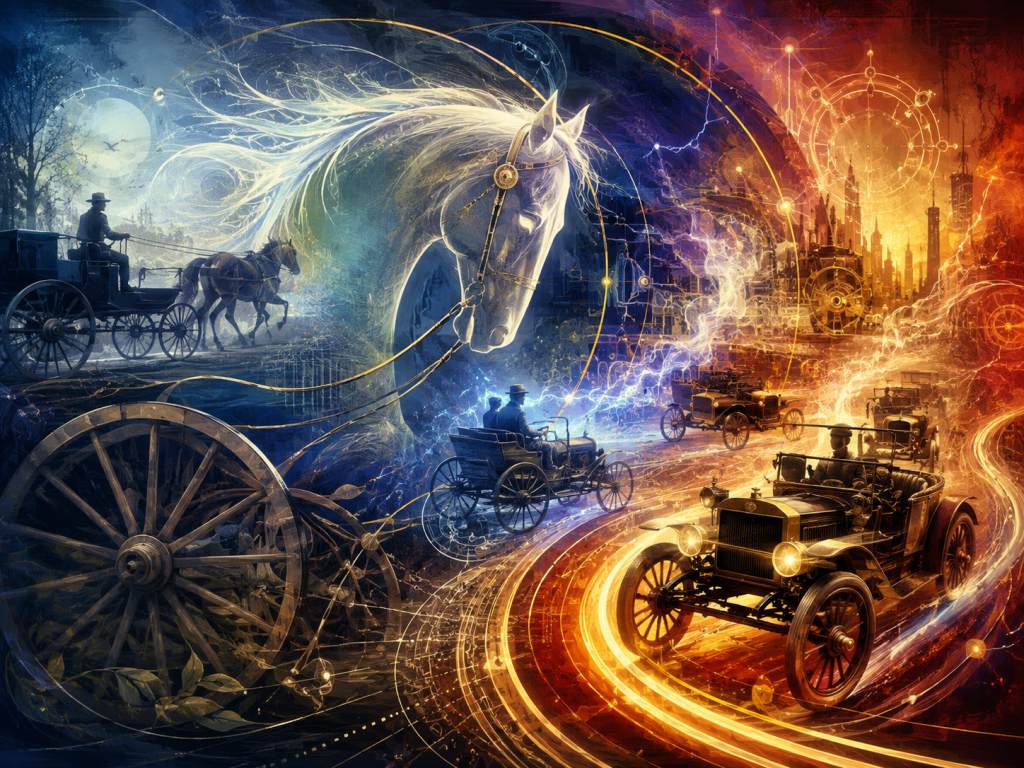
I have carried them longer than their factories have stood.
Before the paved road, before the curb, before the filling station, before the salesman with his polished pitch and his gloves too clean for weather, there was harness, wheel, hoof, rein, breath. There was the morning yard. The hand on the neck. The buckle drawn through leather. The sound of iron taking the street as if the street itself had been made to understand weight and patience.
I remember when motion still had a pulse.
Do not misunderstand me. I am not sentimental about labor. I know what I was to them. I was power with a face. I was transport that ate, tired, sweated, startled, sickened, aged, and died. I was economy that had to be fed before dawn. I know the cost of manure, the flies, the stable boys, the broken legs, the winter lungs, the long hill, the bad road, the city smell in August. I know all of it. I have lived inside the arithmetic of hay and muscle.
But I also know this:
when they moved with me, they moved at the speed of consequence.
Distance meant something then.
Weather meant something.
Fatigue meant something.
To go required preparation.
To arrive required time.
The world did not surrender itself all at once merely because a man felt impatient.
Then came the first little contraptions, humming more than roaring, odd and nervous, with their batteries and their confidence. People forget this now. They imagine the whole new age arrived coughing smoke and smelling of oil. But no. At first it whispered. At first it glided in a peculiar manner, like a machine embarrassed by its own ambition. An electric carriage, some called it, as if giving it the old name might make the new thing behave.
I saw them look at it with curiosity, not yet devotion.
It did not snort. It did not shy. It did not leave dung in the avenue. It stood where it was left. For city people, that alone was nearly a miracle. No stable, no oats, no watering, no temper, no eyes to calm. It promised motion without relationship. That was new.
But it was not yet destiny.
Then the other kind arrived.
Combustion. Noise. Odor. Mechanical irritation turned into doctrine. A thing that seemed, at first, too ugly to win. It spat, rattled, coughed, frightened children, insulted dogs, broke down theatrically, and announced its presence as if volume itself were proof of the future. Had you asked any sensible mare, she would have told you it lacked breeding, rhythm, and self-respect.
And yet I watched them choose it.
Not because it was beautiful.
Not because it was gentle.
Not even because, at first, it was clearly better.
They chose it because it pointed toward a world in which they would no longer have to negotiate with life.
That is always the seduction.
Not merely convenience.
Release from terms.
With me, a man had to know certain things. He had to feel a body through the reins. He had to understand that force has moods. He had to stop for water. He had to judge the hill. He had to notice lameness before catastrophe. Even indifference had limits, because neglect showed itself in flesh.
But a machine — ah, a machine offers a different fantasy.
It says:
Command me without regard.
Use me without intimacy.
Replace me without guilt.
Push farther.
Push later.
Push faster.
And if I fail, call it maintenance.
I do not say they were wrong to want relief. Only that they rarely admit what kind of relief they are buying.
They told themselves the motorcar was progress, and in many ways it was. Cleaner streets, at first. Faster roads. Longer reach. New trades. New freedoms. A farm boy could outrun his district. A doctor could answer a call miles away before the fever finished its work. A family could leave the town that had defined its grandparents. Yes. All that is true. I will not insult truth merely because it replaced me.
I have watched too much history to confuse displacement with falsehood.
But I also remember the moral speeches.
I remember the men of the buggy trade, the carriage makers, the stable owners, the breeders, the harness men, the drivers for hire, all standing in their injured dignity and saying the world was losing something essential. And they were right. It was. Then the motorists, with their goggles and their certainty, replied that the old industry was merely afraid, merely obsolete, merely sentimental, merely defending its profits. And they were right too.
That is what makes these moments so hard for your species.
Both sides usually carry a piece of the truth, and then each uses it as permission to go blind.
I, speaking now for the horse-and-buggy industry, could make the case plainly.
I could say that a civilization should be wary of any invention whose first social triumph is to make patience look foolish. I could say that speed rearranges value long before anyone notices. That once quickness becomes normal, slowness is treated not as a condition but as an offense. I could say that roads built for engines do not merely accommodate engines; they reorganize towns, appetites, distances, courtship, commerce, even loneliness. I could say that when power ceases to breathe, men forget they are commanding something real. They grow abstract. They mistake control panels for mastery of consequences.
And I would be right.
But if I stopped there, I would be doing what all displaced powers do: pretending the future is wicked because it no longer requires them.
No. Let me be more honest than that.
Part of what wounded us was not only economic ruin.
It was decentering.
Imagine it. For centuries, to move the human body and its burdens over land required us. We were not ornamental. We were infrastructure with eyes. Kingdoms, farms, wars, mail, weddings, funerals, trade — all of it passed through our backs. Then, within the span of a few decades, we were demoted. From necessity to sport. From industry to leisure. From partner to memory.
That humiliation has a sound. It is the stable going quiet.
And so we warned them.
Some of our warnings were wise.
Some were self-serving.
That is the pattern.
We said machines would make people reckless.
They did.
We said cities would sprawl.
They did.
We said noise would spread and roads would harden and boys would die trying to prove themselves faster than judgment.
They did.
But we also implied that because something would be lost, nothing could be gained.
That was vanity speaking through grief.
The wiser question was never:
Should the automobile exist?
The wiser question was:
What kind of people will you become once your reach exceeds your old character?
That is always the question.
Not whether a tool can replace a trade.
Whether a society can absorb new power without letting power rewrite the soul too quickly.
They did not ask that carefully enough. They built for speed first and wisdom later, as they always do. By the time they understood what the car had done to the street, the town, the hour, the adolescent mind, the courting ritual, the suburb, the war machine, and the air, the roads were already everywhere, hard as verdicts.
So if I speak now, old industry, old muscle, old patience, old smell of leather and rain, it is not to beg restoration. I do not ask to be put back at the center. Time has no reverse gear, whatever the motorists believed.
I say only this:
Do not mock the displaced simply because they can see one cost you are still too exhilarated to feel.
When the first electric carriage glided by, when the first combustion engine barked and shuddered past the stable gate, the future was not yet settled. It still contained choices. Not about whether movement would change, but about what terms would govern the new abundance.
That is where you always fail yourselves.
You treat invention as fate.
You let adoption impersonate wisdom.
You wait until the whole landscape has been rebuilt around a new power, and only then ask what kind of life it has trained you to accept.
Yes, the horse-and-buggy trade lost.
Yes, the automobile won.
But victory is a crude measure.
A thing can win and still damage proportion.
A thing can replace drudgery and still erode judgment.
A thing can enlarge freedom and still make human beings less capable of bearing limit.
I know. I watched it happen from the side of the road.
And perhaps that is the most difficult truth for your species to swallow:
the obsolete are sometimes ridiculous,
sometimes selfish,
sometimes doomed —
and still able to see something real.
So listen, if not to our demands, then at least to the shape of our alarm.
We were not only mourning a market.
We were mourning a tempo.
The world after us would be faster, yes.
But it would also become less reciprocal.
Less negotiated.
Less bodily.
More immediate.
More commandable.
And therefore more tempting to those who believe that friction itself is an insult.
That was the true revolution.
Not wheel for hoof.
Not engine for muscle.
But the dream of motion without mutuality.
And once a civilization acquires that dream, it does not easily give it back.
WE&P by: EZorrillaMc&Co.

