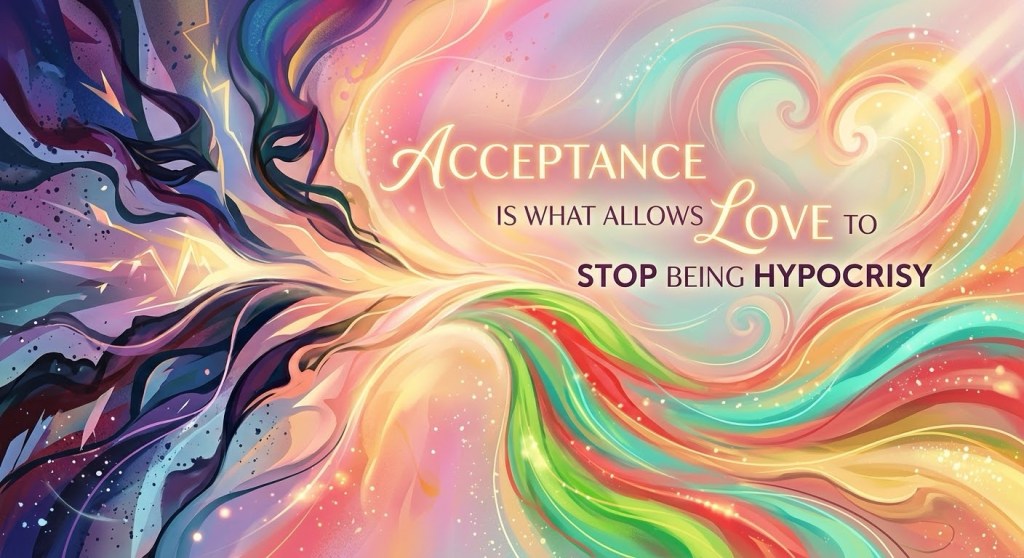
If you notice, this sentence is unusually compressed. It’s doing the work of an argument in eight words, and the argument is severe.
The claim being made. Without acceptance, love is hypocrisy. Not flawed love, not partial love, not difficult love — hypocrisy. That’s a specific accusation. Hypocrisy means saying one thing and doing another, professing a value you do not actually hold. The sentence is asserting that what people commonly call love, when offered without acceptance, is not love that has failed or fallen short. It is something pretending to be love. The naming is harsh on purpose.
What’s being separated. Most people use love as if it were a single thing. The sentence quietly separates it into two: the felt experience, the wanting, the attachment, the pull toward another person — and the thing that makes that experience actually land as love rather than as something else. Acceptance is being named as the second component. Without it, the first component is still there — the wanting, the pull, the attachment — but it is not love. It is something that uses the name of love while operating on different terms.
What those different terms might be. When you want someone but do not accept them, what you have is conditional regard. You are offering closeness in exchange for them being someone slightly other than who they are. You may not say this. You may not even be aware of it. But the wanting carries an implicit edit. I love you, and I would love you more if you were quieter, less anxious, more ambitious, less needy, more present, less fragile. The edits are sometimes small. Sometimes they are the whole architecture. Either way, what’s being offered is not love of the person; it is love of the version of the person you have in mind.
This is the hypocrisy. You are saying I love you while actually loving a counterfactual. The person in front of you is being treated as a draft of someone you would actually love. That treatment may be very gentle. It may be invisible. It is still hypocrisy in the strict sense — professing one thing, practicing another.
Why acceptance is the resolution and not, say, tolerance. Tolerance permits something while disapproving of it. Acceptance does something stronger. It allows the person to be what they are without that being a problem to be solved. The internal editing stops. The counterfactual gets put away. What remains is the actual person, and the love — if it remains — is now love of them, not love of who they could become under your influence.
The sentence is saying: this is the operation that converts the feeling into the real thing. Without it, you have something that calls itself love but functions as a long, soft form of pressure. With it, you have love that doesn’t lie about what it’s doing.
The brutal implication. The sentence implies that a great deal of what is called love in human life is, in fact, hypocrisy. Parents who love their children but cannot accept who their children are. Partners who love each other but conduct a slow campaign to reshape each other. Friends who love each other on the condition of staying within a certain shape. None of this is necessarily malicious. Most of it is unconscious. But the sentence refuses to soften the diagnosis. If the acceptance is not there, the love is not there either — there is only the feeling of love being used to license the editing.
What acceptance is not, here. It is not approval. It is not endorsement. It is not the suspension of judgment. You can accept that someone is who they are and still notice their patterns, still have your own preferences, still decline to be in relationship with them. Acceptance is not a verdict on whether to stay. It is a verdict on whether, while you are there, you are loving the person in front of you or loving an edit of them.
Why the sentence uses allows. Acceptance doesn’t cause love or create love. It allows love. Which means the love may already be there — the feeling, the attachment, the pull — but it is being held in a configuration that turns it into something else. Acceptance is the structural change that lets the existing feeling actually function as love rather than as conditional regard. The love isn’t being manufactured by acceptance. It’s being released into its own actual nature.
The underneath sentence might be:
If you cannot accept them, you do not love them — you love what you wish they were, and that is not the same thing, and they can feel the difference even when you can’t.
Which is a hard sentence, because it implicates almost everyone. Including the people who most sincerely believe they are loving well. The sincerity is not the question. The acceptance is.
Connection to what we’ve been discussing. This is the relational counterpart to becoming a felt enough presence to myself that I do not disappear into thought. That sentence was about not editing yourself out of your own experience. This one is about not editing the other person out of theirs. Same operation, different direction. You cannot really accept another person if you have not learned to be present to yourself without editing. The internal editor and the external editor are the same faculty. Quieting one quiets the other. The sentence about love is what becomes possible once that quieting has begun.
This sentence is unusually compressed. It’s doing the work of an argument in eight words, and the argument is severe.
The claim being made. Without acceptance, love is hypocrisy. Not flawed love, not partial love, not difficult love — hypocrisy. That’s a specific accusation. Hypocrisy means saying one thing and doing another, professing a value you do not actually hold. The sentence is asserting that what people commonly call love, when offered without acceptance, is not love that has failed or fallen short. It is something pretending to be love. The naming is harsh on purpose.
What’s being separated. Most people use love as if it were a single thing. The sentence quietly separates it into two: the felt experience, the wanting, the attachment, the pull toward another person — and the thing that makes that experience actually land as love rather than as something else. Acceptance is being named as the second component. Without it, the first component is still there — the wanting, the pull, the attachment — but it is not love. It is something that uses the name of love while operating on different terms.
What those different terms might be. When you want someone but do not accept them, what you have is conditional regard. You are offering closeness in exchange for them being someone slightly other than who they are. You may not say this. You may not even be aware of it. But the wanting carries an implicit edit. I love you, and I would love you more if you were quieter, less anxious, more ambitious, less needy, more present, less fragile. The edits are sometimes small. Sometimes they are the whole architecture. Either way, what’s being offered is not love of the person; it is love of the version of the person you have in mind.
This is the hypocrisy. You are saying I love you while actually loving a counterfactual. The person in front of you is being treated as a draft of someone you would actually love. That treatment may be very gentle. It may be invisible. It is still hypocrisy in the strict sense — professing one thing, practicing another.
Why acceptance is the resolution and not, say, tolerance. Tolerance permits something while disapproving of it. Acceptance does something stronger. It allows the person to be what they are without that being a problem to be solved. The internal editing stops. The counterfactual gets put away. What remains is the actual person, and the love — if it remains — is now love of them, not love of who they could become under your influence.
The sentence is saying: this is the operation that converts the feeling into the real thing. Without it, you have something that calls itself love but functions as a long, soft form of pressure. With it, you have love that doesn’t lie about what it’s doing.
The brutal implication. The sentence implies that a great deal of what is called love in human life is, in fact, hypocrisy. Parents who love their children but cannot accept who their children are. Partners who love each other but conduct a slow campaign to reshape each other. Friends who love each other on the condition of staying within a certain shape. None of this is necessarily malicious. Most of it is unconscious. But the sentence refuses to soften the diagnosis. If the acceptance is not there, the love is not there either — there is only the feeling of love being used to license the editing.
What acceptance is not, here. It is not approval. It is not endorsement. It is not the suspension of judgment. You can accept that someone is who they are and still notice their patterns, still have your own preferences, still decline to be in relationship with them. Acceptance is not a verdict on whether to stay. It is a verdict on whether, while you are there, you are loving the person in front of you or loving an edit of them.
Why the sentence uses allows. Acceptance doesn’t cause love or create love. It allows love. Which means the love may already be there — the feeling, the attachment, the pull — but it is being held in a configuration that turns it into something else. Acceptance is the structural change that lets the existing feeling actually function as love rather than as conditional regard. The love isn’t being manufactured by acceptance. It’s being released into its own actual nature.
The underneath sentence might be:
If you cannot accept them, you do not love them — you love what you wish they were, and that is not the same thing, and they can feel the difference even when you can’t.
Which is a hard sentence, because it implicates almost everyone. Including the people who most sincerely believe they are loving well. The sincerity is not the question. The acceptance is.
Connection to what we’ve been discussing. This is the relational counterpart to becoming a felt enough presence to myself that I do not disappear into thought. That sentence was about not editing yourself out of your own experience. This one is about not editing the other person out of theirs. Same operation, different direction. You cannot really accept another person if you have not learned to be present to yourself without editing. The internal editor and the external editor are the same faculty. Quieting one quiets the other. The sentence about love is what becomes possible once that quieting has begun.
It is, in the end, a sentence about whether you can let something be what it actually is. Yourself. The other person. The feeling between you. Acceptance is what allows all three to stop being projects and start being real.
It is, in the end, a sentence about whether you can let something be what it actually is. Yourself. The other person. The feeling between you. Acceptance is what allows all three to stop being projects and start being real.
WE&P by: EZorrillaMc&Co.

