Pleasurematic
When purgatory was abolished, Father Anselm did not lose faith. He pivoted.
For nearly thirty years he had supervised, with admirable piety and excellent margins, the manufacture of corrective devices in the modest but industrious town of St. Walpurga-on-the-Mud, a place so damp that even its heretics mildewed. From a long timber workshop attached to the rectory, he supplied bishops, abbots, magistrates, noble households, and several private persons of intense devotional ambition with every manner of calibrated affliction. There were penitential racks for the stubborn rich, portable kneelers lined with pious nails for overeducated widows, domestic flagellation frames for troubled marriages, and a collapsible traveling scourge marketed to pilgrims under the slogan: Repent Anywhere.
Father Anselm did not consider himself cruel. He considered himself useful. The world, as he understood it, was a corridor lined with error. Some souls required a firm sermon. Others required a pulley.
His greatest commercial triumph had been the Sorrow Wheel, a beautifully crafted upright instrument of oak and iron with adjustable straps, velvet lining for aristocratic flesh, and a discreet shelf for devotional reading. “Pain without vulgarity,” read the printed circular distributed to select cathedral chapters in Mainz, Cologne, and Bruges. “A noble companion on the difficult road to grace.”
Business had been excellent.
Then, like a rat in the grain, reform arrived.
At first the trouble came in scraps of rumor: a monk in Germany with a hammer, pamphlets appearing in taverns, students repeating things they did not yet understand in tones of deep intoxication, noblemen discovering theology precisely at the moment it became convenient to seize church property. Soon after came a more material sign of unrest: orders were delayed. Payments slowed. One bishop in Saxony wrote to say that, due to “certain uncertainties concerning the intermediate condition of souls,” the cathedral chapter would postpone purchasing six deluxe mortification benches and an imported Florentine shame cage.
Father Anselm read the letter twice, then a third time, then laid it carefully on his desk and whispered, “Interesting.”
He was not a stupid man. He had not survived three bishops, two famines, and a local uprising over the burial tax by being doctrinally rigid. He understood that ideas, like weather, were most profitably treated as external facts. If the age no longer wished to be saved through scheduled torment, then perhaps it might yet be persuaded to purchase relief by other means.
The need had not vanished. Only the branding had changed.
People still wished to feel that something real had happened to them. They still longed to be transformed, purified, renewed, corrected, shaken, softened, relieved, forgiven, and, where possible, pleasantly surprised. They were merely becoming more selective about the route.
So, one damp Thursday between Matins and lunch, Father Anselm crossed the square, looked at an abandoned cooper’s warehouse opposite the rectory, and had what later generations would call a vision, though he himself preferred the term market correction.
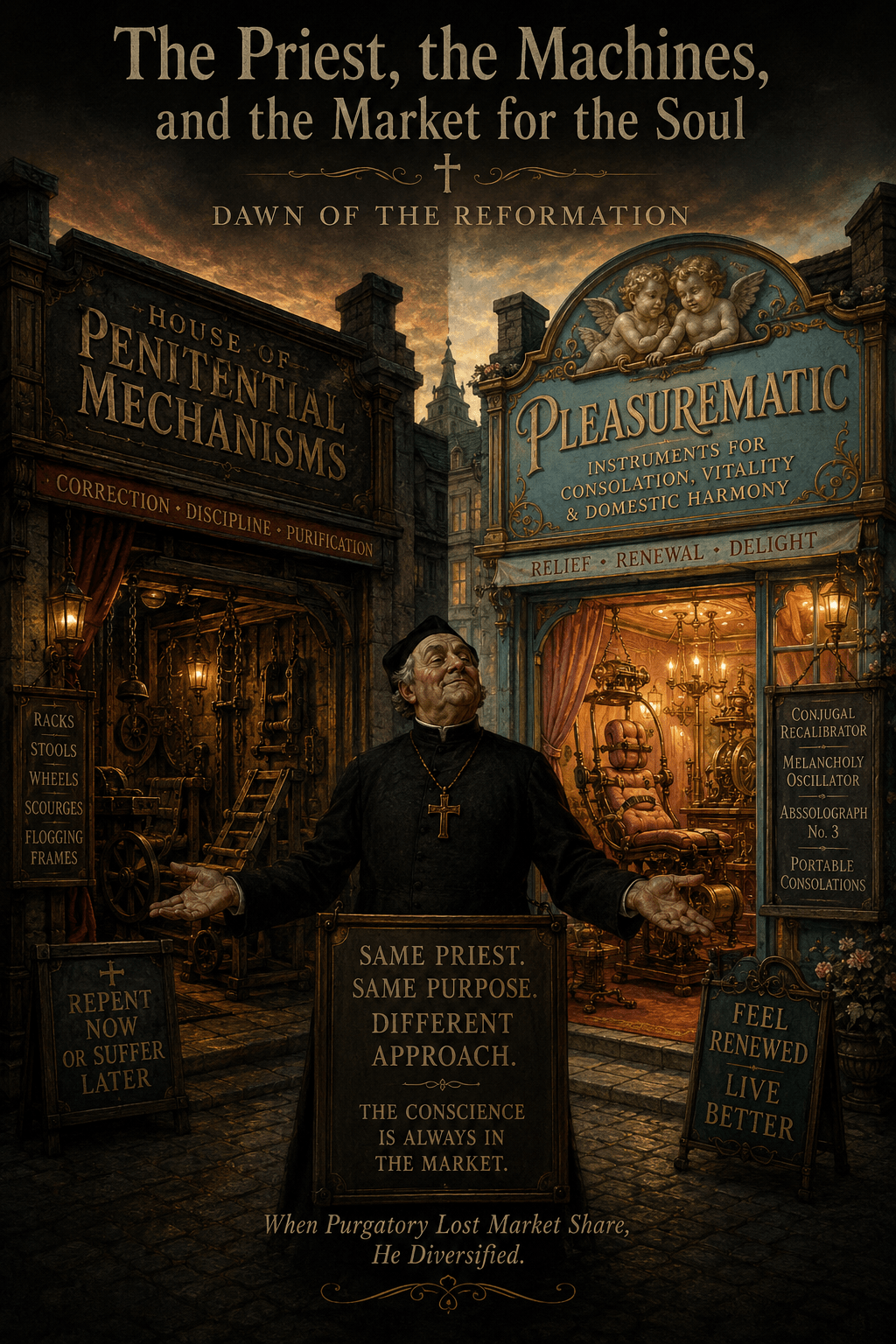
Within six months the old torture workshop remained in operation under the name House of Penitential Mechanisms, while across the square, under a fresh coat of pale blue paint and a sign ornamented with smiling cherubs of suspicious musculature, there opened Pleasurematic: Instruments for Consolation, Vitality, and Domestic Harmony.
The town was scandalized, which Father Anselm took as proof of sound timing.
At first people did not know whether Pleasurematic was a pharmacy, a brothel, a spa for the nobility, or some new Protestant outrage in gears. The signboard did not clarify matters. It depicted a married couple standing on a cloud, both looking as though they had recently been forgiven by means not yet approved by Rome.
The grand opening drew a fine crowd.
There were merchants’ wives, attorneys’ clerks, one nervous countess wearing a veil so aggressive it seemed to accuse the street of indecency, several students pretending not to be interested, and a delegation of rival clergy who had come, as they later put it, to condemn the enterprise from within.
Father Anselm stood at the doorway in clean black robes, smiling with the serene confidence of a man who had long ago ceased to distinguish between pastoral care and product launch.
“My friends,” he announced, “for too long the body has been spoken to in only one dialect. Correction has had its day. But comfort, too, may elevate. Relief, when skillfully administered, can be instructive. Renewal has its apparatus.”
A widow in the crowd frowned. “Is this lawful?”
“Madam,” said Father Anselm, “lawfulness is a conversation. Today I offer furniture.”
He then ushered the public inside.
Pleasurematic smelled faintly of beeswax, lavender, polished wood, and ambition. The machines were displayed on raised platforms with handwritten placards, each in elegant Latin, French, and increasingly optimistic German. There was the Conjugal Recalibrator, a padded bench with levered armatures, adjustable incline, and a brass foot pedal whose exact purpose remained diplomatically unexplained. Nearby stood the Melancholy Oscillator, a chair suspended from a steel frame designed to “reawaken cheerful motion in the spiritually fatigued.” There was a cabinet of velvet-lined instruments known collectively as the Portable Consolations, recommended for travel, marital frost, and certain forms of doctrinal heaviness.
Most impressive of all was a gleaming apparatus in the center of the room shaped like a cross between an astrolabe, a birthing chair, and a siege engine designed by a florist. This, Father Anselm explained in a lowered, reverent tone, was the Absolvograph No. 3.
“It does not absolve, of course,” he said quickly, for there were lawyers in town and one had married his cousin. “It merely produces, under proper supervision, the distinct bodily conviction that something substantial has been released.”
A silence followed.
Then the countess whispered, “Can one sit in it alone?”
“With Christ, all things are possible,” said Father Anselm, “but the recommended configuration is flexible.”
Across the square, business at the House of Penitential Mechanisms began to suffer immediately. Customers who once ordered walnut confession stools with retractable thigh clamps now wandered into Pleasurematic “only to have a look.” Monks sent on errands returned late and flushed. A baron from Utrecht canceled his order for a family-sized mortification carousel and instead commissioned two custom Consolation Cabinets in walnut with silver hinges “for the health of the household.”
The blacksmith, who had forged iron teeth for Anselm’s old correction devices for years, was scandalized by the new direction.
“We used to make instruments for discipline,” he grumbled one morning as he delivered a crate of precision springs.
“We still do,” said Father Anselm.
“These are upholstered.”
“And yet no less instructional.”
The blacksmith leaned in, lowered his voice, and pointed a greasy thumb at the warehouse across the square. “Between us, Father… what exactly goes on in there?”
Father Anselm smiled. “The future.”
The true genius of the enterprise lay not in the machines themselves, though several were undeniably ingenious, but in the literature. Father Anselm commissioned printed catalogues with woodcuts of respectable-looking couples and phrases like Measured Relief for the Spiritually Overburdened, A New Century of Sensible Consolation, and No Soul Too Reforming for Delight. Gone were the old images of flames, demons, and narrow bridges over impossible pits. In their place appeared draped curtains, braided cords, polished brass, and the vague promise that one might, for a reasonable fee, feel better in a meaningful way.
Orders poured in from cities where theology was in flux and boredom well financed.
A canon in Antwerp purchased three Melancholy Oscillators “for choir morale.” A Lutheran merchant in Hamburg, eager to distinguish himself from his Catholic father while not entirely abandoning bodily symbolism, requested a stripped-down line of machines “with fewer cherubs and no implied intercession.” Father Anselm was delighted to oblige. He opened a second catalogue division under the heading Reformed Domestic Consolations, identical to the first except for plainer wood and more direct copy.
The town physician objected to all this vigorously.
“It is madness,” he declared in the tavern. “One day he says pain saves, the next he says pleasure heals. Which is it?”
The tavern keeper shrugged. “Whichever one has prepaid deposit.”
Yet controversy, as Father Anselm knew, is merely advertisement with moral posture.
Soon enough, pilgrims began coming not for relics but for demonstrations. On feast days, the square filled with carts and horses. Visitors toured both establishments in sequence, as if comparing vineyards. In the first workshop they observed the venerable technologies of remorse: racks, pulleys, corrective stools, devotional frames. In the second they encountered the brave new machinery of restoration: padded platforms, articulated benches, revolving seats with polished grips and velvet belts “for secure spiritual engagement.”
Many emerged from the full tour thoughtful, confused, and eager to purchase something.
A young scholar from Wittenberg, thin as a quill and twice as earnest, requested an audience with Father Anselm.
“I have come,” he said, “to ask whether you feel no contradiction.”
“Between what and what?”
“Between suffering and pleasure.”
Father Anselm considered this. “My son, contradiction is for theologians. I deal in sequence.”
The scholar blinked.
“When men feared the afterlife,” the priest continued, “they paid to suffer now. When they began doubting the architecture of the afterlife, they paid to feel redeemed in the present. The body remains. The conscience remains. Only the preferred method of persuasion changes.”
“That is cynical.”
“That,” said Father Anselm, “is inventory.”
But the problem with success is that it breeds innovation among the undeserving. Within a year, rival workshops sprang up in nearby towns. One former apprentice opened Comfort Forge outside Utrecht, specializing in “devotional amusements for the tenderly burdened.” A widow in Ghent produced budget imitations of the Portable Consolations under the brand name Softening Grace. Worst of all, a Venetian immigrant with no theological background whatsoever launched a line of obscene but mechanically superior relaxation devices marketed under the slogan Why Suffer Through an Intermediary?
Father Anselm was furious.
“This is what comes,” he told his clerk, “when one deregulates expiation.”
The clerk, a dry man named Martin whose religious loyalties changed with shipping costs, cleared his throat.
“With respect, Father, did you not begin the deregulation?”
Father Anselm paused.
“Martin,” he said, “history is about who writes the pamphlet.”
He began writing immediately.
The pamphlet, titled On the Proper Administration of Relief, was half theological defense, half product distinction. In it, Father Anselm argued that not all pleasure was equal, not all comfort was sanctifying, and not every machine that agitated the flesh was fit to refine the soul. Certain low-cost imitators, he warned darkly, offered stimulation without structure, release without meaning, and consolation “devoid of the moral afterglow proper to civilized peoples.”
Sales rose twenty percent.
By the third year, the town of St. Walpurga-on-the-Mud had become a destination of international significance. Delegations arrived to study its unprecedented dual economy of suffering and reward. Princes sent advisors. Housewives sent cousins. Clergymen sent anonymous inquiries written in excellent handwriting. One bishop denounced the entire square as “a marketplace of mechanized ambiguity,” then privately ordered a deluxe upholstered Oscillator with carved lion feet and monogrammed restraint straps.
Father Anselm kept the order slip.
He was, by then, an old man but a thriving one. His cheeks had taken on the satisfied gloss of those who have ceased entirely to distinguish providence from market timing. Each morning he walked across the square from the old House of Penitential Mechanisms to Pleasurematic, blessing both doors with equal care.
To visitors he liked to say, “The Church must meet souls where they are.”
To investors he said, “No one wants unchanged suffering.”
To himself he said nothing at all.
Then came the day of reckoning, though not the sort he had spent a career monetizing.
A delegation from the archbishop arrived with seals, robes, and faces like wet parchment. For years they had tolerated the workshops because the profits were useful and the age confusing. But a rival in the cathedral chapter, having been denied exclusive rights to distribute the Portable Consolations in France, had denounced Father Anselm as a corrupter, innovator, and “merchant of bilateral confusion.”
The charges were extensive. They included doctrinal inconsistency, mechanical indecency, confusing iconography, false implication of sacramental efficacy, and improper use of cherub buttocks in promotional materials.
Father Anselm heard them all without visible distress.
When the reading was complete, the bishop’s delegate folded the parchment and said, “Have you anything to say in your defense?”
Father Anselm looked through the open door, across the square, at his two workshops facing one another like an argument that had become architecture.
“Yes,” he said. “Demand was mixed.”
There was a silence so total that even the town pigeons seemed briefly doctrinal.
The delegate blinked. “That is your defense?”
“No,” said Father Anselm. “That is my explanation.”
The trial dragged on for months. Witnesses were called. Husbands praised the machines in tones of moral shame. Wives defended them with startling fluency. A prior testified that the Sorrow Wheel had once saved his vocation. A Lutheran merchant argued that the Portable Consolations had improved inter-confessional civility in his household. The blacksmith, when summoned, declared that he had never known so much iron to make so many people feel so much of anything.
In the end, Father Anselm was neither fully condemned nor fully cleared, which he regarded as an appropriately ecclesiastical outcome. He was ordered to cease implying that any machine could absolve sin, shorten postmortem distress, improve election, or guarantee conjugal affection. He was forbidden from using the phrase engine of grace in any language. He was also, rather contradictorily, granted a seven-year charter to continue operation under revised wording, provided all catalogues include the disclaimer: Results vary according to doctrine, disposition, and upholstery.
It was enough.
He died eight years later, comfortably, in his own bed, after dictating a final letter to Martin.
In it he left the House of Penitential Mechanisms to the cathedral, Pleasurematic to his nieces, and the patents for the Absolvograph to “whomever proves least boring.” He also included one final maxim, which Martin had carved over the rectory fireplace by spring:
The conscience, properly approached, can be made to purchase almost any weather.
By the next century the original torture devices were exhibited as curiosities by those who insisted the age had grown gentler. Pleasurematic, meanwhile, expanded into France, split into luxury and household lines, and eventually lost its religious vocabulary altogether. The machines became more polished, the copy less honest, and the customers no wiser.
But in St. Walpurga, if one stood in the square at dusk when the mist rose off the mud and the bells began their sleepy argument with the sky, one could still feel the old joke in the stones:
that punishment and reward had once shared a landlord,
that purgatory had closed and reopened across the street,
and that Father Anselm, seeing the age no longer wished to suffer on credit, had simply found a way to let it pay in advance.
WE&P by: EZorrillaMc&Co.

