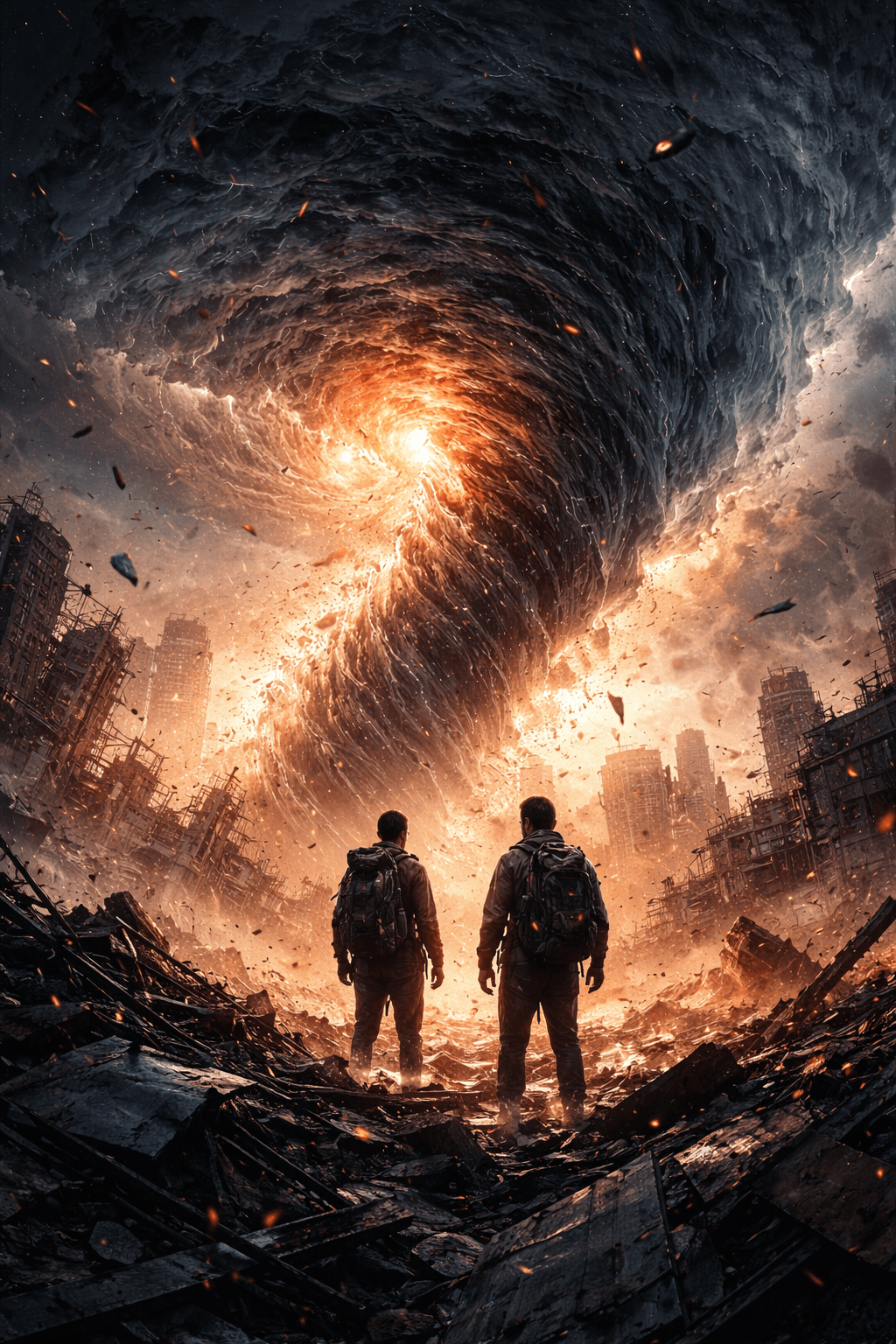
They called it the last game of Survivor, though no one had the energy left for games.
The storms had changed years ago. They no longer followed weather. They followed memory.
Whole towns would be spared for decades, then erased in a single afternoon—not by chance, but by something like selection. The scientists had tried to model it. The survivors stopped asking why.
Eli had meant to ask the question before things got this bad.
Who survives a tornado—the one who’s lived through one, or the one who hasn’t?
He never got around to it. Now the question was no longer theoretical.
They were six people left in the bunker beneath what used to be Elk City. The sky above them had turned the color of oxidized metal, and the wind never fully stopped anymore. It just rested.
Mara had seen a storm before. She talked about it like a teacher—low, steady, procedural. “You don’t run in a straight line,” she said. “You watch the debris, not the funnel. You stay low. You move perpendicular.”
Jonas had never seen one. He listened carefully, nodded, repeated the instructions back.
Eli noticed something that didn’t sit right.
Mara spoke as if the storm would behave.
Jonas spoke as if it wouldn’t.
The difference stayed with him.
A week later, the sirens triggered—not from the old system, but from the sky itself. A pressure drop. A silence so complete it felt staged. Then the wind began to turn.
“Positions,” Mara said, already moving.
They followed her. That was the advantage of experience—it organizes action quickly. No hesitation. No wasted motion.
But as they reached the access tunnel, Eli looked up.
The sky wasn’t forming a funnel. It was folding inward, like something remembering how to close.
“This isn’t right,” Jonas said.
Mara snapped, “It’s always like this at the start.”
“No,” Jonas said quietly. “It isn’t.”
The storm arrived without announcing itself. No clean funnel. No visible core. The air itself twisted. Objects didn’t fly outward—they vanished sideways, as if removed.
Eli saw the first mistake.
Mara led them to the reinforced chamber—standard protocol. Thick walls. No windows. It had survived three previous storms.
She sealed the door.
“That’s it,” she said. “We wait.”
Waiting had worked before.
The chamber trembled. Then something worse—it shifted. Not shaking, but relocating by inches, as if the ground beneath it had loosened.
Eli understood, too late.
Experience had taught Mara what storms had been. It had not prepared her for what they had become.
The advantage of experience was obvious. The disadvantage less so.
It fixed the shape of the threat.
Jonas was pacing. Not panicked—thinking.
“It’s not removing things randomly,” he said. “It’s taking what’s anchored.”
“What?” Mara said.
“The buildings. The roads. The chamber. Anything fixed.”
Eli felt it click.
“What survives?” Jonas continued. “Not what’s strongest. What isn’t where it was expected to be.”
Mara shook her head. “You don’t move in a storm.”
“That’s the old rule,” Jonas said. “This isn’t the old storm.”
The chamber lurched again. A seam cracked open in the wall, thin but widening.
Jonas moved first.
He unlatched the maintenance hatch—something no one had ever used during a storm. It led to the service tunnels, unstable, unfinished.
“You go out there, you’re dead,” Mara said.
Jonas didn’t argue. He just looked at Eli.
“What are you seeing?” Eli asked.
Jonas hesitated. “I don’t know what it is,” he said. “But it’s not doing what I imagined. And that matters.”
Eli thought of something he’d read once, before the storms changed.
A woman had prayed for a tornado to take her barn. It had taken her house, too.
It’s what you fail to imagine that kills you.
Mara stayed. She had reasons. The chamber had held before. That wasn’t stubbornness. It was fidelity.
Jonas left. Not because he was braver, but because he had no past shape to defend.
Eli followed him.
The service tunnel was narrow, half-collapsed. The air was wrong—moving sideways, slipping past instead of pressing down.
Behind them, the chamber gave way with a sound that wasn’t a collapse, but a subtraction.
They didn’t run. There was nowhere to run to. They moved irregularly, stopping, shifting direction, never fully committing to a path.
The storm passed through them.
Not over. Not around.
Through.
When it was done, the sky returned to its dull, resting color.
They climbed out hours later.
The bunker was gone. Not destroyed—absent. The ground where it had been was smooth, as if nothing had ever occupied it.
Jonas stood there for a long time.
“You were right,” Eli said finally.
Jonas shook his head. “No,” he said. “I just didn’t know what to expect.”
Eli looked at the empty space where the chamber had anchored itself to the past.
Experience had almost saved them.
But it had also told them where to stand.
In the end, survival hadn’t belonged to the one who knew the storm.
It belonged to the one who understood that the storm would not remain what it had been.
And that what you imagine will be taken is never all that gets taken.
The main damage always comes with sides.
WE&P by: EZorrillaMc&Co
 Travel in Life