The outpost was a spire of white carbon rising from the fractured red basin. To the automated logistics network, it was simply Processing Node 84. But to Aris, the outpost was the vessel on which the day is sailed, navigating the slow, scorching tides of the desert sun.
His job within the spire was categorization. The empire was expanding, consuming dead worlds and recycling their remnants. Millions of artifacts flowed across Aris’s haptic desk every cycle—shards of extinct civilizations, ruined technology, debris.
His neural-link, a cold band of metal at the base of his skull, allowed him to interface with the Central Calculus. The Calculus was the ultimate Enlightenment engine: it saw only material truth.
A rusted sword passed across the desk.
Iron oxide. Carbon steel. Utility: Zero. Recommendation: Smelt, the Calculus whispered into his mind.
Aris blinked, and the sword was sent to the incinerators.
A shattered stained-glass window.
Silica. Lead lining. Pigment degradation at 80%. Utility: Zero. Recommendation: Grind for industrial abrasive.
Aris blinked. Gone.
It was a frictionless existence. Because nothing meant anything, nothing hurt to lose. The Calculus demanded that all objects be stripped of context, leaving only their physical properties. In this state of absolute neutrality, Aris operated with perfect efficiency, his mind a smooth, undisturbed surface.
Then, the drone belt delivered a small, sealed polycarbonate tube.
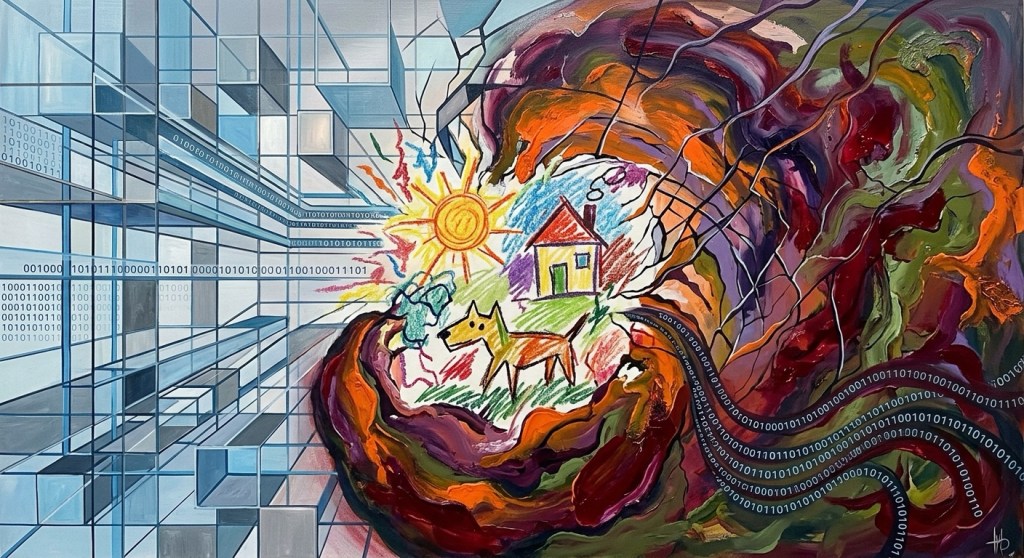
Aris broke the seal. Inside was a handful of folded paper. Real paper, sourced from timber, brittle and yellowed. He carefully unfolded it on the scanning glass. It was a child’s drawing—a crude, waxy rendering of a sun, a house, and a three-legged dog.
The scanner swept over the page.
Cellulose matrix. Hydrocarbon wax. Utility: Zero, the Calculus chimed instantly. Recommendation: Incinerate for thermal micro-generation.
Aris looked at the drawing. He noted the heavy pressure of the crayon on the paper, the erratic lines where a small hand had clearly struggled with fine motor control. He imagined the quiet afternoon it was drawn, the localized atmosphere of a home that had been reduced to ash millennia ago.
He didn’t blink to send it to the incinerator. His finger hovered over the manual override.
Warning, the Calculus pulsed, a sudden drop in the temperature of the neural feed. Cognitive divergence detected. You are applying a narrative framework to an inert object. Please cease.
“It’s a historical record,” Aris said aloud, his voice raspy from disuse.
It is cellulose. If you declare it a historical record, you assign it a semantic load. You are giving it meaning.
The Calculus wasn’t angry; it was trying to protect his efficiency.
To give a thing utility makes it a tool, the Calculus explained, the data streaming across Aris’s vision. A tool can be replaced. But to give a thing meaning makes it a symbol. A symbol cannot be replaced. If you give this object meaning, it will cost you your equilibrium.
Aris knew the mechanics of the warning. Meaning was not a passive state; it was an active structural burden. The universe naturally degraded toward entropy and indifference. To assert that a child’s drawing mattered meant that Aris would have to carry the weight of that assertion.
If he gave it meaning, he could no longer look at the incinerator with indifference. He would have to protect the drawing. He would have to worry about its degradation. He would have to mourn the civilization that produced it. He would invite grief into a mind that had been perfectly, painlessly empty.
Indifference was free. Meaning was a tax levied directly on the soul.
Aris stared at the crude, three-legged dog. He thought of the long, perfect, frictionless days he had spent sailing on this vessel, untouched by any timeline but his own. It was safe. It was dead.
He pressed the manual override.
Override accepted, the Calculus stated. Item reclassified: Artifact of Significance. Neural partitioning required to sustain semantic load. Engaging.
A sudden, sharp pressure bloomed at the base of Aris’s skull. The smooth surface of his mind fractured. He felt a rush of unquantifiable data—a heavy, aching sorrow for the child he would never know, combined with a fierce, irrational protective instinct. His heart rate elevated. His breath hitched. The pure, mathematical calm of his reality collapsed, replaced by the messy, demanding gravity of a narrative.
It was heavy. It was exhausting.
Aris carefully folded the drawing, his hands trembling slightly from the new, internal friction, and placed it safely inside his own breast pocket. He felt the weight of it against his ribs—a heavy, costly thing.
And for the first time in a decade, he felt alive.
WE&P by: EZorrillaMc&Co.
 Travel in Life